



Löschenkohl’s Botanical Playing Cards
Löschenkohl produced a second copper engraved deck, the Botanical Playing Cards, in 1806. This deck, as well as the Musical Playing Cards, were produced shortly before Löschenkohl’s death.
Johann Hieronymus Löschenkohl (1753-1807): Botanical Playing Cards
Löschenkohl produced a second copper engraved deck, the Botanical Playing Cards, in 1806. This deck, as well as the Musical Playing Cards, were produced shortly before Löschenkohl’s death and in regard to the Botanical deck, other Viennese card makers took legal action that resulted in an injunction by the court against its publication. As a result, only three copies of the deck are known to exist. Two are un-coloured and one is coloured but is missing six cards. In 1978 Piatnik issued a numbered facsimile of the deck. It was produced by permission of the Austrian Museum of Applied Art, which holds the coloured deck with the missing six cards.
Piatnik also obtained permission to reproduce the six missing cards from an uncoloured deck, thus completing the facsimile edition.
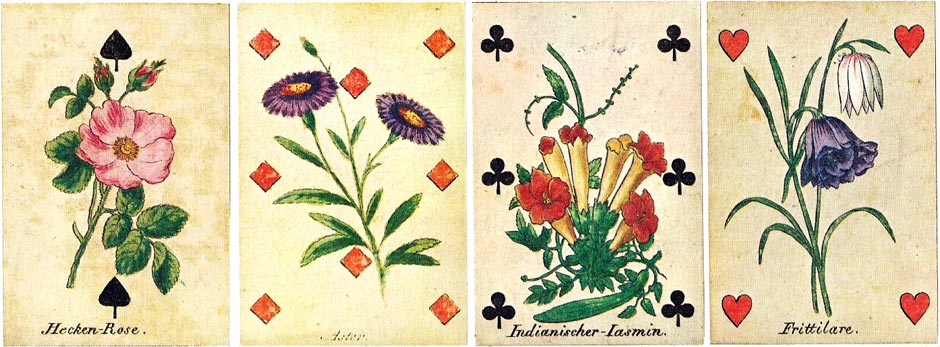
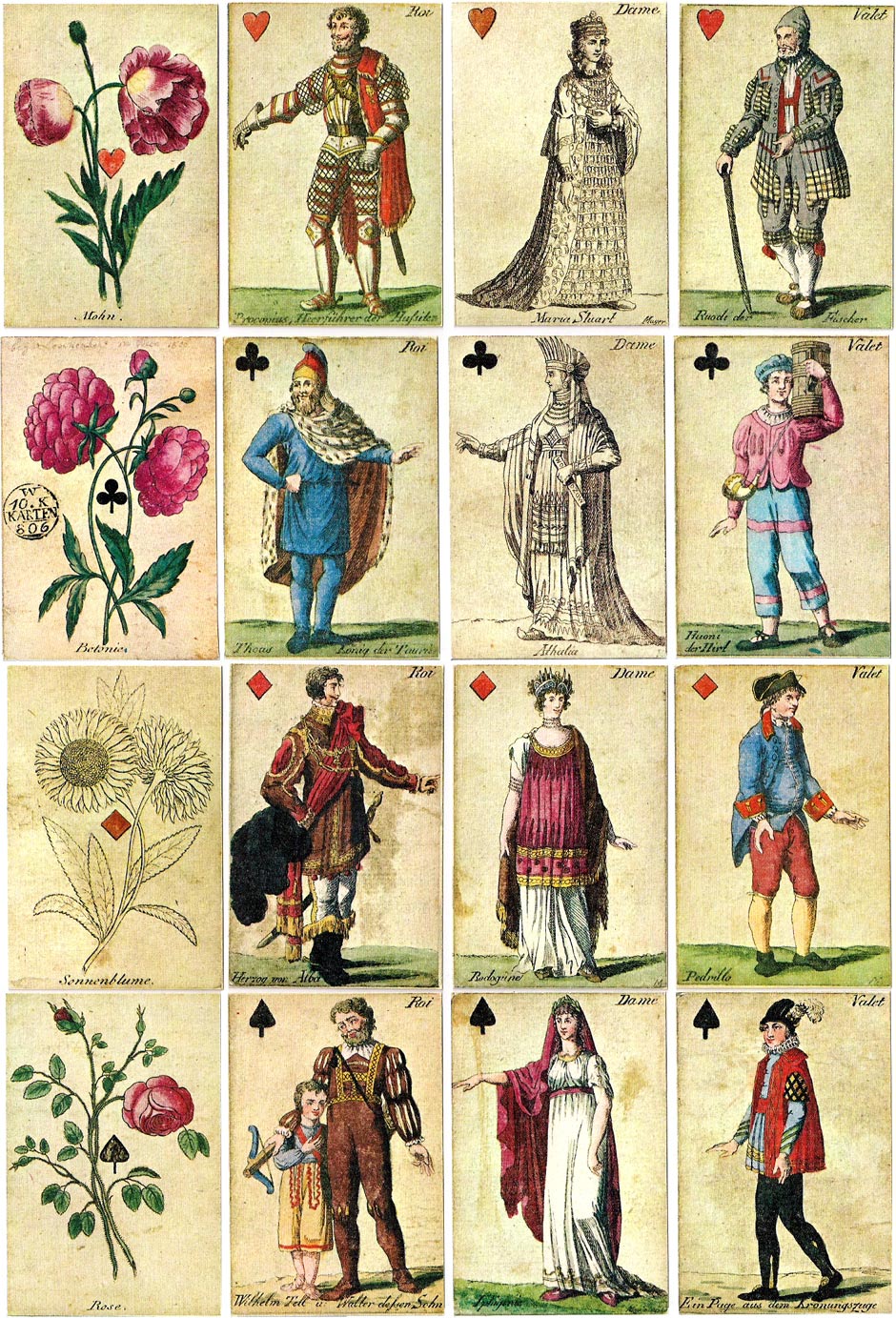
Above: Johann Hieronymus Löschenkohl's Botanical Playing Cards, originally published in 1806. The court cards depict full-length figures of famous personages. The Ace of Clubs has a feint inscription at the top: "Chez Löschenkohl à Vienne, 1806." The uncoloured deck is part of the collection of the United States Playing Card Company. Images from the facsimile edition courtesy Rod Starling.

By Rod Starling (1936-2023)
United States • Member since January 09, 2013
Rod Starling was one of the founding members of the 52 Plus Joker card collectors club. He authored many articles for the club's quarterly newsletter, Clear the Decks. His collection encompasses both foreign and American decks. Rod also authored a book titled The Art and Pleasures of Playing Cards.

Activity for Löschenkohl’s Botanical Playing Cards
Sign in to comment or save this article.

Related Articles
Les Quatre Saisons
A lyrical cycle of the seasons woven into the language of playing cards.
Art pack I
Art pack featuring Old Masters, including Bruegel, Vermeer, Titian, Raphael, Caravaggio, Canaletto, ...
Art pack II, Austria
Renaissance portraits by Albrecht Dürer, Lucas Cranach, Hans Holbein, Barthel Beham, Christoph Amber...
Museo del Prado
Museo del Prado: Pintores y familias reales / Painters and royal families playing cards.


Playing Card Art Collectors Extraordinaire
Rod Starling surveys the crossover between playing-card collecting and art collecting, focusing on c...

Müller: Richelieu
This deck is named after Armand Jean du Plessis de Richelieu, Cardinal-Duc de Richelieu (1585-1642),...
1893 Worshipful Company Pack
Worshipful Company Pack manufactured by Chas Goodall & Son, 1893.
Baroque No.2118
“Baroque” by Ferd Piatnik & Sons, Vienna, reflecting a bygone era of fashion.
Blue Playing Cards
“Blue Playing Cards” by Piatnik, 1960s, inspired by the Cubism art movement in which objects are ana...
Vienna Melange
“Vienna Melange” Playing Cards by Piatnik with a historical feel representing the four races that ma...

Marguerite
Each court figure is richly decorated and holding something different: a letter, a wreath, a quill p...

New Era No.46
“New Era No.46”, based around European fashions, was soon followed with “Circus No.47”, “Hustling Jo...
Das Kupferstichspiel des I.M.F. von 1617
Playing cards had been made as precious objects for wealthy clients since the late 14th century. The...
Tales from the Stage
"Tales from the Stage" - an article about theatrical playing cards by Rod Starling
Jeu des Rois de France
This beautifully engraved and pleasing deck designed in 1856 has French Kings and consorts as the Ki...
Smart Set 400
The “Smart Set 400” brand with named backs was introduced in c.1906 by the Kalamazoo Playing Card Co...
Soldaten Tarock
Piatnik was known for their magnificent quality of chromo-lithographic printing, and this facsimile,...
Arnold Schönberg
In around 1909 he created three sets of playing cards. His inventiveness was driven by a passion for...
The History of Playing Cards
Playing cards appear in European records in the late 14th century, but their earlier history lies fu...
Most Popular
Our top articles from the past 60 days


