



Blanchard, c.1770
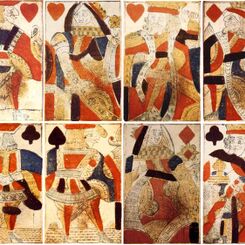
The style of these cards is descended from the earlier seventeenth century cards of makers such as Hewson.

Cards by Blanchard, c.1770
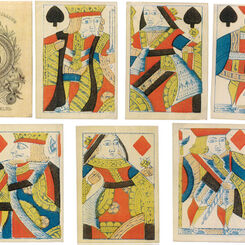
The style of these cards is descended from the earlier seventeenth century cards of makers such as Hewson. In 1769 Charles Gibson took over Blanchard and was later joined by John Gisborne in c.1780. Charles Gibson's son Matthew joined the firm in 1798 and then linked up with Joseph Hunt in 1801 so that a continuous succession of firms comprising Gibson & Gisborne, Hunt, Hall and Bancks Brothers endured until c.1886. During this period the standard English pattern, as shown here, evolved into the modernised and double-ended version which prevailed by the end of the Victorian era.
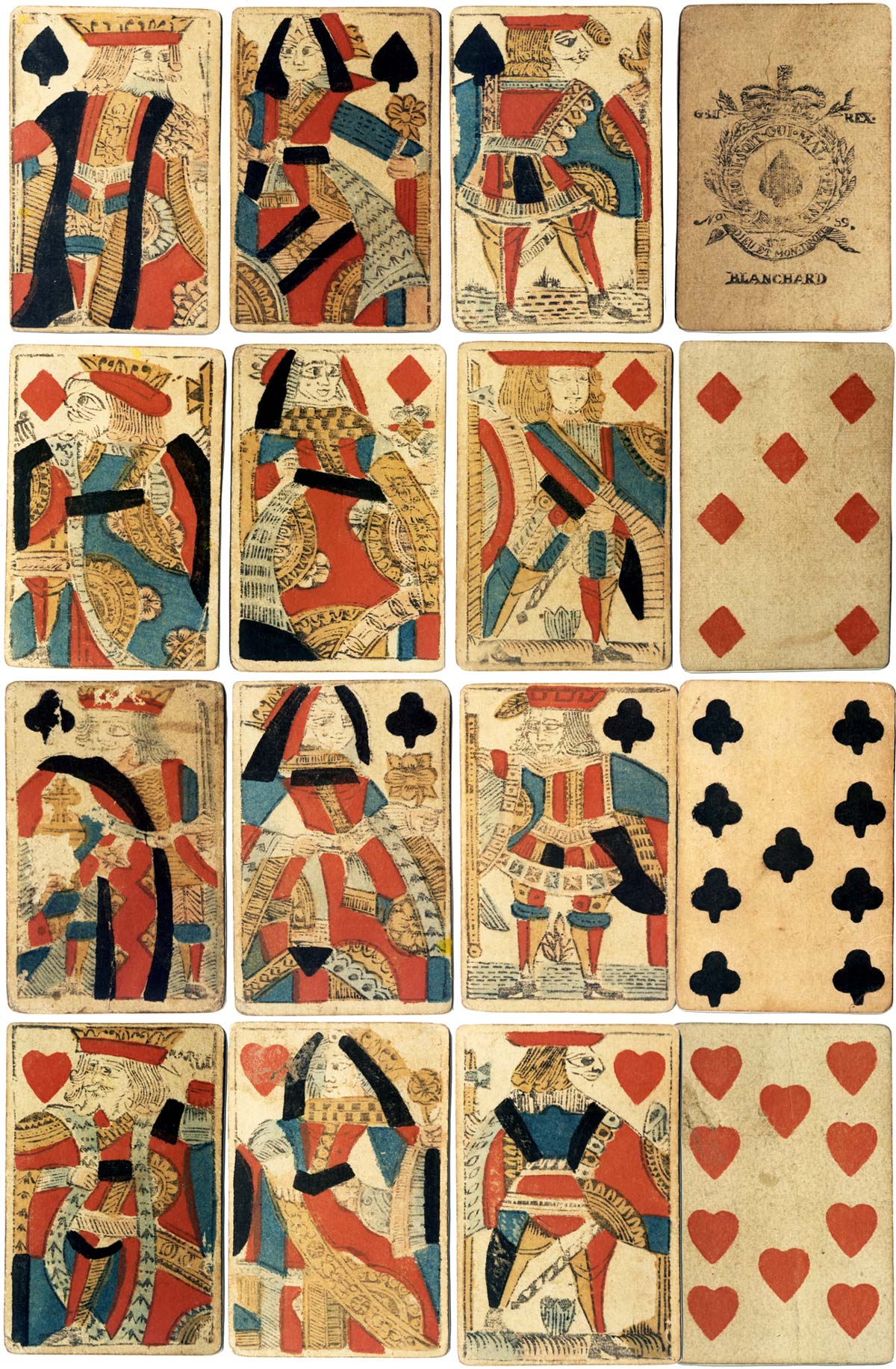
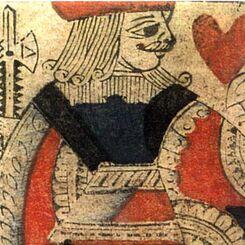
Above: cards supposedly manufactured by Blanchard, c.1770, but with a forged Ace of Spades to avoid paying the duty. The King of hearts is wielding a battle axe, rather than a sword as in later examples. See also: Fake Blanchard duty Ace of Spades→
Queen of Clubs: “Black Bess”. This is a common nick-name, though it is difficult to pin-point the reason for it, the claim that Queen Elizabeth was swarthy of complexion being untrue. However, in Lincolnshire, the card is sometimes referred to as “Queen Bess”.

By Donald Welsh
United Kingdom • Member since February 01, 1996

Activity for Blanchard, c.1770
Sign in to comment or save this article.

Related Articles
77: The Standard English pattern - Part 1, the basics
A simple set of criteria for defining the standard English pattern
Tangle Foot Ale
Badger Brewery Tangle Foot strong ale advertising pack.
Dorset Dialect Trails
‘Dorset Dialect Trails’ playing cards, United Kingdom, 2015.
Whist writers and their pseudonyms
Why did so many early writers about whist and other card games feel the need to write under a pseudo...
Ethics Education playing cards
Ethics Education playing cards produced by the Centre for Military Ethics at King’s College London, ...

The Winning Hand
The Winning Hand playing cards with artwork from multiple artists, United Kingdom, 1993.
Even More Trial and Error
“Even More Trial and Error” produced by the Worshipful Company of Makers of Playing Cards, United Ki...

Union Jack
Union Jack card game published by C.W. Faulkner & Co., c.1897-1902.
Ken McCarthy
An unknown deck by Ken McCarthy, c.2018.

The Lost Heir
“The Lost Heir” was first issued by J. W. Spear and Sons in UK in 1912.
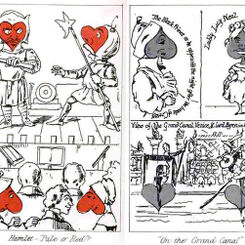
Thackeray Transformation Cards
Transformation playing cards by William Makepeace Thackeray, 1876.

GoFishFriday
GoFishFriday is a unique deck of playing cards designed and created in an offbeat and quirky horror-...
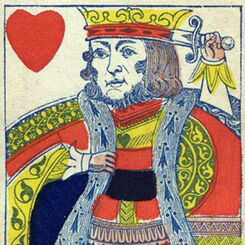
Suicide King
The King of Hearts, holding a sword behind his head, is sometimes nicknamed the “Suicide King”. He c...
Henry Wheeler, manufacturer, c.1828
In 1836 Henry Wheeler was found guilty of using forged duty Aces of Spades.

Playing cards in Wales - Welsh playing cards
Whereas the distinctiveness of Wales is an important resource contributing to the rich texture of va...

James English & Co.
Victorian Playing Cards manufactured by James English & Co., London, c.1875
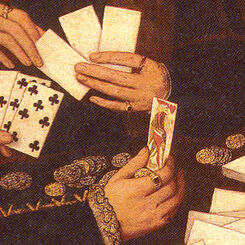
History of English Playing Cards & Games
The History of English Playing Cards dates probably from the mid 15th century
Hunt, c.1800
Standard English pattern playing cards manufactured by Hunt, c.1800.
Early English Playing Cards
Early examples of traditional, standard English playing cards of which the best known are those of H...
Collecting English Playing Cards & Games
The History of English Playing Cards dates probably from the mid 15th century, the first documentary...
Most Popular
Our top articles from the past 60 days


