



Naipes del Salitre
Playing cards recovered from the Northern Chile saltpetre workers. The cards are mostly from Spanish 'Cadiz' pattern decks, and several manufacturers can be identified.
Playing cards recovered from the saltpetre workers from Northern Chile, 1850-1940.
“En el norte de Chile hay dos historias que marcaron una época importante, la historia del salitre que data de 1850 hasta 1940, esto significó un asentamiento de miles de personas que vivían en situaciones precarias y su forma de pago mensual era con fichas, estas eran de vaquelitas, y solamente se transaban en la misma oficina salitrera. En el año 1900 fuerón abolidas por el gobierno chileno y el pago a los trabajadores era con moneda nacional, pues bien para entretenerse lo hacian através de los naipes los cuales yo los he estado coleccionando por varios años, estos tienen fecha de 1867 hacia adelante. La segunda importante sería la guerra del pacífico entre Chile y Bolivia.” - Chilean collector.
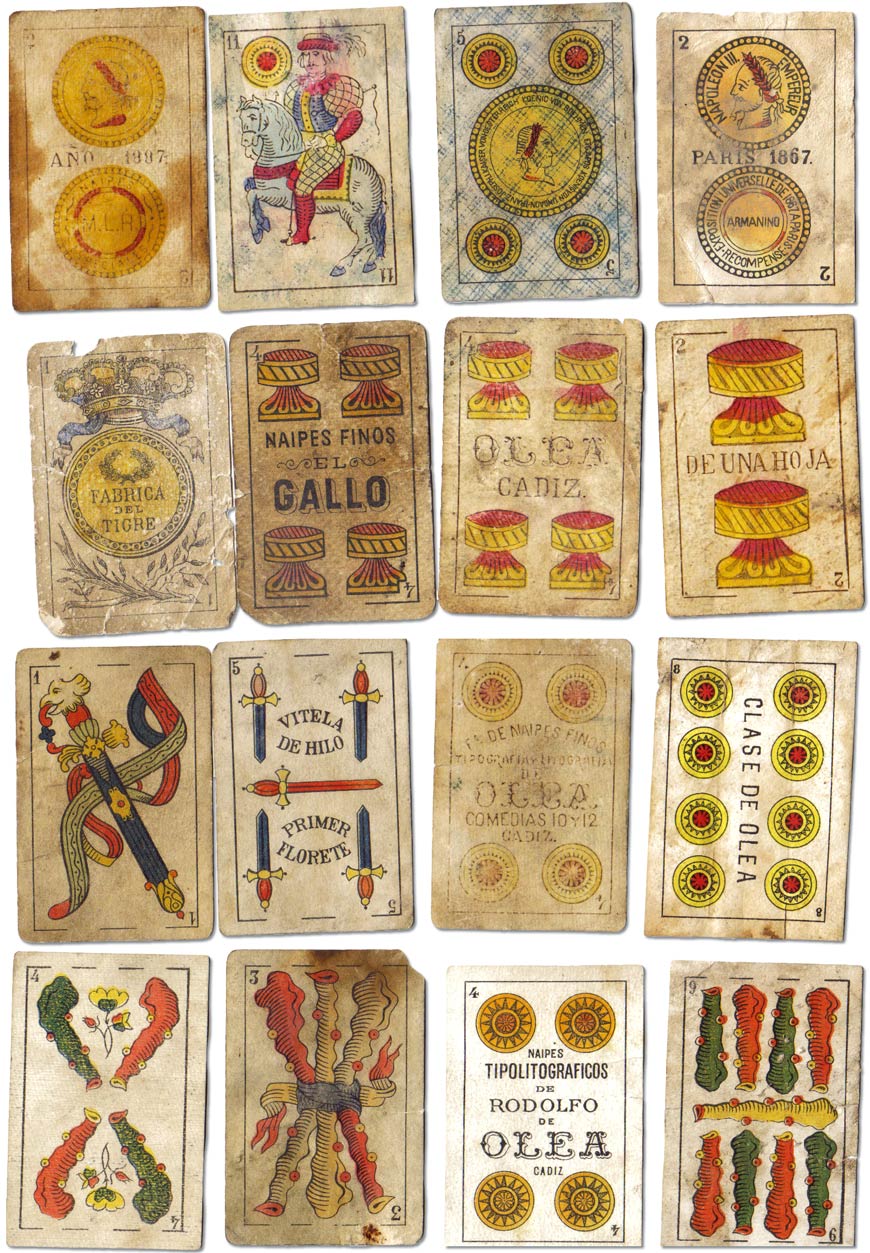
Above: assorted playing cards recovered from the rubbish bins in the old saltpetre works in Northern Chile. The workers endured hard living conditions and their main form of recreation was playing cards. The cards shown here are mostly from Spanish 'Cadiz' pattern decks, and several manufacturers can be identified. Inscriptions on the cards include: "M.L.R.", "Armanino", "Fabrica del Tigre", "Naipes Finos El Gallo", "Olea Cadiz", "Tipografía y Litografía de Olea, Comedias 10 y 12, Cadiz" and "Naipes Tipolitograficos de Rodolfo de Olea Cadiz". This indicates a preponderance of cards imported from Spain and Italy.
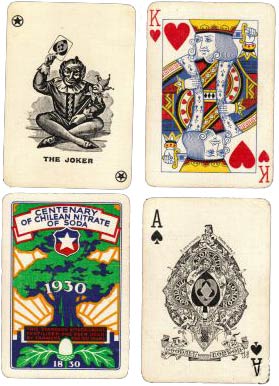
Right: cards from a pack manufactured by Goodall & Son, Ltd, London, commemorating the Centenary of Chilean Nitrate of Soda (Saltpetre) production, 1930.

By Simon Wintle
Spain • Member since February 01, 1996
I am the founder of The World of Playing Cards (est. 1996), a website dedicated to the history, artistry and cultural significance of playing cards and tarot. Over the years I have researched various areas of the subject, acquired and traded collections and contributed as a committee member of the IPCS and graphics editor of The Playing-Card journal. Having lived in Chile, England, Wales, and now Spain, these experiences have shaped my work and passion for playing cards. Amongst my achievements is producing a limited-edition replica of a 17th-century English pack using woodblocks and stencils—a labour of love. Today, the World of Playing Cards is a global collaborative project, with my son Adam serving as the technical driving force behind its development. His innovative efforts have helped shape the site into the thriving hub it is today. You are warmly invited to become a contributor and share your enthusiasm.

Activity for Naipes del Salitre
Sign in to comment or save this article.

Related Articles
Bertschinger y Codina - Cartes Françaises
French ‘Paris’ pattern made by Bertschinger y Codina, Barcelona, c.1850.
Vicente Gombau y Labad
Elegant fantasy designs by Vicente Gombau y Labad (Madrid), 1861.
Toledo, 1584
Archaic Spanish-suited deck with 48 cards made in Toledo in 1584.
Navarra Pattern, 1682
Navarra pattern produced for the Pamplona General Hospital Monopoly in 1682.
Rodolfo de Olea : “El Elefante”
“El Elefante” Cadiz pattern by Rodolfo de Olea Viaña, 1899.

Cádiz Pattern playing cards
A popular Spanish playing card pattern widely exported to Spanish-influenced markets.
Heráldica Castanyer
Spanish Catalan pattern No.6 by Heráldica Castanyer, Sabadell (Barcelona), c.1980.
Pedro Rotxotxo
Standard Spanish National pattern by Pedro Rotxotxo, Barcelona, late 18th century.
Xilografías de Mallorca
Spanish National pattern re-printed from original woodblocks which are preserved in the monastery at...

Maciá Pattern
The Maciá Pattern which was originally produced by a Barcelona cardmaker in the 1830s and subsequent...

S. Giráldez, Barcelona
Standard Spanish Catalan pattern playing cards by S. Giráldez, Barcelona, c.1905.

Sanmartí, 1840
Sanmartí, 1840.
Heraclio Fournier S.A.
Founded in 1868, today it is part of Cartamundi.

Fagoaga y Compañía (Casa Bertrand Domec), Buenos Aires, c.1970
Playing Cards Imported into Argentina by Fagoaga y Compañía (Casa Bertrand Domec), Buenos Aires, c.1...

Spanish Playing Cards ~ La Baraja Española
Spain has played a pivotal role in the history of playing cards in Europe and Latin America.

Taller Fotolitográfico, Chile
Spanish suited pack made in Chile by Taller Fotolitográfico, inspired by Fournier's classic 'Castili...

Naipes Siluv, Valparaiso, Chile, 1931
Naipes Siluv, Valparaiso, Chile, 1931

Hugo Castro, Santiago de Chile
Imprenta y Litografía Hugo Castro, Santiago de Chile.

Baraja Boxeo
Baraja de Boxeo, c.1930.

Baraja Artistas del Cine Mudo
Baraja Artistas del Cine Mudo, c.1926.
Most Popular
Our top articles from the past 60 days


