Czech Nationalistic playing cards
During the 19th century growing nationalist sentiment led to a rejection of Austro-Hungarian culture in favour of that of the native Czech people. One outcome from this movement was a ‘Nationalistic’ pack of playing cards painted by Emanuel Neumann.
designed by Emanuel Neumann, c.1895
During the 19th century growing nationalist sentiment led to a rejection of Austro-Hungarian culture in favour of that of the native Czech people. One outcome from this movement was a ‘Nationalistic’ pack of playing cards painted by Emanuel Neumann in which the standard national suit symbols are replaced with non-standard ones having particular meaning to the Czech people. Ears of corn, or Sheaves, replace Acorns symbolising the fertility of agriculture and the Czech lands. Deep red Garnets, which replace Hearts, have reputed healing powers. Wine Kegs replace bells to celebrate viniculture in Bohemia and Moravia that was started by the Romans. Lime Leaves are from the national tree of the Czech lands. The cards were made in an effort to raise national self-confidence and esteem.
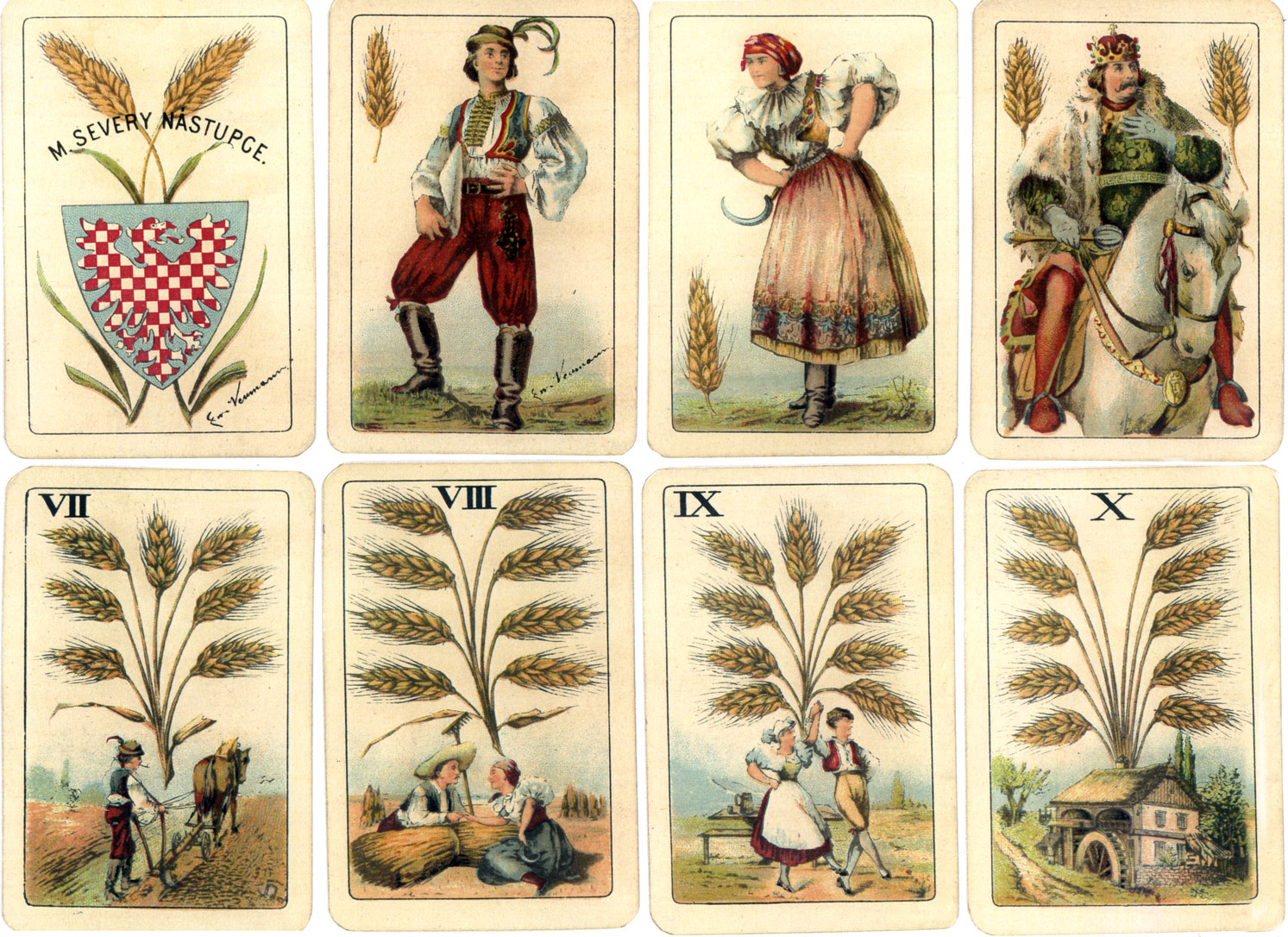
The suit of Ears of Corn features workers in the fields ploughing, harvesting and celebrating. The Upper Jack shows a man in traditional Moravian dress, and the King is George of Podebrad, the last King of an independent Bohemia. The signature of the artist who painted the cards, Emanuel Neumann (1873-1932), can be seen on the Upper Jack and the daus (2) which also shows the Moravian eagle on a shield. Manufactured by Antonín Kratochvíl, Prague.
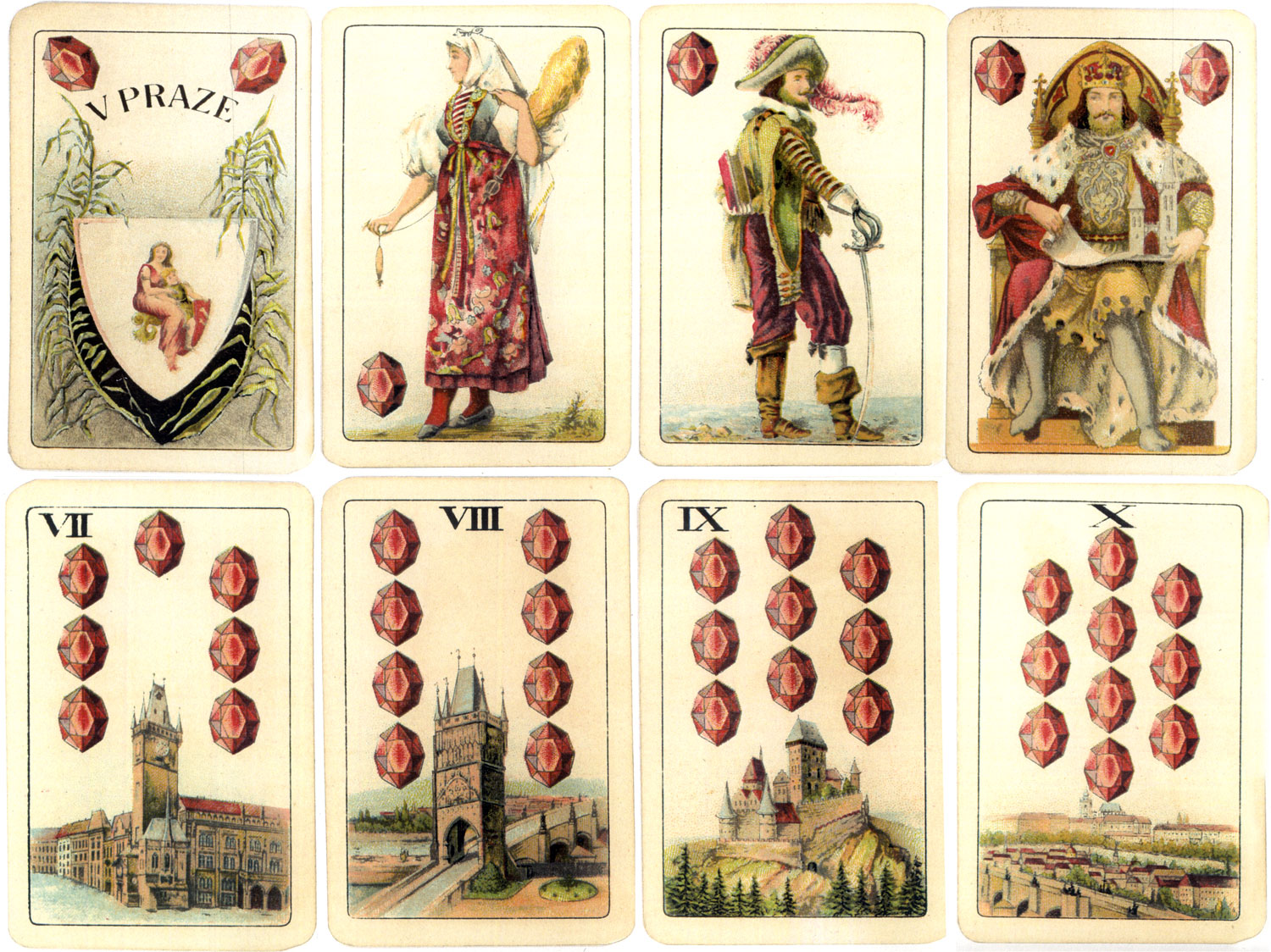
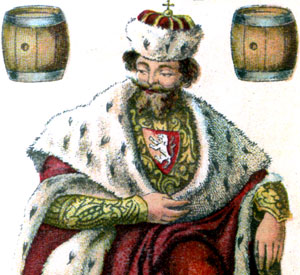
The suit of Garnets features Charles IV as the King, "Father of the Nation". The lower Jack is a female weaver. whilst the VIII of garnets shows the old town bridge. The daus card (2) depicts a mother and child, symbolising maternity and the founding of the nation, with an inscription which means 'In Prague'.
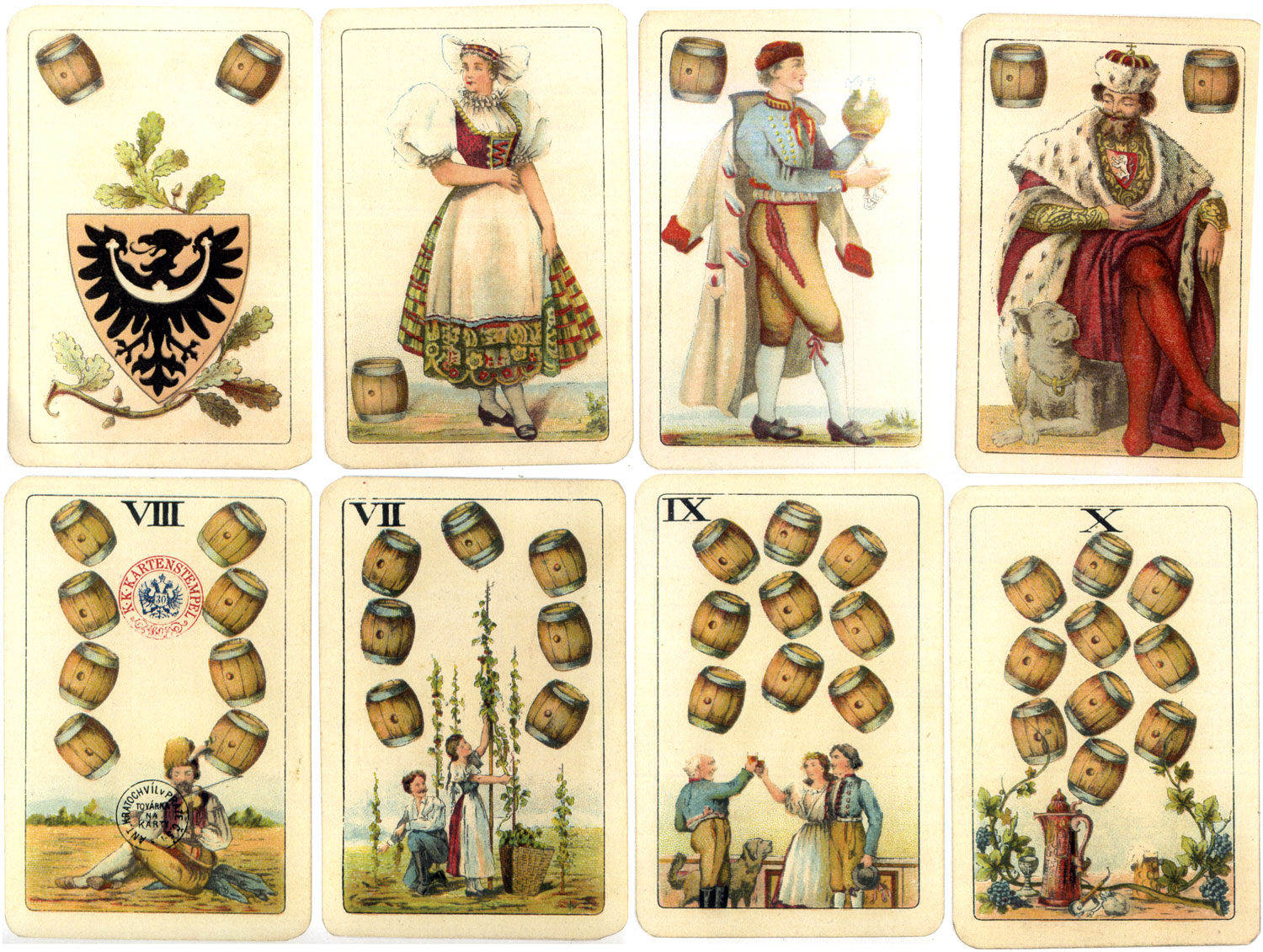
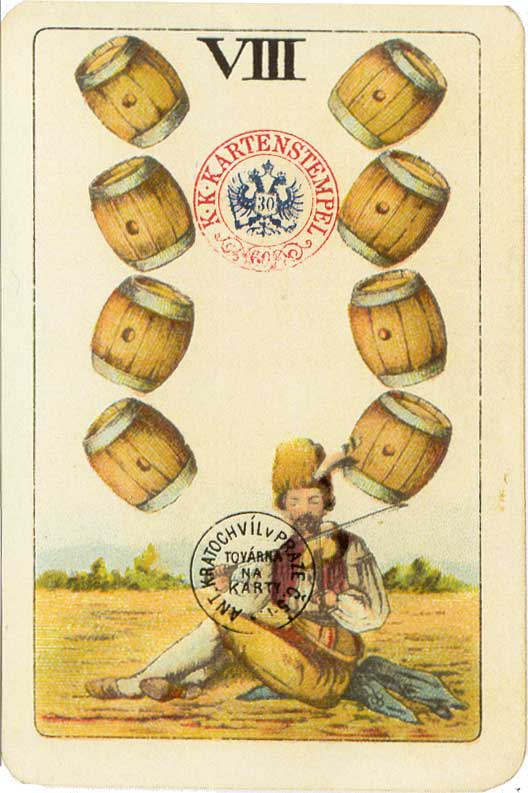
The suit of Wine Barrels features the Silesian eagle on the daus while the Lower jack shows a woman in traditional Bohemian dress. The numeral cards show scenes such as vineyards and people toasting. The VIII has the Austro-Hungarian tax stamp along with the maker's stamp.
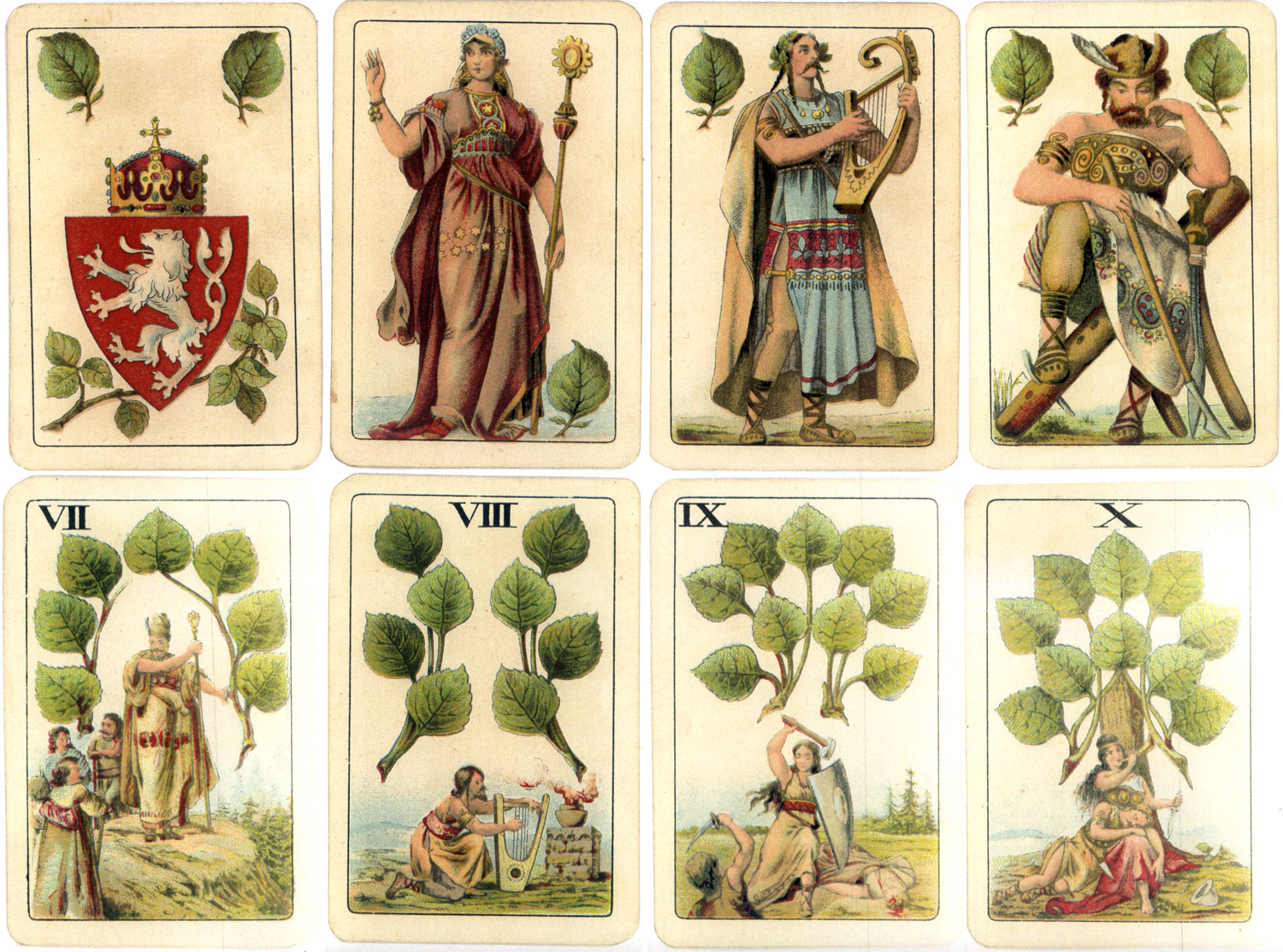
The suit of Lime Leaves features scenes from Czech history and mythology. The King is the farmer Premsyl who married Queen Libussa who is shown as the Lower Jack. The IX shows a scene from the legend of Sharka. On the daus card (2) we see the heraldic Czech two-tailed lion.
REFERENCES
Šťáhlavsky, Zdenĕk: "A 19th Century Czech Nationalistic Pack by Emanuel Neumann", The Playing-Card vol.32 no.6, May-June 2004, IPCS, England.
• See also: 1908 Prague Jubilee Exhibition • 'Jugendstil' designed by Artuš Scheiner, 1920 • Ritter & Cie "Art Deco", 1933 • Eagle Playing Card Co., Ltd.

By Simon Wintle
Spain • Member since February 01, 1996
I am the founder of The World of Playing Cards (est. 1996), a website dedicated to the history, artistry and cultural significance of playing cards and tarot. Over the years I have researched various areas of the subject, acquired and traded collections and contributed as a committee member of the IPCS and graphics editor of The Playing-Card journal. Having lived in Chile, England, Wales, and now Spain, these experiences have shaped my work and passion for playing cards. Amongst my achievements is producing a limited-edition replica of a 17th-century English pack using woodblocks and stencils—a labour of love. Today, the World of Playing Cards is a global collaborative project, with my son Adam serving as the technical driving force behind its development. His innovative efforts have helped shape the site into the thriving hub it is today. You are warmly invited to become a contributor and share your enthusiasm.

Activity for Czech Nationalistic playing cards
Sign in to comment or save this article.

Related Articles
Virgil Solis
Remarkable pack of 52 animal-suited playing-cards designed and etched by Virgil Solis.
Czech Bohemian style playing cards
Czech Bohemian style playing cards with a charming aesthetic, reflecting the cultural and social lif...
Laughing Made Easy
a Victorian card game published by D. Ogilvy.
Heathen Wars
German-suited ‘Heathen War’ playing cards published by Joseph Fetscher, Munich, c.1820.
Infirrera
Italo-Portuguese-suited cards by Andrea Infirrera with the arms of Malta, 1693.
Hindooly
Hindooly published by Chas Goodall & Son Ltd with four newly designed suits, c.1904.
Georg Kapfler
Antique deck of old Bohemian playing cards of the German type manufactured by Georg Kapfler and date...
Master of the Playing Cards
Animal suited playing cards engraved by the Master of the Playing Cards, Germany, c.1455
Whimsical Playing Cards
Whimsical Playing Cards by Turkish designer & illustrator Oksal Yesilok, 2016.
Stuttgart pack, c.1430
The luxury, hand-painted Stuttgart Cards (Stuttgarter Kartenspiel) dated c.1430, with suits of ducks...

Kamarát Toy Cards
Kamarát miniature toy playing cards from Czechoslovakia.
Bohemian Pattern
The Bohemian Pattern, sometimes called the Prager Pattern, has roots in the 16th century.

Czechoslovakia
The Republic of Czechoslovakia was founded in 1918 from the former Austro-Hungarian empire.
Czech Hussite Deck
Czech “Hussite” Pack engraved by Karel Hoffmann and first printed by Jan Ritter in 1895.
Naipes Nacionales
Naipes Nacionales designed by Manuel Bayardi and published by Clemente Jacques y Cia, Mexico c.1940....
Master PW Circular Cards
Master PW Circular Playing Cards: roses, columbines, carnations, parrots and hares... everyday objec...

Eagle Playing Card Co. Limited
Cards from std English pattern printed by The Eagle Playing Card Company Limited, Czechoslovakia, c....
The Princely Hunting pack, c.1440
The Princely Hunting Pack, c.1440/45, is attributed to Konrad Witz and his workshop in Basle.
The History of Playing Cards
Playing cards appear in European records in the late 14th century, but their earlier history lies fu...
Zoo Comics
ZOO COMICS animated playing cards made by Litografía Ferri, Valencia (Spain), first published in 196...
Most Popular
Our top articles from the past 60 days