



Benoist Laius
Spanish playing cards such as these were used in those parts of France where certain games were enjoyed, such as Aluette.
Spanish National Pattern made in South France, early 18th century
Benoist Laius is believed to have worked in Montpellier between 1706 - 1738. Montpellier is located on the south coast of France on the Mediterranean Sea. The pack could possibly have been carried to Spain by French troops supporting Felipe V in Barcelona in 1714.
Spanish playing cards like these were used in those parts of France where certain games were enjoyed, such as Aluette.

Above: cards from a 48-card deck in the 'Spanish National' pattern, manufactured by Benoist Laius, Montpellier (France), sometime between 1706-1725. The maker's name or initials appears on several cards. Woodblock and stencil printing technology. There are no 'pintas' or breaks in the framelines to denote the suits, as is usual in Spanish playing cards. The backs are plain white.
There is no Bourbon escutcheon on the Spanish arms on the Ace of Coins (the first Bourbon King in Spain was 1700). Possibly the woodblocks were out-of-date, or the woodcutters supplied unnamed blocks so that the new owner could print their own name or initials in the empty spaces. The Sota of Coins holds a horn in his right hand. Almost identical packs were being produced by other makers, such as Jacques Sellon, Marseille, c.1710 or J. Coissieux, Romans in c.1725.
REFERENCES
Mann, Sylvia: All Cards on the Table, Jonas Verlag/Deutsches Spielkarten-Museum, Leinfelden-Echterdingen, 1990

By Simon Wintle
Spain • Member since February 01, 1996
I am the founder of The World of Playing Cards (est. 1996), a website dedicated to the history, artistry and cultural significance of playing cards and tarot. Over the years I have researched various areas of the subject, acquired and traded collections and contributed as a committee member of the IPCS and graphics editor of The Playing-Card journal. Having lived in Chile, England, Wales, and now Spain, these experiences have shaped my work and passion for playing cards. Amongst my achievements is producing a limited-edition replica of a 17th-century English pack using woodblocks and stencils—a labour of love. Today, the World of Playing Cards is a global collaborative project, with my son Adam serving as the technical driving force behind its development. His innovative efforts have helped shape the site into the thriving hub it is today. You are warmly invited to become a contributor and share your enthusiasm.

Activity for Benoist Laius
Sign in to comment or save this article.

Related Articles
Rouen Pattern - Portrait Rouennais
An attractive XV century French-suited design from Rouen became the standard English & Anglo-America...
Cartes Catalanes by Fossorier, Amar et Cie
‘Cartes Catalanes’ published by Fossorier, Amar et Cie (Paris)
The Parisian Tarot
The “Parisian Tarot”, early 1600s, with imagery and design synthesizing several influences.
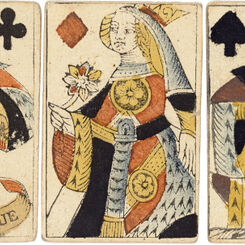
Languedoc pattern - Portrait de Languedoc
The old Languedoc pattern was known at the beginning of the seventeenth century, if not before.
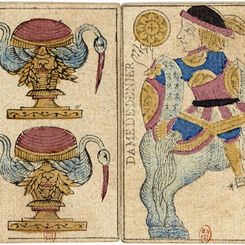
Pierre Roiné Aluette
Archaic form of Aluette published by Pierre Roiné, Nantes, c.1785.
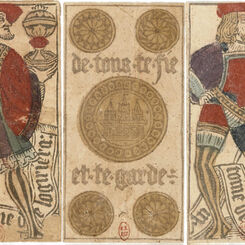
Antoine de Logiriera
Archaic Spanish-suited playing cards published in Toulouse by Antoine de Logiriera (1495-1518).
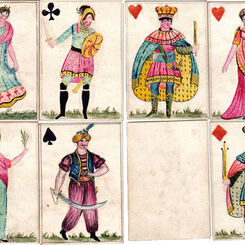
Prisoners of War
Hand-made playing cards by French prisoners of war in Porchester Castle, Hampshire, c.1796.
64: The descendants of the French regional patterns: 2
A continuation oF the development of the off-spring of the Paris patterns and a few examples of how ...
Suicide King
The King of Hearts, holding a sword behind his head, is sometimes nicknamed the “Suicide King”. He c...
Provence Pattern - Portrait de Provence
The 'Provence' pattern contains figures which go back to the fifteenth century.
Pierre Marechal
Rouen became an important centre for card-making whose influence extended far afield. Cards from Rou...
Lyon Pattern type iii
This pattern was used in various parts of eastern France but was ultimately replaced by the official...
History of Blackjack
Over the years the origin of Blackjack, like many other games, has eluded researchers for a long tim...
Paris Pattern
The Paris pattern was established as such around the middle of the seventeenth century (based, perha...
Early Anglo-French Cards
Cards produced in Rouen during the sixteenth century. It was cards like these which were imported to...
Translucent Erotic Playing Cards, page 2
Translucent Erotic Playing Cards, page 2
Italian Playing Cards
The first reliable evidence that playing cards were being used in Italy is from 1376, when a game ca...
The History of Playing Cards
Playing cards appear in European records in the late 14th century, but their earlier history lies fu...
History of Court Cards
The court cards in English packs of playing cards derive from models produced by Pierre Marechal in ...
History of English Playing Cards & Games
The History of English Playing Cards dates probably from the mid 15th century
Most Popular
Our top articles from the past 60 days


