



Spanish pattern by Eugène Boisse
Spanish pattern published by Eugène Boisse, Bordeaux.
These Spanish-suited cards were engraved by Albaret of Agen, whose name appears on the Ace of coins. New technologies were facilitating a move away from woodblocks, allowing more intricate designs, in this case somewhat eclectic and embellished. The engraver has also added small indices which was another emerging innovation at that time. His connection to Agen, a city in southwestern France, likely signifies either his place of origin or the location where he worked or was based. The deck was subsequently published by Eugène Boisse of Bordeaux, whose name has been hand-stamped onto the cards (not on the original engravings).
The Bibliothèque nationale and several authors regard the deck as ‘Aluette’, but it is perhaps better described as a blend or "métissage" of the French Catalan and Parisian Spanish patterns, with female or androgynous cavaliers, plumed hats and distinctive details on some numeral cards. The borders have 'pintas' or breaks to differentiate the suits. The lion atop a globe is found on many Spanish decks, and along with "Naypes Refinos" this projects global influence. The Real Fábrica de Madrid, which was the royal playing card manufacturer in Spain, used the term "Naypes Refinos" or "Naypes Finisimos" on their cards, denoting superior quality. The snake on the ace of batons is unusual.
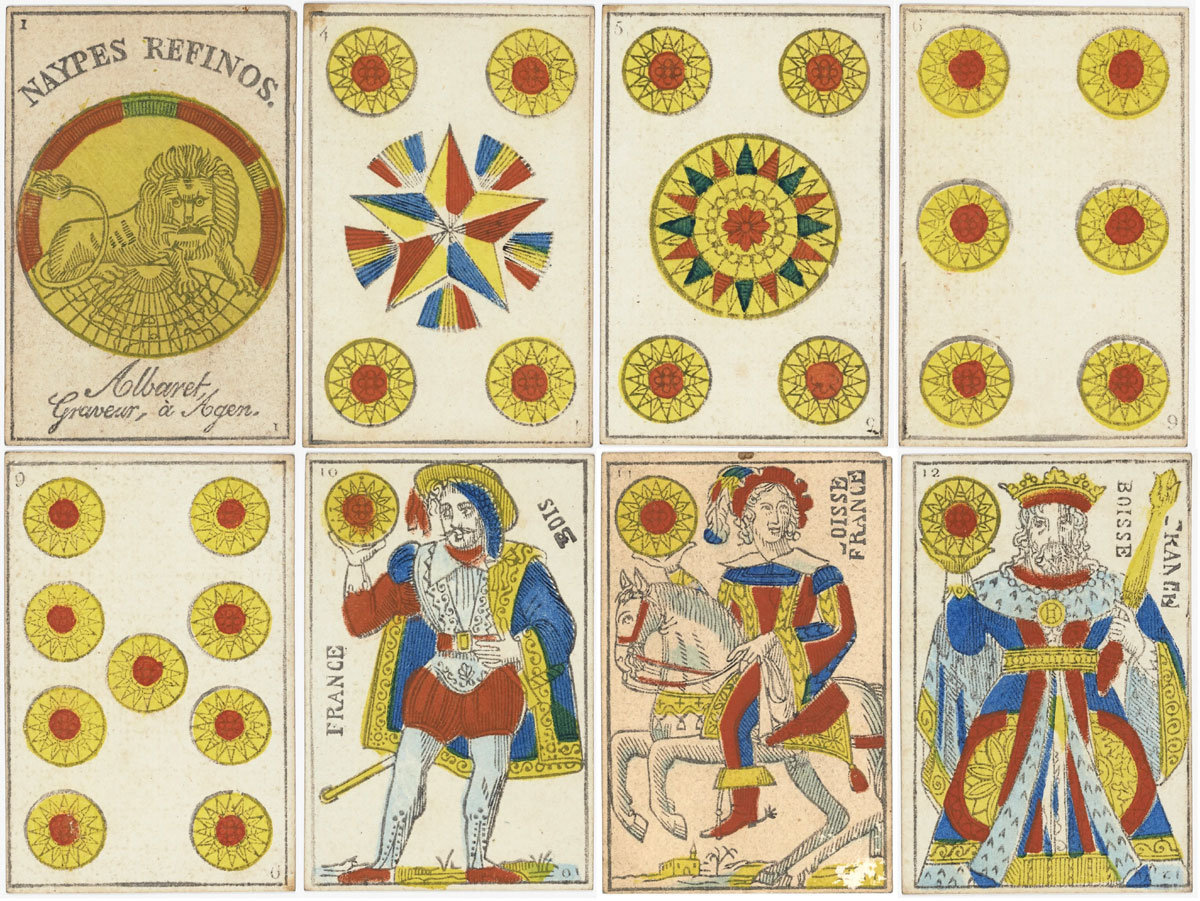
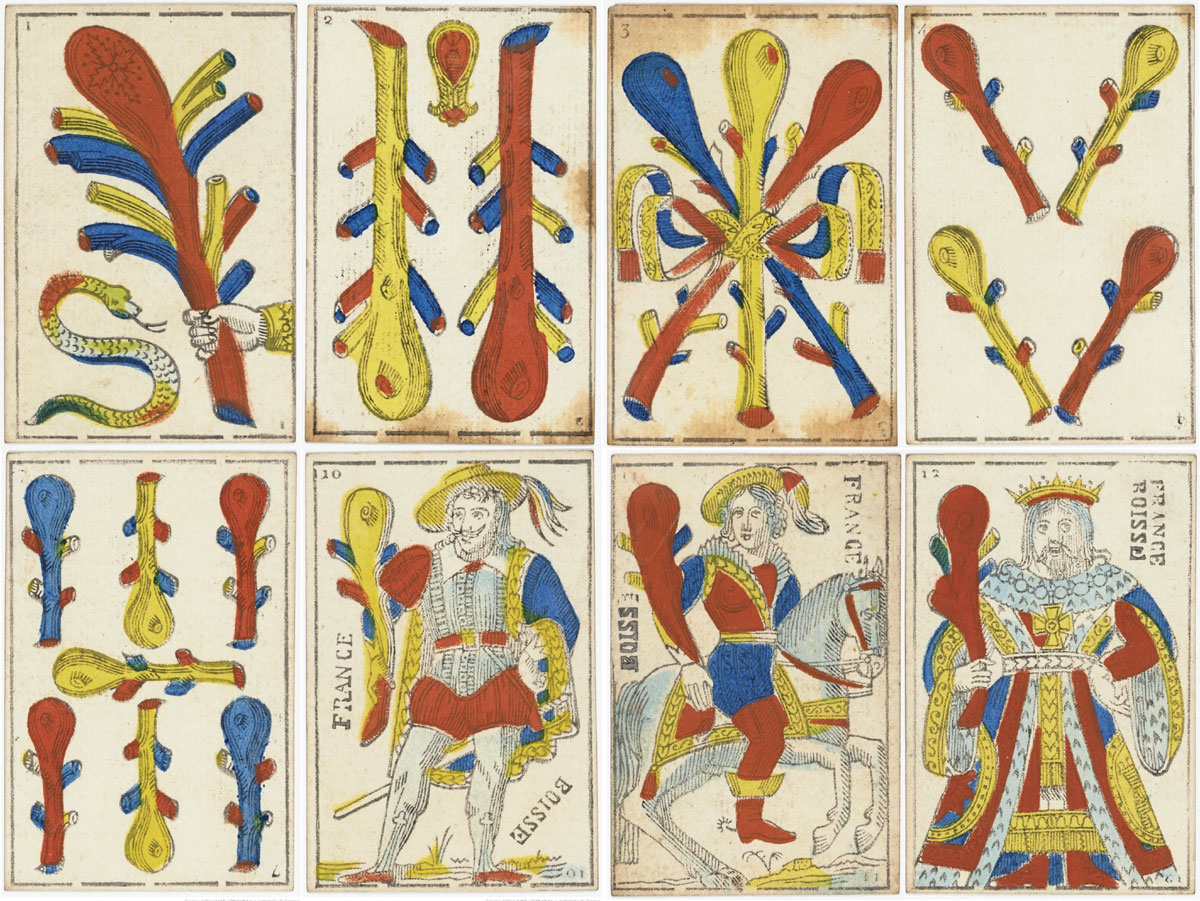
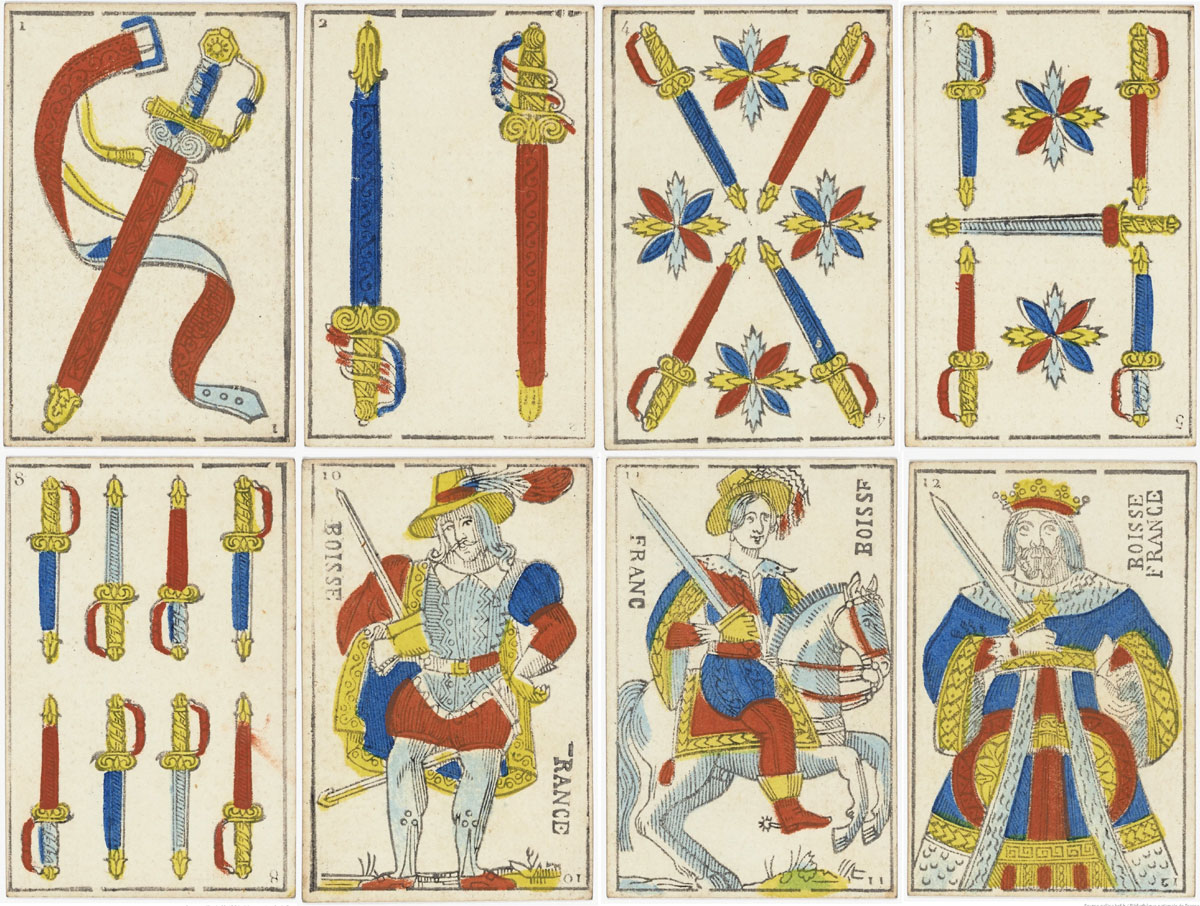
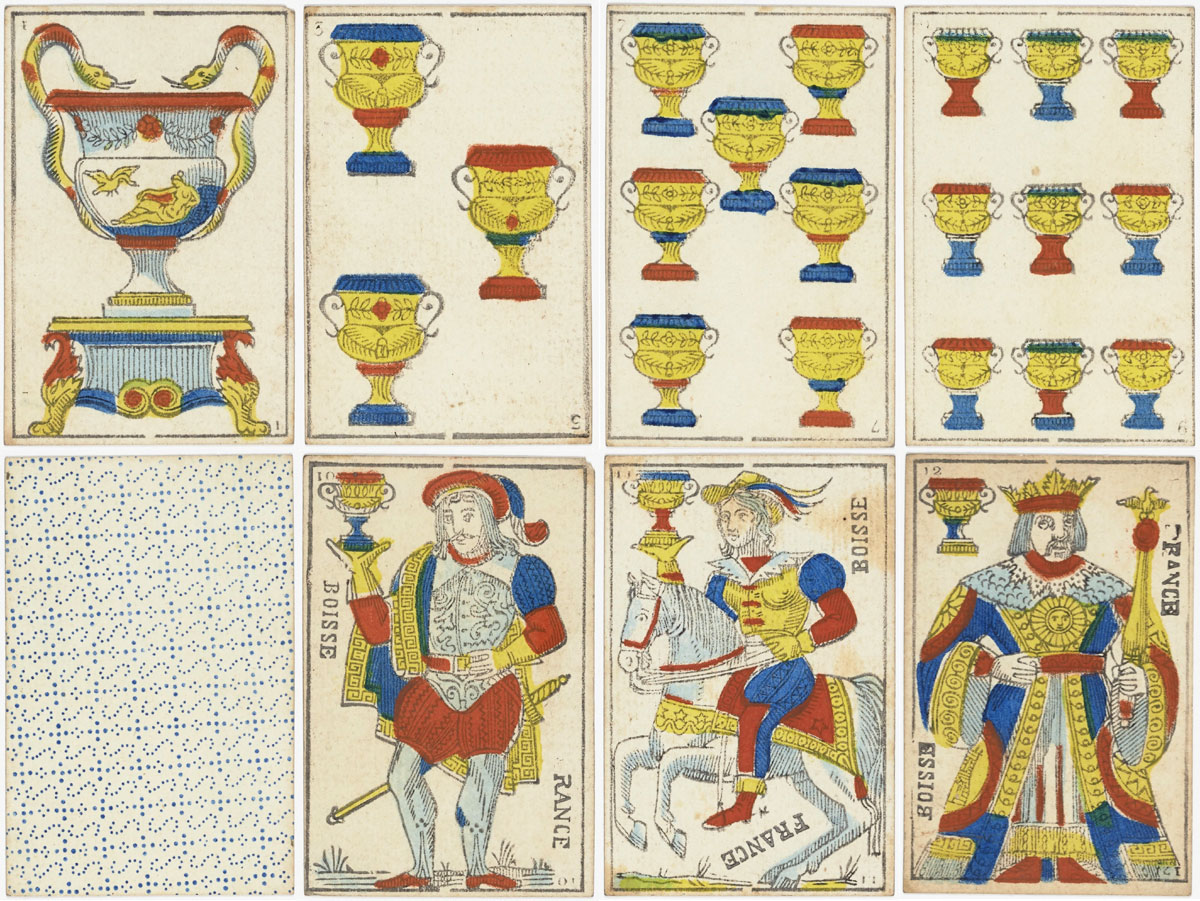
Above: Spanish pattern published by Eugène Boisse, Bordeaux, c.1865. 48 cards, stencil coloured; 8,5 x 5,6 cm. Square corners, small indices, backs with blue dotted decoration. Bibliothèque nationale de France • Jeu d'aluette, Albaret, graveur, à Agen►
The cards may have been intended for foreign markets such as Spain, North Africa or South America. Proofs pulled from the original block do not have Boisse’s name stamped on them. That was added later in the example shown above.

Above: uncoloured proof sheet pulled from the original blocks engraved by Albaret, graveur à Agen.
References
Bibliothèque nationale de France:
d'Allemagne, Henry-René: Les cartes à jouer du XIVe au XXe siècle, tome 2, p.101 Cartes d’Alluettes éditées par Boisse, cartier de Bordeaux, 1839-1860►

By Simon Wintle
Spain • Member since February 01, 1996
I am the founder of The World of Playing Cards (est. 1996), a website dedicated to the history, artistry and cultural significance of playing cards and tarot. Over the years I have researched various areas of the subject, acquired and traded collections and contributed as a committee member of the IPCS and graphics editor of The Playing-Card journal. Having lived in Chile, England, Wales, and now Spain, these experiences have shaped my work and passion for playing cards. Amongst my achievements is producing a limited-edition replica of a 17th-century English pack using woodblocks and stencils—a labour of love. Today, the World of Playing Cards is a global collaborative project, with my son Adam serving as the technical driving force behind its development. His innovative efforts have helped shape the site into the thriving hub it is today. You are warmly invited to become a contributor and share your enthusiasm.

Activity for Spanish pattern by Eugène Boisse
Sign in to comment or save this article.

Related Articles
Swiss playing cards by Iehan Hemau
17th century Swiss-suited playing cards by Iehan Hemau of Épinal.
Dessoris
Spanish-suited cards by Dessoris, Perpignan, which anticipate the French Catalan pattern.
Lyon pattern by Michel Ressy
Lyon pattern by Michel Ressy, c.1760.
Guyenne Pattern - Portrait de Guyenne
The Guyenne pattern emerged from the earlier Languedoc pattern.
Auvergne Pattern - Portrait d'Auvergne
The Auvergne pattern is one of the oldest in France.
Cartes Catalanes by Fossorier, Amar et Cie
‘Cartes Catalanes’ published by Fossorier, Amar et Cie (Paris)
The Parisian Tarot
The “Parisian Tarot”, early 1600s, with imagery and design synthesizing several influences.
Jean Noblet Tarot de Marseille
Jean Noblet: the oldest known ‘Tarot de Marseille’ deck, Paris, c.1650.
Éditions Dusserre, Paris
Éditions Dusserre, Paris.

Benoist Laius
Spanish playing cards such as these were used in those parts of France where certain games were enjo...
Lyon Pattern type iii
This pattern was used in various parts of eastern France but was ultimately replaced by the official...

Cartes Catalanes
Cartes Catalanes are used in a small area in the Eastern Pyrenees region of Southern France.
Livre du Destin
Livre du Destin or Book of Fate, printed by B.P.Grimaud, Paris, c.1900.
Richard Bouvier
The assorted antique playing cards shown below are examples of the French 'Paris' pattern from the s...
Boisse English pattern
Boisse English pattern, c.1870 based on designs by De La Rue.
Paris Pattern
The Paris pattern was established as such around the middle of the seventeenth century (based, perha...
French Playing Cards
Some of the oldest cards still in existence come from France. During the 16th and 17th centuries Fra...
Translucent Erotic Playing Cards, page 2
Translucent Erotic Playing Cards, page 2
O. Gibert, Paris c.1840-60
Gibert was a master card-maker whose fashionable playing cards were of a very high standard.
History of Court Cards
The court cards in English packs of playing cards derive from models produced by Pierre Marechal in ...
Most Popular
Our top articles from the past 60 days


