




Matyó-Bridge No.50
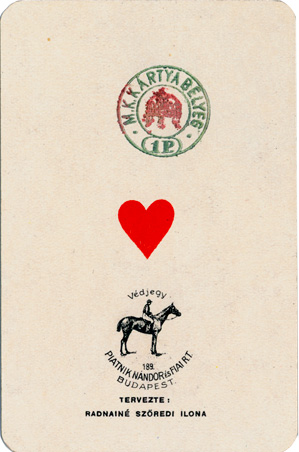
The court cards in this delightful Art Deco pack represent persons in various colourfully embroidered folkloric costumes. Designed by Hungarian artist Ilona Radnainé Szöredi.
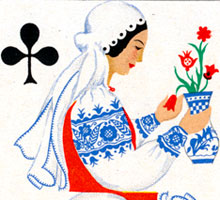
“Matyó-Bridge No.50”
The court cards in this delightful Art Deco pack represent persons in various colourfully embroidered folkloric costumes designed by Hungarian artist Ilona Radnainé Szöredi, who specialised in folk needlework. The cards were produced at Piatnik's Hungarian branch in Budapest, 1932.
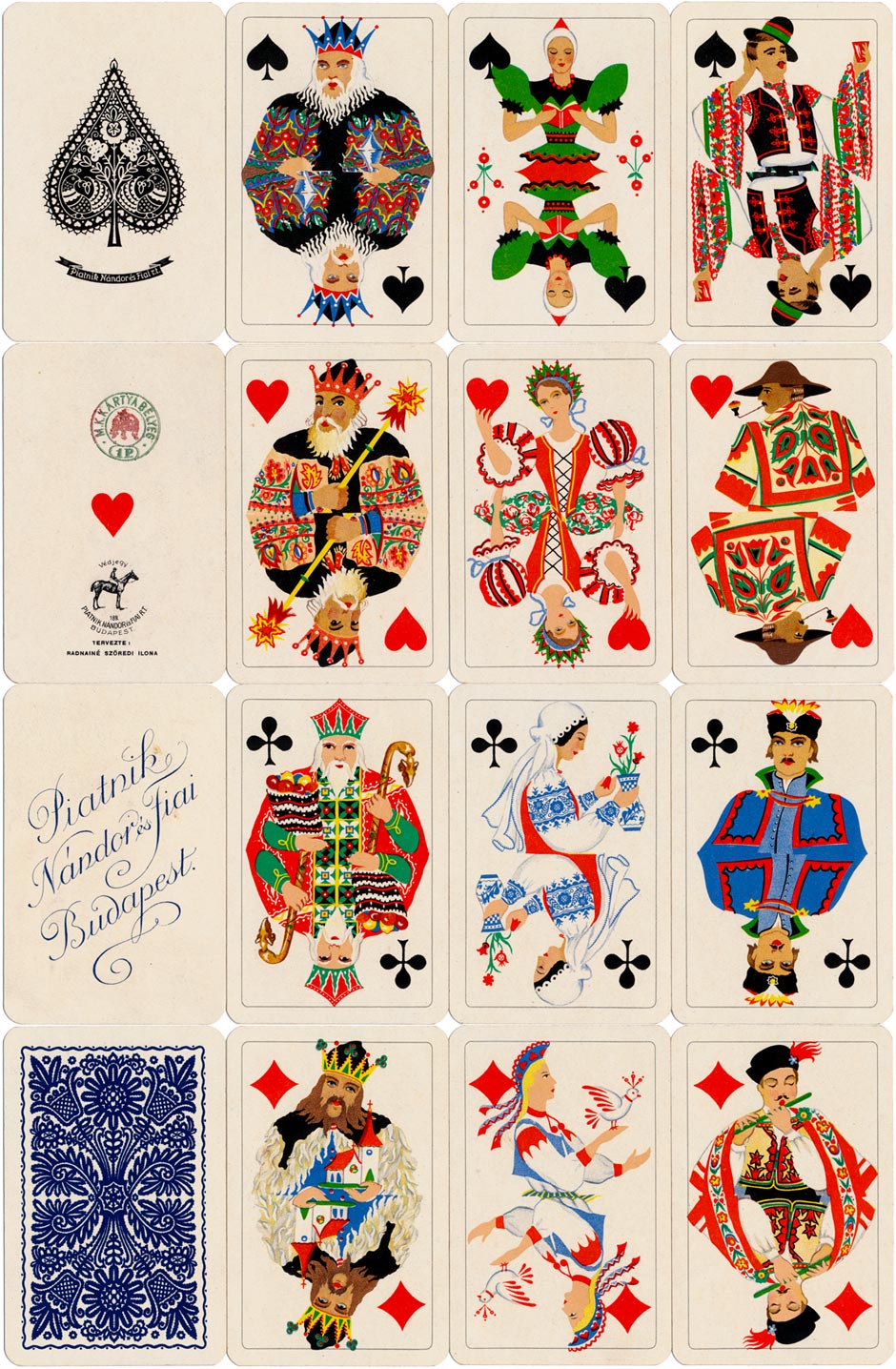
Above: Matyó-Bridge No.50 manufactured by F. Piatnik Nándor és Fiai, (Hungarian branch, 1896-1948), Budapest, 1932. 52 cards, printed by offset, in paper wrapper. The firm of Piatnik had several branches besides the main office in Vienna, which included Prague, Cracow and Budapest. Images courtesy Barney Townshend.
REFERENCES
Segeth, Uwe-Volker: Spielkarten Jugendstil und Art Déco, Edition Christian Brandstätter, Wien, 1994
See also:
Hungarian ‘Seasons‘ pattern by Piatnik, c.1991 • Hungarian War Aid pack • Balázs Pál Nagy's playing cards • Hungarian 'Seasons' playing cards by G. Berger, Buenos Aires c.1940 • Hungarian Playing Cards made in Argentina.

By Barney Townshend
United Kingdom • Member since October 06, 2015
Retired Airline Pilot, interested in: Transformation Playing Cards, Karl Gerich and Elaine Lewis. Secretary of the EPCS. Treasurer of the IPCS.

Activity for Matyó-Bridge No.50
Sign in to comment or save this article.
Related Articles
Schweizer Trachten
Schweizer Trachten No.174 (Costumes Suisses) by Dondorf.
Ken McCarthy
An unknown deck by Ken McCarthy, c.2018.
Carl Arnold Transformation
Transformation playing cards designed by Carl Johann Arnold (1829-1916), the court artist for King F...
Ritter & Cie, 1933
A colourful re-working of the standard Anglo-American pattern in Art Deco style.
Rummy No.210
Period cartoon images from the 1930s. The Kings are in fancy dress ready to party, the Queens appear...
Brussels Euro Joker Club 1998
Brussels Euro Joker Club's 10th Anniversary deck, with artwork by Yvette Cleuter, was produced in a ...

Ceska Graficka Unie AS
Playing Cards printed by Ceska Graficka Unie AS, Prague, Czechoslovakia, 1890-1925.
Luxus Club Karte No.184
Another of Dondorf's masterpieces of chromolithography, the detailed artwork on these cards has mult...
Dilkhus playing cards for India
Van Genechten was one of the most competent cardmakers in Turnhout and they produced almost every ki...

Leonor Fini
The originality of Leonor Fini's work is evident in these playing card designs. The imagery of her p...
Salvador Dalí
Based on the standard French ‘Paris’ pattern, Dalí composed his playing card figures out of geometri...

Graciela Rodo Boulanger
Boulanger's paintings and graphic art works are easily recognized. The Latin American influence is a...
Karl Korab (Ed. Hilger)
Karl Korab was born in 1937 in Falkenstein (Lower Austria), the son of a forester. As a child he exp...
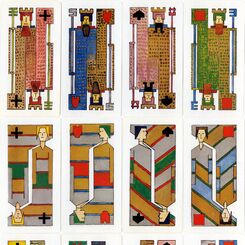
Arnold Schönberg
In around 1909 he created three sets of playing cards. His inventiveness was driven by a passion for...
Waisenfond
Intended to attract donations on behalf of the Imperial Royal Austrian Military Widows’ and Orphans’...
Cashmere
Bernhard Altmann is from the “The House of Cashmere” and these playing cards honour their best known...
Gedimino Stulpai
Gedimino Stulpai playing cards made in Lithuania by Spindulys Printing Co., Kaunas, depicting Lithua...
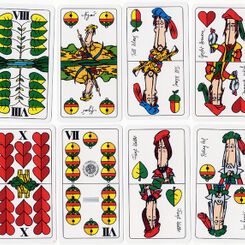
Balázs Pál Nagy's Tell No. 3306 Playing Cards
Balázs Pál Nagy Tell 3306
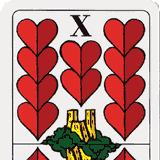
Balázs Pál Nagy's Playing Cards
Balázs Pál Nagy's Playing Cards
The History of Playing Cards
Playing cards appear in European records in the late 14th century, but their earlier history lies fu...
Most Popular
Our top articles from the past 60 days


Maria Nick
21 February 2026, 10:15SavedSaved this article to Maria Nick's Collection