



John Newman’s Colour Cards
John Newman’s Colour Cards

Above: Six of John Newman's Colour cards for playing Bridge. In this new edition, colour borders have been added to the Diamond and Club suit signs to achieve greater clarity. The four Aces are decorated. The cards were designed by Anthony Gray and were printed by Richard Edward Ltd, London. An innovative feature is the use of a different colour for each suit, as opposed to the traditional red and black.
John Newman’s Colour Suited playing cards were developed for playing Bridge. The colour coding enables the player more easily to sort his hand and follow suit since in addition the indexes are much larger than normal. This means that the cards are also particularly well suited to the needs of the visually impaired, and for children or beginners.
Note: different coloured suit symbols had been patented in USA on Nov 23, 1926, by Antoine Lefebure of San Francisco, with the assertion that “even experienced players confuse clubs and spades; hearts and diamonds” here►
Other features are: both male and female double headed jokers (as far as we know for the first time) based on well known Aubrey Beardsley images - see below - and ornamented aces. The new colour cards have been used to publicise a simplified form of Bridge for children known as Mini-Bridge.
 |
"New easy-to-read four-colour playing cards are very popular" - David Bird, Bridge Columnist, Mail on Sunday. "The Bridge success story of 1995 has to be colour suited playing cards launched earlier this year by John Newman." - Bridge Christmas 95. "A step forward" - BBC Radio 4 In Touch.  |
Above: the jokers are adaptations of designs by Aubrey Beardsley, Lysistrata from Aristophanes and Satires from Juvenal's "Satire VI". |

By Simon Wintle
Spain • Member since February 01, 1996
I am the founder of The World of Playing Cards (est. 1996), a website dedicated to the history, artistry and cultural significance of playing cards and tarot. Over the years I have researched various areas of the subject, acquired and traded collections and contributed as a committee member of the IPCS and graphics editor of The Playing-Card journal. Having lived in Chile, England, Wales, and now Spain, these experiences have shaped my work and passion for playing cards. Amongst my achievements is producing a limited-edition replica of a 17th-century English pack using woodblocks and stencils—a labour of love. Today, the World of Playing Cards is a global collaborative project, with my son Adam serving as the technical driving force behind its development. His innovative efforts have helped shape the site into the thriving hub it is today. You are warmly invited to become a contributor and share your enthusiasm.

Activity for John Newman’s Colour Cards
Sign in to comment or save this article.

Related Articles
Cartomancy, Oracle and Divination Cards
Playing cards are used for fortune-telling - turning another card illumines the moment and a new per...
Corner Indices
Corner Indices were a major innovation in playing card production.
Lincard
“Lincard” card game invented by John William Wolf and patented in 1937.
Hesslers Enhanced
Matt Hessler’s “Enhanced” four-colour playing cards, 2015.

Gilbert & Sullivan Cards
“Gilbert & Sullivan” hand-made Savoy Operas pack designed and created by Rex Pitts.
Suicide King
The King of Hearts, holding a sword behind his head, is sometimes nicknamed the “Suicide King”. He c...
David James Binns
Hand-made “Tudor Playing Cards” by David James Binns, age 12.

Arpak
The Arpak No-Revoke playing cards, 24 Mount Pleasant, Liverpool, c.1927-35.
Printing of Playing Cards: Letterpress
Some notes on the manufacture of playing cards taken from Thomas De la Rue's patent, 1831.
Pneumatic Playing Cards
The surface of the cards was slightly grooved by being rolled on prepared plates, so that there were...
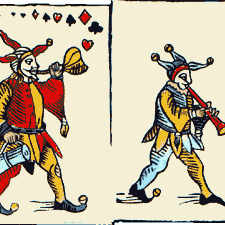
The Joker Card
The 'Joker' is believed to have been invented by American Euchre players who, when modifying the rul...
De La Rue
De La Rue introduced letter-press printing into playing card production and his patent was granted i...

Production Methods for Small Scale Editions
Some alternative approaches to producing small, hand-made editions of playing cards
Waddington’s Playing Cards
John Waddington Limited was a leading producer of playing cards and card games in the UK during the ...
Hidden Mickeys
HiddenMickeys

Grace Cards
My creativity proved useful in the Primary School classroom and children's clubs I run at Brooke Bap...
About Shelley Fowles
Shelley Fowles was born in South Africa but has lived in the United Kingdom since 1979. She trained ...

About Peter Wood
Peter Wood is a UK based artist.

About Karl Gerich (1956-2016)
About Karl Alexander Gerich, 23rd April 1956 — 4th January 2016

About Georgina Harvey
Georgina Harvey worked together with Karl Gerich.
Most Popular
Our top articles from the past 60 days


