Peruvian Playing Cards
Playing cards have been travelling from Spain to South American colonies ever since Christopher Columbus.
Playing cards travelled from Spain to South America from the earliest decades of colonisation. Following Christopher Columbus’s voyages, Spanish cards circulated widely across the Atlantic, reaching Peru soon after the Spanish conquest. In 1531, Francisco Pizarro set sail from Panama with a small force to conquer the region for the Spanish Crown, and Peru was incorporated into the Viceroyalty of Peru, one of the principal administrative units of Spain’s overseas empire. Vast quantities of silver were extracted from Peruvian mines during the 16th and 17th centuries and shipped to Spain, while gambling, already a familiar Iberian pastime, became increasingly widespread in colonial society.
Archaeological excavations in the Lower Rímac Valley near Lima have uncovered dice and fragments of 16th-century Spanish playing cards manufactured in Seville, confirming that Peru was supplied with imported cards from Spain from an early date. These finds also reflect the broader administrative and commercial structures of the viceroyalty, through which goods, people, and cultural practices were tightly regulated and distributed under royal authority.
In everyday colonial life, Spanish playing cards were widely used by settlers in Peru as a familiar form of leisure. Played in taverns, wine shops and other informal social spaces, card games brought together people from different social backgrounds and were often accompanied by gambling and alcohol. Disputes arising during play were common and could escalate beyond the gaming table, drawing the attention of colonial authorities and courts, and underlining the social visibility of playing cards in early Peruvian colonial society.Sheets of playing cards were already being produced and sold locally in Peru by the mid-16th century, but in 1553 their manufacture was prohibited, reflecting official concern over gambling and the Crown’s desire to maintain fiscal and moral control. The first printing press in Peru appeared in 1594, primarily to support evangelisation through the printing of Christian doctrine. Further presses soon followed, but their output was closely supervised to prevent the circulation of unapproved or subversive material. Most printed imagery was religious in character and often followed styles and tastes current in Spain. Decorative motifs included double-tailed mermaids, fish, hybrid creatures, demons, and dragons.
At some point, local woodcutters or engravers were employed, and by 1618 an accusation was made that Francisco del Canto had produced counterfeit playing cards. This suggests that a clandestine playing-card industry had already developed at an early stage, operating alongside official restrictions and imported supplies.

Above: cigarette cards for "La Mutua" tobacco company printed by Litografía Fabbri, c.1900 using the Spanish Cadiz pattern.
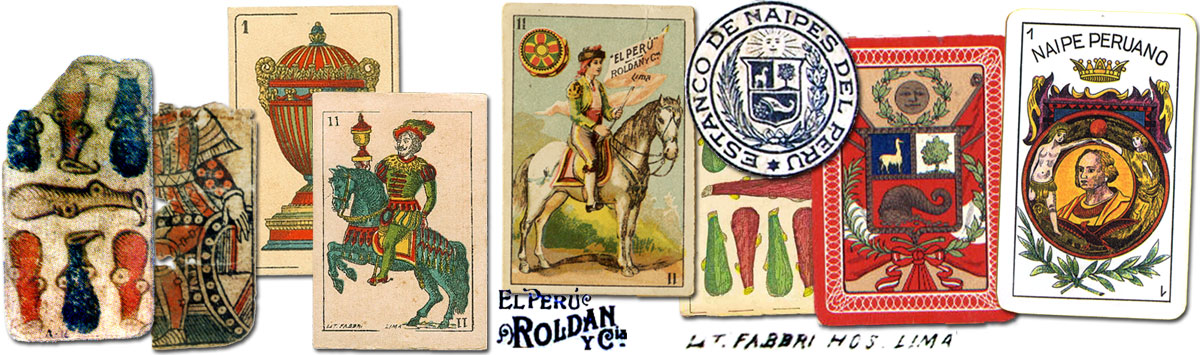
The Spanish Cadiz pattern has been used in Peru since before 1900 and has become a sort of Peruvian National Pattern. The Castilian and Catalan patterns are seldom seen. For many years foreign-made cards were imported, including those made for the Estanco de Naipes del Perú, until Peruvian printers began to produce their own.

The Estanco de Naipes del Perú was first established in 1781 and administered by Spanish authorities as a sort of monopoly. Cards were produced in Spain at the Real Fábrica de Macharaviaya. Subsequently the Estanco was devolved to the Peruvian Congress who controlled the playing cards industry until the Estanco de Naipes was finally abolished in 1967.
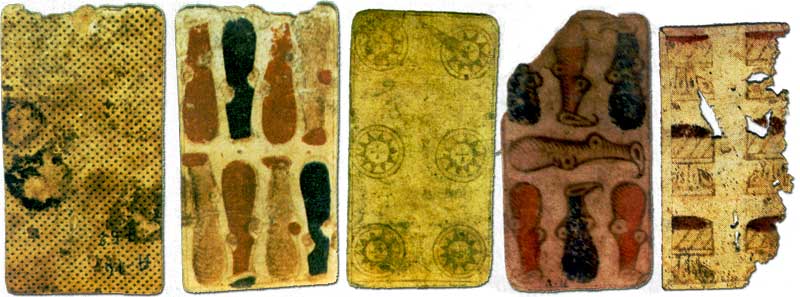
Above: discoveries in archaeological excavations.
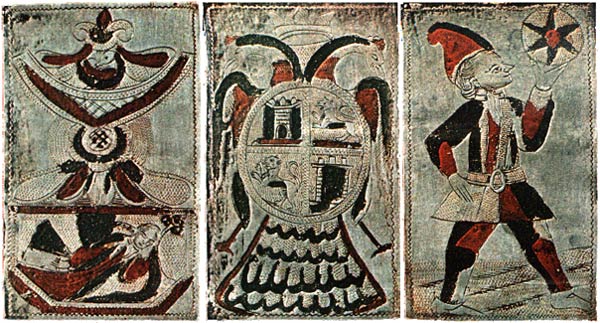
Above: playing cards engraved in silver, 1745.
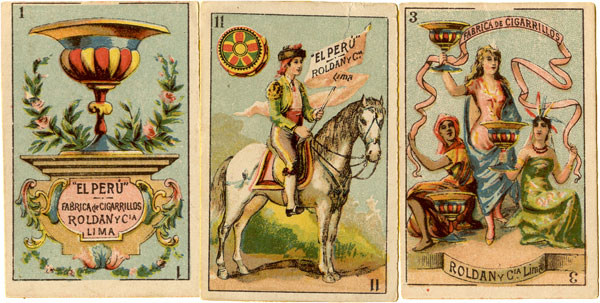
Above: Fabrica de Cigarrillos Roldan y Cia, c.1890.

Above: cards for export to Peru made in Spain.

Above: Cádiz pattern made in Peru.

Above: Naipes Pavias, c.1990.

Above: miniature playing cards inset into tobacco cards, printed by Litografía y Tipografía Fabbri Hermanos, Lima, for Roldan y Cia Tobacco, c.1895.
A number of Peruvian tobacco companies produced collectible insert cards and playing cards to promote their cigarette brands during the late 19th century and early 1900s, many of which are finely lithographed by local printers. In addition there has been a small output of locally-produced packs. Local printers who also produced playing cards include: Color & Trazos ¦ Imprenta Lecaros ¦ Jan Mer S.A.C. ¦ Litográfica del Perú ¦ Litografía Fabbri ¦ Litografía Goicochea Hnos, S.A. ¦ Naipes y Casinos ¦ OBD, S.A. ¦ Offset Cecil S.A. ¦ Pavias ¦ Power Casinos ¦ Zandrox Producciones.
Publicity & Advertising

Above: Van Genechten for the Estanco de Naipes del Peru and Cigarrillo Holiday, c.1965.

Above: publicity pack for Laboratorios Magma, Lima, c.1990.

Above: Cefacidal by Offset Cecil S.A., Peru, c.1975.

Above: Coca-Cola themed deck for Ripley Depertment Store, anon manufacturer, c.2000.
Tourist Souvenir

Above: Vistas de Lima, c.1910.

Above: Vistas del Perú, c.1920s.

Above: Cusco Inca Souvenir.

Above: Peruvian Souvenir by Jan Mer S.A.C., c.2000.

Above: Peru Rail souvenir playing cards "exploring the land of the Incas" published by Peru Rail.

Above: Inka Culture playing cards, Peru, c.2000.

Above: “Líneas de Nazca” souvenir playing cards, Peru, c.2008.

Above: Fenno souvenir playing cards, Peru, c.2009.
Tarot & Cartomancy

Above: Ramses II Tarot, Peru. c.1975.

Above: TU DESTINO Cartomancy Cards by Zandrox Producciones, Miraflores, Peru, c.1975.
 |
 |
 |
 |

Above: El Reloj card game by Imprenta Lecaros.

Above: “Amos del Universo” superhero card game published by Litografía Goicochea Hnos, S.A., Lima, Peru, c.1980.
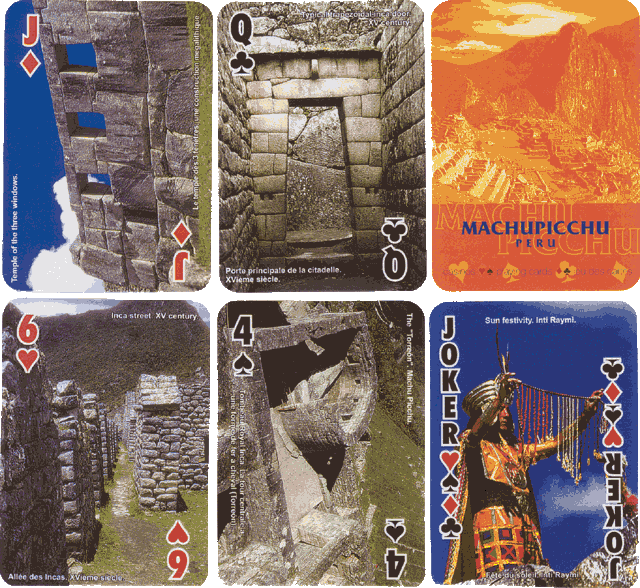
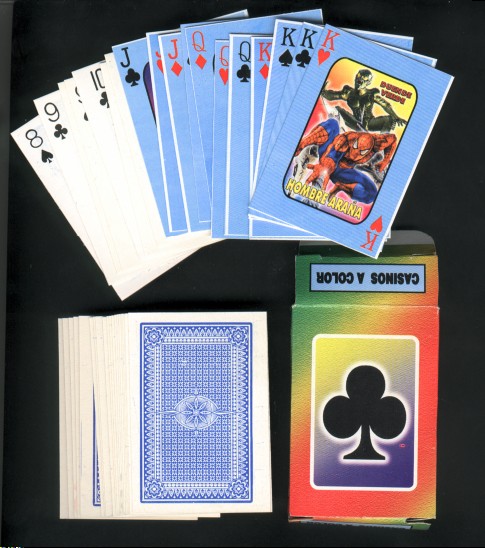
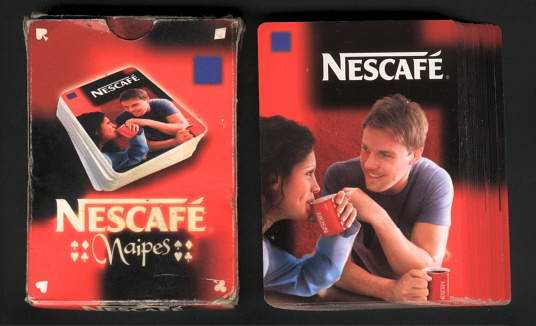
Rimac Valley cards | Silver Cards | El Perú Tobacco | Litografía Fabbri | Cigarrillos Compadre | Cigarrillos El Figaro | Cigarrillo Holiday | Imprenta Lecaros 'El Reloj' | Vistas de Lima, c.1910 | Vistas del Perú, c.1920s | OBD | Pavias | Ramses II Tarot | Zandrox Tu Destino | Litográfica del Perú | Cefacidal by Offset Cecil | Laboratorios Magma | Ripley Coca-Cola | Inka Culture | Inka-Dynasty | Cusco Inca Souvenir | Líneas Nazca Souvenir | Fenno Souvenir Cards | Peru Rail Souvenir | Machupicchu playing cards | Spiderman | Nescafé

By Simon Wintle
Spain • Member since February 01, 1996
I am the founder of The World of Playing Cards (est. 1996), a website dedicated to the history, artistry and cultural significance of playing cards and tarot. Over the years I have researched various areas of the subject, acquired and traded collections and contributed as a committee member of the IPCS and graphics editor of The Playing-Card journal. Having lived in Chile, England, Wales, and now Spain, these experiences have shaped my work and passion for playing cards. Amongst my achievements is producing a limited-edition replica of a 17th-century English pack using woodblocks and stencils—a labour of love. Today, the World of Playing Cards is a global collaborative project, with my son Adam serving as the technical driving force behind its development. His innovative efforts have helped shape the site into the thriving hub it is today. You are warmly invited to become a contributor and share your enthusiasm.

Activity for Peruvian Playing Cards
Sign in to comment or save this article.

Related Articles

Naipes Tu Destino Cartomancy Cards
“Naipes Tu Destino” Cartomancy Cards from Peru will ease any stress in your interpersonal relationsh...
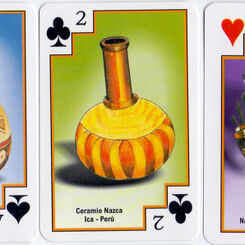
Líneas de Nazca
“Líneas de Nazca” souvenir playing cards, Peru, c.2008.

Litográfica del Perú
Litográfica del Perú S.A. were manufacturers of playing cards in Peru sometime around the decades of...

Vistas del Perú, c.1920s
Vistas del Perú souvenir deck, made in USA and imported by Edw. E. Muecke, Lima, Peru, c.1920s.

Fenno, Peru
Fenno souvenir playing cards, made in Peru.
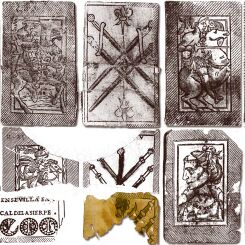
16th century cards discovered in Peru
Fragments of playing cards and 2 dice were unearthed in a 16th century rubbish tip adjacent to a Spa...

El Reloj card game by Imprenta Lecaros
“El Reloj” card game by Imprenta Lecaros, Lima, Peru, c.1920.
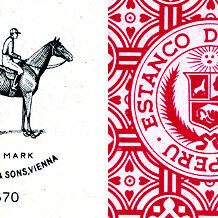
Piatnik & Sons for the“Estanco de Naipes del Perú”
Playing Cards made by Piatnik & Sons for the“Estanco de Naipes del Perú”, c.1960.
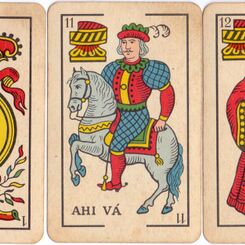
Cards for export to Peru by Heraclio Fournier
'El Caballo' brand (No.5P) playing-cards manufactured in Spain by Heraclio Fournier S.A. especially ...
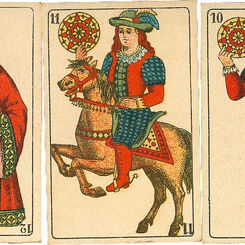
Cigarrillos Compadre, Peru, early 1900s
Spanish-suited playing cards for Cigarrillos Compadre, Peru, early 1900s

Spanish-suited deck for the Estanco de Naipes del Perú
Spanish-suited playing cards printed for the Estanco de Naipes del Perú.

Coca~Cola themed pack for Ripley department store, Peru
Coca-Cola themed deck produced for Ripley Department Store, Peru, anonymous manufacturer, c.2000.

Peruvian Souvenir Playing Cards
Assorted scenes from Peruvian landscape, architecture and culture published by Jan Mer S.A.C., c.200...

Pavias Playing Cards made in Peru
Pavias playing cards made in Peru, c.1990.

OBD Playing Cards made in Peru
Spanish-suited playing cards printed by OBD, S.A., Lima, Peru, 1976.

Naipes y Casinos Industria Peruana
Naipes Tipo Español “Naipes y Casinos” Industria Peruana.

Naipe Peruano
Peruvian costumes playing cards.

Laboratorios Magma, S.A.
Publicity playing cards manufactured for Laboratorios Magma, S.A., Lima, Peru, c.1990.

Disney playing cards from Peru
Disney playing cards from Peru.
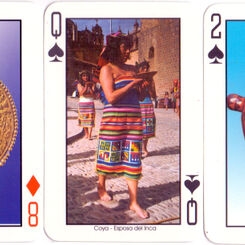
Cusco Inca Souvenir
Pre-Incas & Incas Souvenir Playing Cards, Cusco, Peru, 2000.
Most Popular
Our top articles from the past 60 days