



Simeon Durá 1871-1940
Simeon Durá of Valencia was one of Spain's most distinguished playing card manufacturers, flourishing between 1871-c.1940.
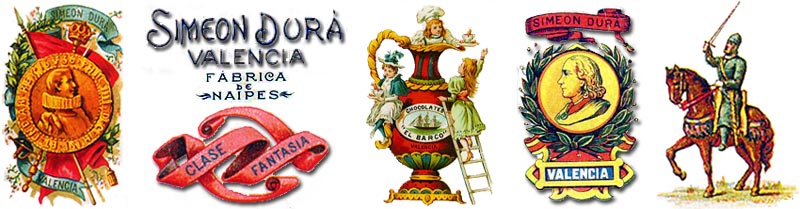
Simeon Durá of Valencia was one of Spain's most distinguished playing card manufacturers, flourishing between 1871-c.1940. In the same league as Naipes Comas (Barcelona) and Heraclio Fournier (Vitoria), it is believed that Simeon Durá learnt his trade whilst serving as an apprentice with Manáut Hermanos, another playing-card manufacturer located in Valencia. When Manáut Hermanos ceased trading in 1871, Simeon Durá opened his first playing card factory just around the corner, in calle San Vicente 116. Soon afterwards his address changed to Guillem de Castro 130, Valencia. By around 1890 Durá had completed an extensive new factory in Arrancapinos No.29 (renamed Angel Guimerá in c.1930).
Durá's early production followed the same designs which had been used by his predecessors Manáut Hermanos but soon afterwards he commissioned artist E. Pastor to create a range of new, distinctive designs. At the same time Durá acquired modern lithographic printing equipment enabling him to compete effectively with other leading players in the market, and to produce his impressive range of highly artistic designs in high quality.
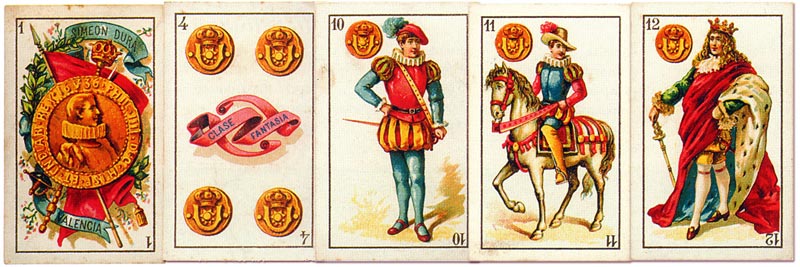
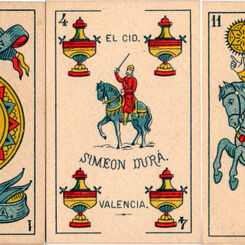
Above: Simeon Durá's 'El Cid' fantasy Spanish-suited playing cards, designed by E. Pastor, c.1875. These were the first in a series of outstanding designs which Simeon Durá developed over the years to replace those of Manáut Hermanos and to raise his status amongst the public. (Click image to see more).

Above: Simeon Durá's illuminated playing cards for Chocolates 'El Barco' designed by E. Pastor, c.1890. (Click image to see more).

Above: naipes de "Don Quijote" by E. Pastor, printed by Litografía S. Martínez, c.1930. A facsimile edition was published by Heraclio Fournier in 1981 here►
Simeon Durá is known to have exported playing cards to Latin American countries including Argentina, Chile, Cuba, Ecuador, Peru, Puerto Rico and Uruguay, as well as The Philippines. The range of playing cards included fantasy designs as well as standard Spanish National, Catalan and Cadiz-style cards for these markets, including specially printed editions for The Estanco de Naipes del Perú, M. Dominguez y Cía of Valparaiso (Chile) and other overseas customers. Durá also produced Anglo-American style 'poker' playing cards with a very elaborate ace of spades and the brand name 'Fortuna', in various qualities, as well as children's packs, advertising packs, Bézique sets, French Baccarat packs and a special 74-card set of 'roulette' cards.
The imposition in 1904 of tax on playing cards by the Spanish government was a severe setback for playing-card manufacturers, and prices almost doubled as a result. This situation encouraged Simeon Durá to diversify and to undertake various other general printing jobs including posters, picture cards, relief prints and boxes. The bullfighting pack (shown below) was produced during this era.

Above: Simeon Durá's 'Baraja Taurina' was in print from 1916 until the 1930s. It was printed with either square or rounded corners and with various backs, including advertisements for Chocolates Angelical, Barcelona, featuring bullfighter photos on the reverse more →
In c.1931 the company name changed to Hijos de Simeon Durá. However, the Spanish civil war adversely affected the company's fortunes from which it never fully recovered and playing-card production was finally abandoned in the early 1950s. The company continued as a general printer until 1970.

By Simon Wintle
Spain • Member since February 01, 1996
I am the founder of The World of Playing Cards (est. 1996), a website dedicated to the history, artistry and cultural significance of playing cards and tarot. Over the years I have researched various areas of the subject, acquired and traded collections and contributed as a committee member of the IPCS and graphics editor of The Playing-Card journal. Having lived in Chile, England, Wales, and now Spain, these experiences have shaped my work and passion for playing cards. Amongst my achievements is producing a limited-edition replica of a 17th-century English pack using woodblocks and stencils—a labour of love. Today, the World of Playing Cards is a global collaborative project, with my son Adam serving as the technical driving force behind its development. His innovative efforts have helped shape the site into the thriving hub it is today. You are warmly invited to become a contributor and share your enthusiasm.

Activity for Simeon Durá 1871-1940
Sign in to comment or save this article.

Related Articles
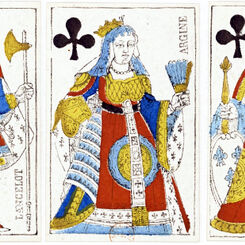
Bertschinger y Codina - Cartes Françaises
French ‘Paris’ pattern made by Bertschinger y Codina, Barcelona, c.1850.
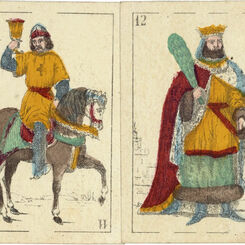
Vicente Gombau y Labad
Elegant fantasy designs by Vicente Gombau y Labad (Madrid), 1861.
Toledo, 1584
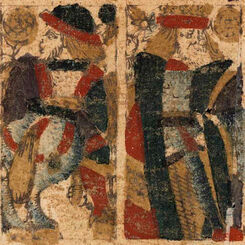
Archaic Spanish-suited deck with 48 cards made in Toledo in 1584.
Navarra Pattern, 1682
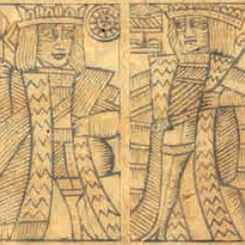
Navarra pattern produced for the Pamplona General Hospital Monopoly in 1682.
Navarra Pattern
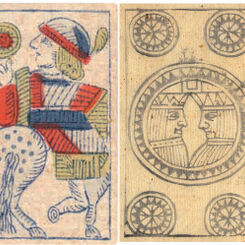
Navarra Pattern produced for the Pamplona General Hospital Monopoly.

Cádiz Pattern playing cards
A popular Spanish playing card pattern widely exported to Spanish-influenced markets.
‘El Cid’ by Simeon Durá, Valencia, Spain
‘El Cid’ playing cards manufactured by Simeon Durá, Valencia, Spain.
Heráldica Castanyer
Spanish Catalan pattern No.6 by Heráldica Castanyer, Sabadell (Barcelona), c.1980.
Pedro Rotxotxo
Standard Spanish National pattern by Pedro Rotxotxo, Barcelona, late 18th century.
Xilografías de Mallorca
Spanish National pattern re-printed from original woodblocks which are preserved in the monastery at...

Maciá Pattern
The Maciá Pattern which was originally produced by a Barcelona cardmaker in the 1830s and subsequent...

S. Giráldez, Barcelona
Standard Spanish Catalan pattern playing cards by S. Giráldez, Barcelona, c.1905.

Sanmartí, 1840
Sanmartí, 1840.
Heraclio Fournier S.A.
Founded in 1868, today it is part of Cartamundi.
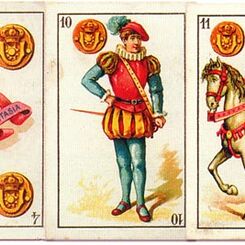
‘El Cid’ designed by E. Pastor, Valencia, Spain, c.1875
‘El Cid’ fantasy playing cards designed by E. Pastor, Valencia, Spain, c.1875.
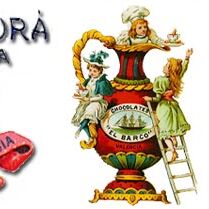
El Barco
El Barco playing cards designed by E. Pastor, Valencia, Spain, c.1895

Fagoaga y Compañía (Casa Bertrand Domec), Buenos Aires, c.1970
Playing Cards Imported into Argentina by Fagoaga y Compañía (Casa Bertrand Domec), Buenos Aires, c.1...

Spanish Playing Cards ~ La Baraja Española
Spain has played a pivotal role in the history of playing cards in Europe and Latin America.

Baraja Boxeo
Baraja de Boxeo, c.1930.

Baraja Artistas del Cine Mudo
Baraja Artistas del Cine Mudo, c.1926.
Most Popular
Our top articles from the past 60 days


