




Francisco Flores
Playing cards in this style have been discovered in various parts of the world, suggesting that they were exported or carried there by early explorers or merchants.
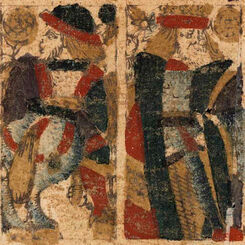
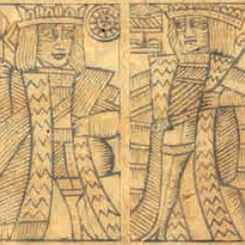
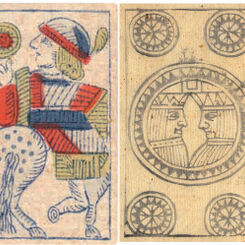
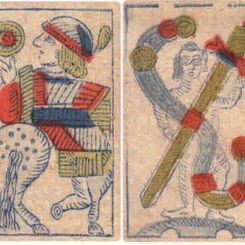
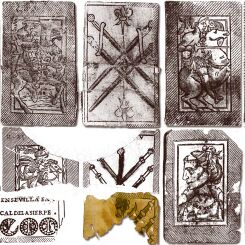
This example of so-called "Dragon" cards was printed by Francisco Flores in Spain sometime around the mid-sixteenth century. There are several interesting features to be noted. The four aces depict fearsome monsters or "dragons" with long tails and wings, holding their respective suit symbol in their mouths. The kings are seated on thrones in the Italian style, the knights are on horseback and the maids (or valets) are female, a characteristic seen in other early Spanish packs. The suit symbols of swords, coins, cups and batons are in an archaic style with straight, overlapping swords and batons. Many of these features are echoed in other early examples of playing cards from Spain and Italy, including in many cases the 'turned over' edges where the back paper is folded around the edges of the cards to produce a margin around the fronts (see image below).
Spain’s First Exportation pattern?
Playing cards in this style have been discovered in various parts of the world, suggesting that they were exported or carried there by early explorers or merchants. For example, cards derived from this style have been found in Japan, believed to have been carried there by Portuguese explorers. Similarly, cards of this type have been discovered in an old house in Antwerp. Another exciting discovery has been made in an archaeological excavation in Peru which suggests that these cards may also have been a prototype for the earliest cards used in Spanish colonies in the Americas, from Mexico down to Peru… perhaps the first 'exportation' pattern. The pattern has virtually died out today, although it survived into the nineteenth century when it was produced by Belgian manufacturers for export to Brazil.


Above: hand-made facsimile of cards printed by Francisco Flores (using the originals shown below).

Above: detail from one of the uncut sheets of archaic sixteenth century Spanish playing cards by Francisco Flores, preserved in the Archivo de Indias, Seville.
A set of three uncut sheets of these playing cards is currently preserved in the Archivo de Indias, Seville (Spain) along with a sheet of back designs depicting Mexican, mythological and Italianate 'grotesque' themes (shown below) and the original dossier and contract granted to Alonso Martinez de Orteguilla to supply playing cards to 'New Spain' (i.e. Mexico, as well as Nicaragua, Guatemala and Honduras) in 1583. These documents can be downloaded digitally from the Ministerio de Cultura website for private study, and samples of the playing cards are shown here for review purposes. The back designs do not necessarily belong to the cards printed by Francisco Flores, but have been placed in the same archive. The mock-ups shown here illustrate what the cards may have looked like in the sixteenth century. This artisan method of card production is more time-consuming than normal two or three-ply cards, but the resulting cards are very sturdy. The cards resemble very closely those discovered in the Lower Rimac Valley excavations in Peru which had been imported from Seville (Spain) in the sixteenth century. It appears that each card would have a different back design; perhaps the visual enjoyment of the allegorical imagery outweighed the disadvantage of the possibility of identifying cards from their backs.

Above: part of a printed sheet of 18 allegorical images which are preserved in the same archive as the playing cards by Francisco Flores. The entire sheet measures 41 x 27.8 cm and each image 6.8 x 9.2 cm. These images, based on contemporary European or Mexican moral allegories executed in the fashionable style of the German Renaissance, are an excellent medium for the dissemination of ideas and thought. They may indeed have served as back papers for sixteenth century playing cards, bringing exotic mysteries into the card playing salon or gambling den...
A note on the dragons: the 'dragons' or winged serpents depicted on the 4 aces have led many researchers to exotic conclusions regarding their symbolism and possible significance on these cards. The appearance of the serpent and the dragon is so widespread and of such great antiquity that attempts to locate a single origin seem unlikely to meet with very much success. The symbolic serpent is a common feature of the mythologies of the Near East and of India; it persisted throughout the early and later Mystery Religions of Greece and Rome and is also encountered in the literature of early Christianity and of Gnosticism. In the middle ages the dragon was adopted as a heraldic motif and also as a symbol for Wales! It's presence on these cards may reflect the indomitable, outward-bound, sea-faring spirit of adventure of the Spaniards at this time, just after their 'discovery' and subsequent colonisation of the Americas. Indeed cards of this type, having appeared in diverse locations around the globe, may represent Spain's first exportation pattern.

By Simon Wintle
Spain • Member since February 01, 1996
I am the founder of The World of Playing Cards (est. 1996), a website dedicated to the history, artistry and cultural significance of playing cards and tarot. Over the years I have researched various areas of the subject, acquired and traded collections and contributed as a committee member of the IPCS and graphics editor of The Playing-Card journal. Having lived in Chile, England, Wales, and now Spain, these experiences have shaped my work and passion for playing cards. Amongst my achievements is producing a limited-edition replica of a 17th-century English pack using woodblocks and stencils—a labour of love. Today, the World of Playing Cards is a global collaborative project, with my son Adam serving as the technical driving force behind its development. His innovative efforts have helped shape the site into the thriving hub it is today. You are warmly invited to become a contributor and share your enthusiasm.

Activity for Francisco Flores
Sign in to comment or save this article.
Related Articles
Bertschinger y Codina - Cartes Françaises
French ‘Paris’ pattern made by Bertschinger y Codina, Barcelona, c.1850.
Vicente Gombau y Labad
Elegant fantasy designs by Vicente Gombau y Labad (Madrid), 1861.
Llombart pattern
The Llombart pattern originated in Spain during the early 19th century.
Toledo, 1584
Archaic Spanish-suited deck with 48 cards made in Toledo in 1584.
Navarra Pattern, 1682
Navarra pattern produced for the Pamplona General Hospital Monopoly in 1682.
Navarra Pattern
Navarra Pattern produced for the Pamplona General Hospital Monopoly.
Navarra Pattern, 1793
Navarra pattern by an unknown cardmaker with initials I. I., 1793.

Cádiz Pattern playing cards
A popular Spanish playing card pattern widely exported to Spanish-influenced markets.
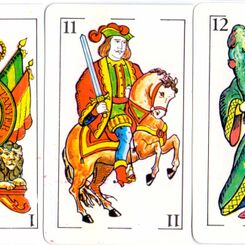
Heráldica Castanyer
Spanish Catalan pattern No.6 by Heráldica Castanyer, Sabadell (Barcelona), c.1980.
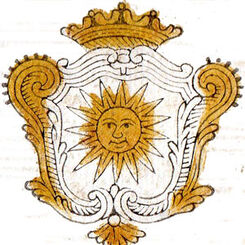
Pedro Rotxotxo
Standard Spanish National pattern by Pedro Rotxotxo, Barcelona, late 18th century.
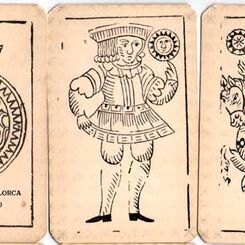
Xilografías de Mallorca
Spanish National pattern re-printed from original woodblocks which are preserved in the monastery at...

Maciá Pattern
The Maciá Pattern which was originally produced by a Barcelona cardmaker in the 1830s and subsequent...

S. Giráldez, Barcelona
Standard Spanish Catalan pattern playing cards by S. Giráldez, Barcelona, c.1905.

Sanmartí, 1840
Sanmartí, 1840.
Heraclio Fournier S.A.
Founded in 1868, today it is part of Cartamundi.
16th century cards discovered in Peru
Fragments of playing cards and 2 dice were unearthed in a 16th century rubbish tip adjacent to a Spa...

Fagoaga y Compañía (Casa Bertrand Domec), Buenos Aires, c.1970
Playing Cards Imported into Argentina by Fagoaga y Compañía (Casa Bertrand Domec), Buenos Aires, c.1...

Spanish Playing Cards ~ La Baraja Española
Spain has played a pivotal role in the history of playing cards in Europe and Latin America.

Baraja Boxeo
Baraja de Boxeo, c.1930.

Baraja Artistas del Cine Mudo
Baraja Artistas del Cine Mudo, c.1926.
Most Popular
Our top articles from the past 60 days


Tania Román Peillet
24 June 2023, 05:52Hello! I am a master’s degree student in Art History at the Universidad Nacional Autónoma de México (UNAM), and my master’s thesis is on the "Dragon" cards printed by Francisco Flores and I found the contributions on this subject very interesting and useful. My hypothesis is that the sheet of back designs belongs to the dragon cards of Francisco Flores that accompany it in the AGI and that could be used several different back designs in a single deck of cards, but I would like to know your opinion and if you know where I can find more examples of sixteenth century diferents back designs in the same deck that the ones discovered in the Lower Rimac Valley in Perú. I would be very grateful, I hope to contribute in the future with some publication for your website.
Alannyë Daeris
19 November 2025, 09:47SavedSaved this article to Decks Históricos