



Kimberley
Kimberley’s Royal National Patriotic playing cards, c.1892-1905.
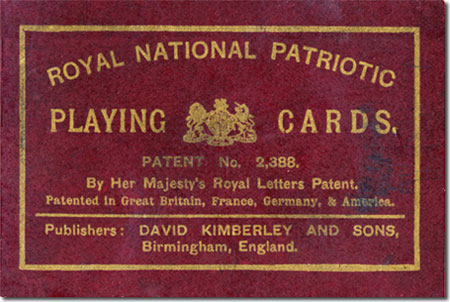
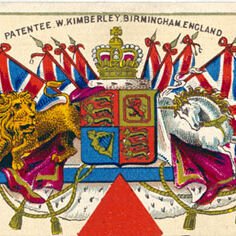
Above: detail from one of the two-part sliding boxes. David Kimberley & Sons, who published the cards, were not previously printers or publishers but manufacturers of carpenters' saws and planes in Birmingham at that time.
Kimberley’s Royal National Patriotic playing cards, c.1892-1905.
“They differ from ordinary cards in having combined with each suit a special distinct nationality of style and appearance. Instead of the ordinary Ace card, I make an Ace which exhibits an illustration of the representative flag of that suit's nationality. Instead of the normal King, Queen and Knave I propose to place a good portrait of the rulers or representatives of the countries indicated...”
Kimberley’s “National Patriotic” playing cards represent four nations: Diamonds represent England, Hearts represent America, Spades represent France and Clubs represent Germany. The Ace card of each suit represents the ‘Royal Standard’ or flag of each Nation. For England (Diamonds) the Union Jack; for America (Hearts) the Stars and Stripes; for France (Spades) the National Colours and for Germany (Clubs) their Royal Standard. Courts represent contemporary and past royalty. The backs usually show an array of clocks in various colours.
The First Edition c.1892-93
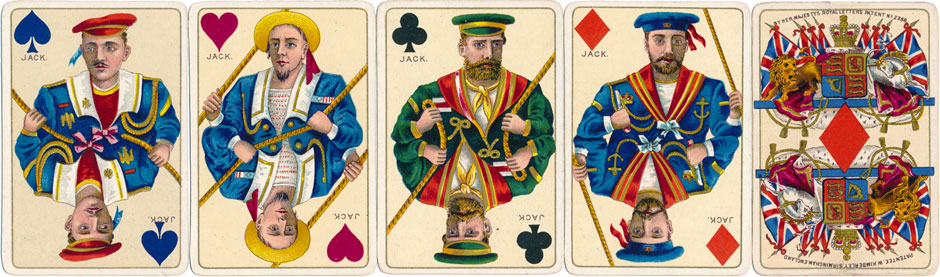
Above: Kimberley's Royal National Patriotic playing cards, first edition c.1892-3. The court cards are richly coloured and incorporate gold see more →
The numerals follow a scheme proposed by Kimberley in his patent application of 1892: a large suit-sign occupies the centre of the card, with the numeric value voided in it twice. The pack has non-standard aces, non-standard courts, non-standard colours for pips (spades are blue, hearts maroon) and the pips on the numeral cards occupy almost the entire card.
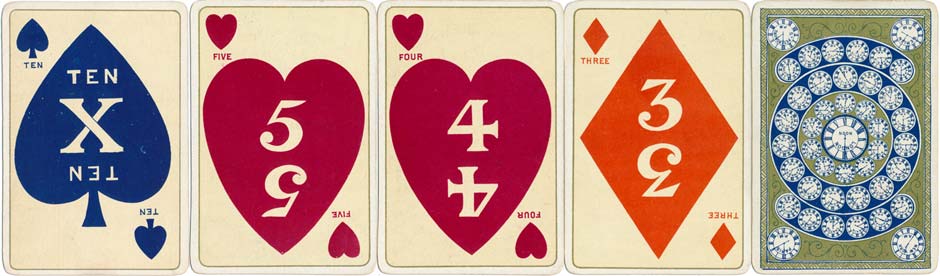
Above: numeral cards from Kimberley's Royal National Patriotic playing cards, first edition c.1892-3. This is the only version with giant suit marks on cards 2 to 10; subsequent editions had conventional suit marks see more →
The cards bear no advertising, nor is there any indication that the cards were intended for commemorative purposes. The fact that they ran into at least five distinct editions suggests they were popular during their ten or twelve years of production, i.e. c.1892-c.1905.
The Second Edition c.1893-97
The court cards and Aces are the same in the first and second editions. Only the numeral cards differ.
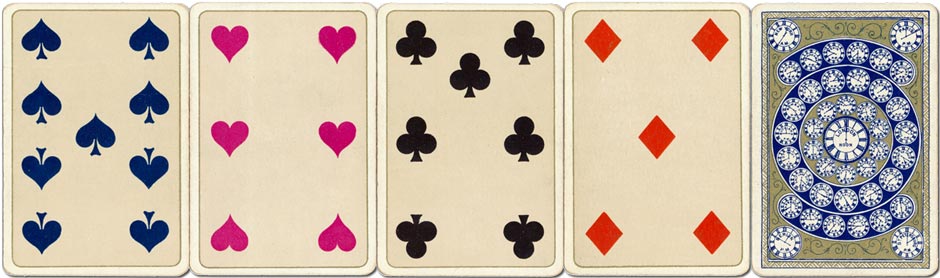
Above: numeral cards from Kimberley's Royal National Patriotic playing cards, second edition c.1893-97. The numeral cards have conventional suit sign sizes and arrangement.
• Bibliothèque nationale de France: Jeu de cartes anglais "patriotique, royal et national"►
The Fourth Edition c.1899-1901
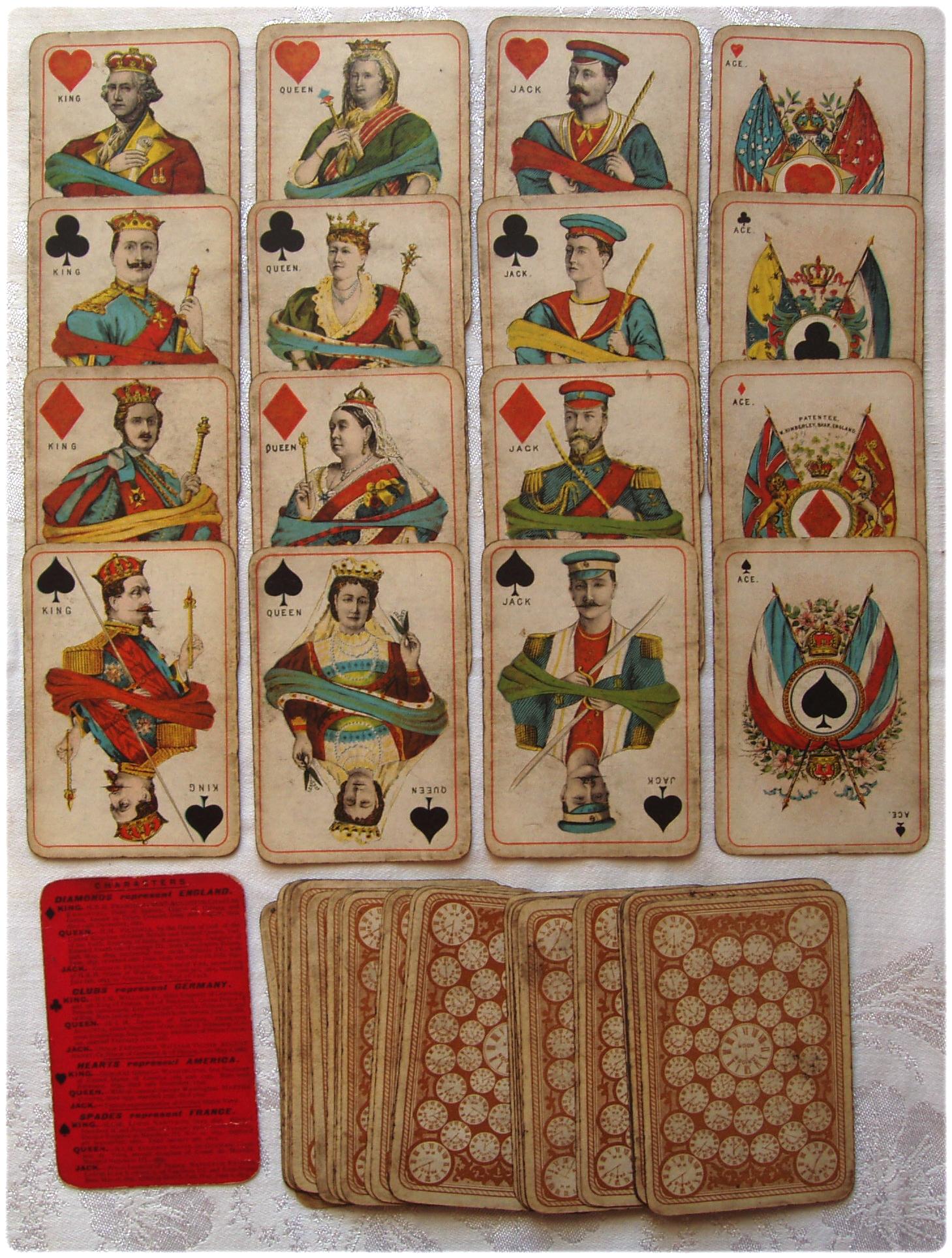
Above: Kimberley's Royal National Patriotic playing cards from the fourth edition published c.1899-1901. The Jack of Hearts is a typical representative from the U.S. Navy of the time. The King of Clubs shows Kaiser Wilhelm II. Unlike the first edition which was printed in luxurious colour lithography including gold, the designs here are rendered by means of fine outlines, stipple printed in black, with areas of mainly flat colour. The back design in this edition features a clock design ~ click image to zoom ~ and the set has an additional red descriptive card.
The Fifth Edition c.1902-05
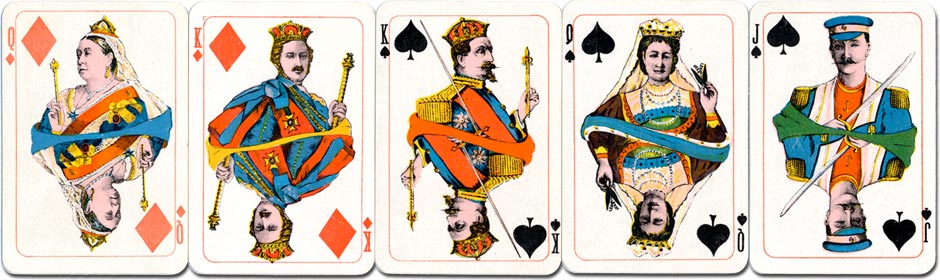
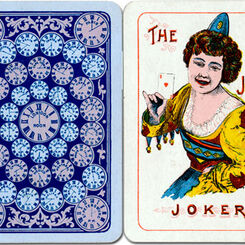
Above: Kimberley's Royal National Patriotic playing cards from the fifth edition published during c.1902-5 with conventional corner indices. This edition also contained a Joker depicting a lady holding a card. The differences between the different editions in quality and method of printing suggest different printers were involved. See more →
NOTE: there is really not a great deal of difference between 'editions' and 'types', and certainly no strictly defined difference. Obviously every time there is a change in the design of the cards, it is a new edition, except maybe for the backs. One edition may be released with several different coloured backs. There might be minor differences in design, but if they are similar I think they could be considered the same type. Large differences could certainly be considered as a new type. There must be at least 20 different versions. For major changes though there would be just 5. The first edition with the very large numeral cards lasted only months before being withdrawn. There are only 2 packs known to exist today. The second edition courts were unchanged from the first edition. Only the numeral cards, A to 10, were radically changed. The third edition Aces show the 'cloud background', and the courts, whilst the same basic design, have a white background and are more crudely drawn. This could certainly be considered Type "B". The fourth edition Aces have totally new flags and court figures. The fifth edition introduces A K Q J etc to all cards, and the court colours are changed. There are also other fifth versions with the courts having differing width centre bands and colours. There are also numerous different coloured clock faces card backs for all but the first version, as well as a fair number of totally different backs as well. I am fortunate to have 13 of these packs !
REFERENCES
Denning, Trevor, "Kimberley's Royal National Patriotic Playing Cards" in the Newsletter, EPCS May 1984, pp.6-7.
All images on this page from the collection of Barney Townshend.

By Barney Townshend
United Kingdom • Member since October 06, 2015
Retired Airline Pilot, interested in: Transformation Playing Cards, Karl Gerich and Elaine Lewis. Secretary of the EPCS. Treasurer of the IPCS.

Activity for Kimberley
Sign in to comment or save this article.

Related Articles
Fortune-Telling Cards
Comic Fortune-Telling Cards published by Reynolds & Sons, c.1850.
Comic Question & Answer cards
Comic Question & Answer cards by Josh. Reynolds & Sons, circa 1850.
Thomas Walters Transformation
Hand-drawn transformation pack dated 1874 with the name Thomas Walters on the ace of spades.
Hand-Painted Transformation, c.1800-20
An early 19th century set of hand-painted transformation playing cards depicting contemporary scenes...
Transformation c.1880
Transformation playing cards hand-drawn on a pack manufactured by Hunt’s Playing Card Manufacturing ...
Kimberley 1892
William Kimberley applied for a patent in respect of his improved playing cards in February 1892 and...
Kimberley’s Royal National Patriotic playing cards, c.1902
This edition has standard corner indices replacing the words King, Queen and Jack, and also contains...
Paramount Film Stars
Promotional playing cards for the Paramount film company with film stars on the court cards.

J.L. & J. Turnbull
An ‘Old Frizzle’ Ace of Spades was assigned to them in 1833. In 1853 James L. & J. Turnbull were lis...

Pickwick
A series of fifty-five original designs (including frontispiece, back and Joker) for a Pickwick pack...

EPCS Transformation
The English Playing Card Society's 10th Anniversary Transformation Playing Cards designed and produc...

Ganesh
Karl's ‘Ganesh’ pack has the four Aces with the suit sign in a circle decorated with flowers and dou...

Trappola Française v.1
Inspired by Piatnik's ‘Trappola’ of c.1890, with double-ended courts, a Jester and decorated Aces, t...

Karl Gerich No.26
Variations on the standard English pattern are one of Karl's favourite themes. He produced several v...

Karl Gerich No.28
Double-ended courts based on standard English pattern but with variant colours; double-ended Joker p...

Karl Gerich No.19
An unpublished design by Karl Gerich showing 12 court cards, a Joker and two additional cards produc...

No.6 Austrian
This early Gerich work is an adaptation of the English pattern with continental stylisation. The dou...

No.10 - Four Corners
Karl Gerich was a great admirer of playing cards produced by B. Dondorf and his tenth pack was inspi...
Deakin’s 1st edition
Deakin & Co., 45 Eastcheap, London EC published a political pack in 1886 with caricatures of politic...

De La Rue Continental
During the latter part of the nineteenth century De La Rue produced two special packs of cards for t...
Most Popular
Our top articles from the past 60 days


