


Masken Costume Tarock
A fashionable deck of tarock cards by Joseph Glanz.
One of the luxury products produced by Joseph Glanz’s Viennese company was the Masken Costume Tarock. It offered a deck of tarock cards that could also serve as inspiration for choosing costumes for the ball season. It was aimed at the ladies’ salons of the upper middle classes. The exceptionally delicate engraving and detailed stencil colouring, including subtle pastel shades, are indicative of the company’s premium product.
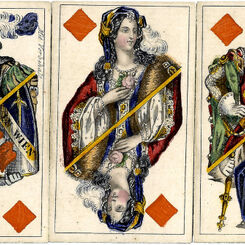
The court cards, as well as the Pagat (Tarock I) and the Skies (the card featuring a clown/Pierrot with no further designation) cards, are identical in the Masken Costume Tarock to those in the Nationality Tarock deck, which Glanz published at the same time. The medallion of the Knight of Clubs retains J. Sürch’s signature and the date ‘Wien 863’. The appearance of these cards makes it clear that they were originally intended for the Nationality Tarock. (A similar situation involving the secondary use of some of the engravings for a different themed deck is also evident in Glanz’s Militar-Tarock No. 38 ►

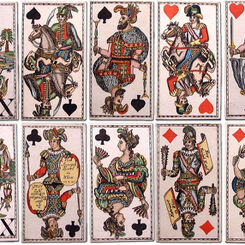
The court cards do not reflect the costume theme at all; moreover, they clearly indicate the affiliation of the major countries that made up the Austro-Hungarian Empire at the time. The Jack of Spades bears the coat of arms of the Kingdom of Bohemia on his chest. The diamond court cards clearly represent Hungary. The figures are dressed in traditional attire; the Jack’s cap bears the Hungarian coat of arms, and the King wears a crown similar to the Hungarian Royal Crown of St Stephen, though here without the characteristic slanted cross. The King of Hearts is adorned with a black double-headed eagle on a yellow background – the symbol of the Austrian Empire. The crown on the king’s head corresponds to the appearance of the imperial crown of the Holy Roman Empire.
The remaining tarock cards depict ladies and boyish-looking men in colourful carnival costumes, mostly individually, though on a few cards they also appear as couples. The illustrations are single-figure depictions that take up the entire surface of the card. Each example of a costume is accompanied by its French (fashion) name.


Masken Costume Tarock with designs by Joseph Sürch, produced by Joseph Glanz, Vienna, 1865. 54 cards. It is difficult to assess today to what extent the product influenced the carnival fashion of the time. The ‘Hazardeuse’ themed costume is worn by the girl in Tarock XIV. The hat resembles a dice, there are dominoes on the collar, and the skirt features playing card symbols and a chequerboard pattern. Tarock No. XIII depicts the traditional character of the Paris Carnival, the ‘Débardeur’. The costume of the girl in trousers also carried feminist connotations. However, the appearance – particularly that of the male costumes – could also have served as inspiration for post-punk and New Romantic musicians. Who, at that time, would not have wanted to look like the ‘Postillon d’amour’ (Messenger of Love) on Tarock card VI?.
The popularity of this thematic design for tarock cards is evidenced by three further well-known editions from the period 1880–1900, in which the changes are minimal. The final edition, from 1914, was produced under the name of Ferd. Piatnik & Sons, the company that had taken over from the original manufacturer.
This example also illustrates what kind of fragment might emerge from some forgotten place after 160 years. Some of the cards are missing; I have added the Pagat and the Skies from another deck for illustrative purposes. I can imagine the sense of wonder these cards must have evoked in a child who found them tucked away in a drawer of their grandmother’s desk.
Sources
Klaus Reisinger : Tarocke. Cultural History in Cards, Volume II, pp. 377–393
WWPCM : Costume Tarock ►
Wikipedia : Austrian Crown Jewels ►
By Marek Brejcha
Czech Republic • Member since June 13, 2024
My relationship with cards grew from playing to collecting and transformed into publishing as well. I am part of the team at Counter Clockwise, a small company that publishes traditional card games. I'm member of the Czech Playing Card Collectors' Club (Club sběratelů hracích karet z.s.).

Activity for Masken Costume Tarock
Sign in to comment or save this article.

Related Articles

Georgia
Souvenir playing cards from Georgia feature eight landmark views on the aces and Georgian national c...
Militar-Tarock No. 38
Non-standard tarock cards combining theatrical and military themes by Joseph Glanz.
Julius Berndl and his Austrian tarock
Josef Glanz's Tarock: a classic deck with artistic innovation by Julius Berndl.
Gigerl-Tarock by Joseph Glanz
Urban Dandy caricature deck from 19th century Vienna designed by Julius Berndl.
Patience by Joseph Glanz
A refined and distinctly European Patience pack by Joseph Glanz from Austria.
Tarock Nr. 71 by Ferd. Piatnik & Söhne
Special tarock deck for the Tyrolean game Droggn.
Animal Tarock by J. G. Pichler
Baroque tarock cards from the late 18th century.
Johann Nejedly Tarok Cards
Johann Nejedly, a 19th-century Viennese card maker, produced Tarock cards featuring modern scenes th...
Joseph Sürch, Engraver
Joseph Sürch, a prominent Viennese engraver, made significant contributions to card sheet engraving ...
Double-ended German-suited pack by Josef Glanz, Vienna.
From the British Museum collection.
Trappola pack by Joseph Glanz
Double-ended Trappola pack by Joseph Glanz, Vienna, late 19th century.
Jugendstil Tarock
‘Jugendstil Tarock’ was designed by Ditha Moser and first published by Albert Berger and Josef Glanz...
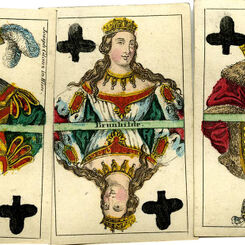
J. Glanz Historical playing cards
Historical Theatrical playing cards manufactured by J. Glanz, c.1860.
Mythological Tarock by Johann Herrl
French-suited Tarock deck made by Johann Herrl in Graz 1815.
Piatnik Tarock
Deck of "Industrie und Glück" or "Rural Scenes" tarock cards manufactured by Ferd Piatnik & Söhne, V...
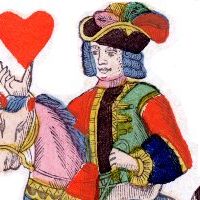
Tarock Cards
The earliest Tarot decks originated in Italy in the fifteenth century, with Italian suit symbols. Ho...
Estel Tarok
J. Estel Tarok, 1820.
Pittner Tarok
Ferd Pittner, Tarok Cards
Joseph Glanz, 1862
Playing cards depicting Turkish and Greek rulers manufactured by Joseph Glanz, Vienna, Austria, 1862...
Adametz, Vienna
Cards from a 54-card "Austrian Tarock" or "Industrie und Glück Tarock" pack made by Franz Adametz of...
Most Popular
Our top articles from the past 60 days


