


Something New and Topical
In the December 2010 issue of CTD, our editor, Judy Dawson, indicated her appreciation for articles that are “new and topical”. In that spirit, or perhaps I should say under cover of that invitation, I shall risk extolling the virtues of yet another facsimile deck but this one, I am confident, will surely find wide appeal amongst the membership. Let me set the stage.
In 1918, Piatnik of Austria published a deck titled Soldaten Tarock. It was a propaganda deck emphasizing Germany’s successes in World War I that was waged from August 1, 1914 to November 18, 1918. It must have been a last gasp effort to boost morale because Germany lost the war in the very year that this deck was published. The original 1918 deck is extremely rare and when Stuart Kaplan, the proprietor of U.S. Games, Inc. and author of the three volume Encyclopedia of Tarot, auctioned his playing card collection, an original of this deck in “slightly worn” condition sold at Christie’s, New York on June 21, 2006 for $1,680.00!
The deck appeals to card collectors and to those interested in military history. The twenty-one numbered major tarot cards are all dedicated to battlefield scenes, military camp life, air and sea encounters and a few German military commanders. Of particular interest is Tarot XXI that pictures a German submarine sailing victoriously into New York Harbor with the German flag flying over the Stars and Stripes of the United States of America! That single card, all by itself, makes the deck an outstanding collectible item. The deck is French-suited and the court cards are representational.
Piatnik has just re-issued the deck and except for a couple of minor differences that I will describe, it is just about identical to the original. As I have often pointed out in previous articles dealing with facsimiles, they are usually easily distinguished from the originals by either having different back designs and/or being larger or smaller. In this case, the back design is the same as the original, having an overall pattern with a center monogram of the German Iron Cross and the Latin motto Vita et Sangvinem (With Life and Blood”). The size is also the same as the original. The differences, such as they are, would be discernable as the original deck was produced by the chromolithographic process while the re-issue utilizes today’s modern printing methods. The only two other differences are found on the Ace of Hearts. The original carried a tax stamp, the re-issue does not but what it does carry in very small print is Piatnik’s website address! Slight as these differences are, they preserve the integrity of the original edition of the deck. The quality of the stock in the re-issue is excellent. I have no way of knowing what the stock was like for the original but I have Piatnik Tarock decks predating 1918 and the stock used is as excellent as this re-issue. Piatnik has always used the highest quality stock and I imagine that the original edition of this deck was no exception.
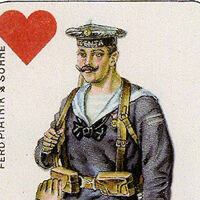
I mentioned that the court cards are representational. The Kings stand as follows: Diamonds - Germany; Hearts - Austria-Hungary; Spades - Turkey and Clubs - Bulgaria. The Queens represent women devoted to war related charity and social work as follows: Spades - a messenger of love; Hearts - a volunteer nurse; Clubs - a fashionably dressed woman collecting money for the wounded and Diamonds - a wealthy woman donating gold and jewelry to by iron for weapons. The Cavaliers represent mounted officers while the Jacks represent the various soldiers and sailors. Of course, the captions on the cards are all in German as is the explanation card included with the deck.
I am showing some of the Tarot cards including of course, number XXI, but the court cards are so beautifully colored that I am showing all of them subject to space constrictions that may be imposed by our good editor. Should she find it necessary to reduce the number of cards that can be shown, I will leave it to her good judgment to select those that can be shown. In either event, they should be viewed on the club website where they will be seen in full color.

Figure 1. King and Queen of Diamonds.

Figure 2. Cavalier and Jack of Hearts.

Figure 3. Cavalier and Jack of Diamonds.

Figure 4. King and Queen of Spades.

Figure 5. King and Queen of Hearts.

Figure 6. Cavalier and Jack of Spades.

Figure 7. King and Queen of Clubs.

Figure 8. Tarot XXI and Tarot XIII.

Figure 9. Cavalier and Jack of Clubs.

Figure 10. Tarot VII and Tarot XII.

Figure 11. Tarot II and Tarot XX.

Figure 12. Tarot XVI and Tarot X.
I know that I have carried on ad nauseum about facsimiles but I think that you will agree that this re-issue is particularly outstanding and will probably be sought after by most card collectors.
Editor’s Note; Thanks very much, Rod, How can I really thank you adequately for your wonderful articles. What a stunning deck and in such glorious colors! There seem to be shades of pink, mauve, orange, blue, green, brown, yellow, red, grey and variations of each. Check these out on the website.
Rod has a strong interest in the best-of-the best reproductions and as this one is so historical in its details, it would be a great one to add to any collection especially if war cards interest you. Note that the Queens have descriptive comments on each card but none of the male cards is named or described. It seems we women are becoming more important on playing cards and everywhere else!!
This article originally appeared in the March 2011 issue of ‘Clear the Decks’, the Newsletter for 52 Plus Joker, the American Playing Card Collector’s Club.

By Rod Starling (1936-2023)
United States • Member since January 09, 2013
Rod Starling was one of the founding members of the 52 Plus Joker card collectors club. He authored many articles for the club's quarterly newsletter, Clear the Decks. His collection encompasses both foreign and American decks. Rod also authored a book titled The Art and Pleasures of Playing Cards.

Activity for Something New and Topical
Sign in to comment or save this article.

Related Articles
Tarock Cards by Antonín Kratochvíl
Excerpt from the catalog of a prominent Prague workshop.
Tarock Nr. 71 by Ferd. Piatnik & Söhne
Special tarock deck for the Tyrolean game Droggn.

CCCP playing cards
Soviet and other Communist celebrities depicted on every card, designed by Vladislav Pankevitch.

Tell Wilmoś
Facsimile of ‘Wilhelm Tell’ Hungarian deck by Salamon Antal, Keczkemét, 1860.
Piatnik No.97
Non-standard French-suited cards published by Ferd Piatnik & Sõhne, Vienna, c.1940s.
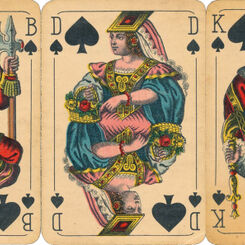
Vienna (ex-Lyon) pattern
‘Vienna pattern’ derived from archaic Lyon pattern by Ferd Piatnik & Söhne A.G., c.1926-1934.
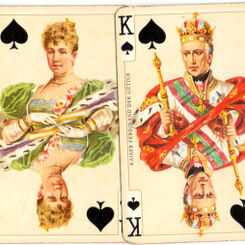
Kaiser Jubiläum
Kaiser Jubiläum Imperial playing cards made in Austria by Ferd Piatnik & Sons, Vienna.
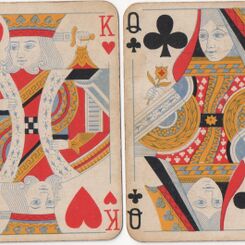
48: Ferdinand Piatnik & Sons
Ferd. Piatnik produced a very large range of cards with many different standard and non-standard pat...
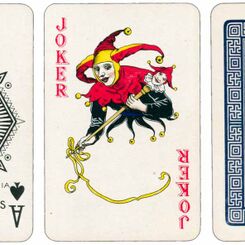
Popular No.257
Piatnik’s “Popular Playing Cards” No.257
Salzburger Pattern
Salzburger pattern by Ferd. Piatnik & Söhne, Vienna
Die Neue ÖVP
Promotional deck for the Austrian People’s Party (ÖVP) printed by Piatnik, 1996.
Tarok c.1900
Piatnik & Söhne “Industrie und Glück” Tarock c.1905-1910.
Vienna Melange
“Vienna Melange” Playing Cards by Piatnik with a historical feel representing the four races that ma...
Löschenkohl’s Musical Playing Cards
Johann Hieronymus Löschenkohl (1753-1807) produced a copper engraved deck of playing cards titled “D...
Soldaten Tarock
Piatnik was known for their magnificent quality of chromo-lithographic printing, and this facsimile,...
Ferd. Piatnik & Söhne
Ferdinand Piatnik was born in Ofen on October 14, 1819.
Piatnik Tarock
Deck of "Industrie und Glück" or "Rural Scenes" tarock cards manufactured by Ferd Piatnik & Söhne, V...

Tarock Cards
The earliest Tarot decks originated in Italy in the fifteenth century, with Italian suit symbols. Ho...
Hofamterspiel, c.1460
Hofamterspiel, c.1460
Most Popular
Our top articles from the past 60 days


