


Hoyle and his Legacy
Edmond Hoyle (1672-1769) was an English writer who made his name by writing on whist and a selection of other games.
Edmond Hoyle (1672-1769) was an English writer who made his name by writing what, at the time, were considered to be the definitive works on whist and a selection of other games. So influential were his writings that for many years Hoyle’s version of these games, and the rules by which they were played, were seen as the main authoritative source.

Above: Portrait of Edmond Hoyle (1672–1769), English writer on whist and other card games.
As a consequence, the phrase “according to Hoyle” entered the language, not just for games but to mean that something was being played “according to the generally accepted rules”.
Hoyle’s first contribution to the literature and practice of games came in 1742 with his “Short Treatise on the game of Whist. Containing the Laws of the Game; and also some Rules whereby a Beginner may, with due attention to them, attain to the Playing it well”. Below is the opening page of his third edition in 1743.
Printed alongside it is the title page of the same text printed in the same year but by a different printer for a different publisher. In this second version, the author is anonymous, “By a Gentleman”, although the purpose of this is unclear when Hoyle was more than happy to put his name to all of his other publications.

Above: Edmond Hoyle’s signed third edition of A Short Treatise on the Game of Whist, London, 1743, including his warning against pirated copies.

Above: An anonymous 1743 reprint of Hoyle’s Whist treatise, published under the description “By a Gentleman”.

Above: Hoyle’s eighth edition of his treatise on Piquet, also containing rules and observations for Chess, showing the expansion of his work beyond Whist.
This is thought to be the first recorded time that a writer offered not only a description of the game, and how it should be played, but also an analysis of the odds of particular card plays. The later editions, of which there were many, offered “great Additions to the Laws of the Game, and explanation of the Calculations which are necessary to be understood by those who play it well”.
As whist was primarily a gambling game, Hoyle’s unique analysis was read with great enthusiasm by gamblers and players across Britain and beyond.
Second, third and fourth editions were published in the following year which underlines the popularity of this work.
Jessel[1] describes these books as “the first attempt at a really scientific work on cards, and the author may be looked upon as the Father of any method of intelligent play applied to games of skill”. They were originally circulated as manuscripts, then printed and sold by the author at a guinea a copy. This was a high price indeed so it is not surprising that from the outset of Hoyle’s career his writings were pirated and sold at much reduced prices. This practice was to continue and although the price of his second edition was reduced to two shillings, and Hoyle had obtained injunctions against nine people for printing and selling pirated versions, it did little to undermine the black market for his work. In an attempt to limit the damage, all editions from the second to the 14th were signed by the author, and he applied the same principle to his equally influential writings on backgammon, Piquet, Quadrille and Chess.

Above: Hoyle’s eighth-edition treatise on Quadrille, another of the games covered in his original writings.

Above: Hoyle’s essay on improving the game of Chess, one of his original specialist works.

Above: Charles Jones’s 1779 edition of Hoyle’s Games Improved, an early expansion of the Hoyle name into a broad compendium of games.

Above: Charles Jones’s enlarged 1796 edition of Hoyle’s Games Improved, adding still more games and betting guidance.
However, from the 15th edition of his Treatise on Whist, he no longer signed them personally but by facsimile which, of course, was as easy for pirates to copy as the text.
Multiple editions of his various tracts followed until he produced his first Greatest Hits volume; “Mr Hoyle’s Treatises of Whist, Quadrille, Piquet, Chess and Backgammon” in 1748. His “The Accurate Gamester’s Companion” followed in the same year including all of the above, plus other writings on memory and odds, and the concept of a Games Compendium book, so much a feature of later years, was born.
Hoyle’s various writings were much pirated during his lifetime, but this was nothing when compared with the use of his name to promote games’ publications after his death. As early as 1775, collections of game rules and advice were published by others using the name of Hoyle as the authority, whether or not the original author was involved in any way in their production. [1] This practice continued throughout the next two centuries. The level of name recognition for Hoyle was second to none and any modern advertising exec would pay a fortune for a brand name of this quality and impact. Here are just a handful of examples. There are so many more. When reading what follows it is worth bearing in mind that, as far as I can discover, Hoyle only published works on the following six games: Whist (primarily from 1742), backgammon (1743), Chess (1744), Piquet (1744), Quadrille (1744) and Brag (1751).

Above: Charles Jones’s 1800 edition of Hoyle’s Games Improved, expanding the compendium with games such as Faro, Cribbage and an essay on game cocks.

Above: Charles Jones’s enlarged 1803 edition of Hoyle’s Games Improved, adding further games while retaining its promise of betting calculations.

Above: The 1808 Hoyle’s Games Improved as a Companion to the Card Table, concentrating on card games and omitting most non-card games.

Above: A substantial 1844 Philadelphia edition of Hoyle’s Games Improved, covering 41 games and showing how far the name had moved beyond Edmond Hoyle’s original works.
1779 1796 1800 1803 1808 1844 1863 1876 1880 1887 1897 1907 1914 1934 2023 (Kindle edition) This is a small sample of editions carrying the name Hoyle from 1779 to the present day. The name Hoyle is synonymous with descriptions of games and their attendant rules. Virtually every new edition carrying his name claims to be an improvement on or enlargement of previous volumes. They certainly included more games, many of which were not even invented when Hoyle was drafting his relatively small number of treatises. I have omitted a picture of a recent DVD of computer games also marketed under the name Hoyle!
The first 5 editions shown here, 1799 to 1808, were published in England and edited by Charles Jones Esq2. each claiming corrections, improvement or enlargement of the one before. All emphasise the inclusion of Calculations for Betting which was obviously a big selling point.

Above: George Frederick Pardon’s 1863 Hoyle’s Games Modernised, combining rules and playing advice with historical discussion of games.

Above: Thomas Frame’s 1876 American improved edition of Hoyle’s Games, another later work promoted through the Hoyle name.

Above: The Modern Pocket Hoyle, edited by “Trumps”, an 1880 pocket compendium of games of skill and chance.

Above: The Modern Hoyle, or How to Play, an 1887 guide bringing the Hoyle name to a more popular format.
The 1779 edition, “Hoyle’s Games Improved”, not only uses the name Hoyle to underline the authority of its contents but also adds “Laws of several games, as settled and agreed to at White’s and Stapleton’s chocolate houses”. This edition contains a number of games not included in Hoyle’s original writings: billiards cricket, draughts3, hazard, Lansquenet, tennis and Quinze. This was the start of the ever-expanding list of games for which the Hoyle name was invoked as a source of authority.
By 1796, Charles Jones “revised and corrected” earlier editions and added a further seven games to those published in 1779: Cassino, Connections, Cribbage, Faro, Goff or Golf, Matrimony and Rouge & Noir.
The 1800 edition adds an additional spelling of Faro (Pharo) and five new games: All Fours, Put, Reversis, Speculation and Vingt-un, plus “An Essay on Game Cocks”. Cock-fighting was a popular pastime in Britain in 1800 before it was outlawed along with bear-baiting and other, similar blood-sports in 1835.
Fox hunting was sadly not included in the list. In 1803 Charles Jones claimed that this edition was “considerably enlarged”. It had certainly had a considerable increase in price (from four shillings to five) but only four more games had been added: Commerce, Domino (singular), Loo and Lottery.

Above: R. F. Foster’s 1897 Hoyle: An Encyclopaedia of Indoor Games, beginning a long series of Foster editions.

Above: An early twentieth-century Hoyle’s Games Autograph Edition, continuing the commercial life of the Hoyle brand.

Above: R. F. Foster’s 1914 Foster’s Complete Hoyle, revised and enlarged to include the indoor games played at the time.

Above: A 1934 Hoyle’s Games Autograph Edition, showing the enduring use of the Hoyle name long after Edmond Hoyle’s death.
In 1808 Charles Jones published two different versions under the Hoyle name. The first, not pictured here, was an update on the 1803 version adding five more games to the list: Brag, EO, Loto, Pope, and Skittles4. This is the first appearance of Brag in these improvements on Hoyle, which is odd given that Brag was one of Hoyle’s original Treatises. A bound copy of this edition retailed at 6s. [2] 1779 but edited by Thomas Jones! [3] [4] In the same year (1808). Jones published “Hoyle’s Games, as a Companion to the Card Table” (shown above). No new games are added but all of the games, other than card games and domino, are omitted.
The Hoyle name was as powerful in America as it was in Britain and had been for many years. By 1844 this substantial hardback version of “Hoyle’s Games Improved” was published in Philadelphia by Henry F. Anners comprising 256 pages covering 41 games. The additional games for the American audience include Boaston, Catch the Ten, Commit, Earl of Coventry, Écarté, Five and Ten, Sift Smoke, Snip-snap-snorum, Thirty-one, Pope Joan, Horse-racing and cocking. By this time, as one can easily see, the link with Hoyle is nominal only.
In 1863, George Frederick Pardon (under his own name5) edited “Hoyle’s Games Modernised; being explanations of the best modes of playing the most popular games in present use, with The Rules and Regulations adopted at the Clubs.” This book offers descriptions, laws and playing advice for the usual wide range of cards and other games, but it is much more than a compendium of popular pastimes. Pardon delights in his erudite discussion of the history and evolution of the games, and assesses the contribution of earlier writers to understanding the subject. It is a “must read” for any student of card games.
By 1876 new authors and editors are still using the name Hoyle to promote books on games. One example is the Thomas Frame “improved edition” of “Hoyle’s Games” for the American market, containing the now familiar array of games and pastimes.

Above: A 2023 Kindle edition of Foster’s Complete Hoyle, showing that the Hoyle brand still survives in digital form.
The 1880 and 1887 examples illustrate the presentation of Hoyle in various styles, sizes and cost. Some are relatively huge, hard-bound tomes while others, like these edited by “Trumps”6 and Professor Hoffmann respectively, claim to cover all the key games currently being played, but in pocket-sized form. This was made possible in part by limiting their scope to cards and indoor games. These examples, along with the book by G. F. Pardon, also illustrate the fact that key writers of the day were more than happy to put their name to a new version of Hoyle, although they were well-known authors in their own right and all of their texts were just about as remote from Edmond Hoyle as it was possible to get.
This was also true for R. F. Foster. probably the most prominent card game writer of the late 19th and early 20th centuries. He like so many others before him was happy to present his work under the name of an author who wrote a small number of tracts about six games more than 130 years earlier. His first version of “Hoyle: an encyclopedia of all indoor games played at the present day”
was published in 1897 and there followed many editions on both sides of the Atlantic and around the world. It is still probably regarded as the best of its kind and is consequently still available in print form and as an eBook almost 80 years after his death in 1945. [5] [6] The power of the Hoyle label is perhaps best illustrated by the fact that R.F Foster’s excellent “Handbook to the Card Games”,1907, published under his own name, covers virtually the same ground as his Hoyle versions but, as far as I can tell, was not a great hit and was never reprinted. And yet, as I have quoted elsewhere, the Publisher in his preface describes the book as “the only entirely original book on games that has appeared in 150 years”. And it was!
Such is the power of a successful Brand. Hoyle is the Coca Cola equivalent of card games and other pastimes!
Footnotes
- Frederick Jessel, Bibliographies of Works on Playing Cards and Gaming, 1905 ←
- I have seen the identical text but prepared by a different printer (T. Wood, Fleet Street, London) in ←
- Draughts is omitted from the list in the Thomas Jones printing. ←
- It also adds an alternative spelling of Loo as Lue. ←
- See Tony Hall, Whist writers and Pseudonyms, wopc, 2023 ←
- See Tony Hall, Whist writers and their pseudonyms, op.cit ←

By Tony Hall
United Kingdom • Member since January 30, 2015
I started my interest in card games about 70 years ago, playing cribbage with my grandfather. Collecting card game materials started 50 years or so later, when time permitted. One cribbage board was a memory; two became the start of a collection currently exceeding 150! Once interest in the social history of card games was sparked, I bought a wooden whist marker from the 1880s which was ingenious in design and unbelievably tactile. One lead to two and there was no stopping. What happened thereafter is reflected in my articles and downloads on this site, for which I will be eternally grateful.

Activity for Hoyle and his Legacy
Sign in to comment or save this article.

Related Articles
Learning to play Cribbage
I learned to pay cribbage when I was very young, aged around six or seven.
Pictures of Early Whist writers and their stories
The Invisible Experts: Tracking the Elusive Faces of Whist History.
Solo Whist
A distinctive British trick-taking game that emerged in the mid-19th century.
Scientific Whist
“Scientific Whist” : standard cards with instructions for play on the faces by Chas Goodall & Son, 1...
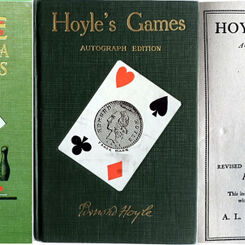
Hoyle v Foster: whose name should we remember?
Hoyle’s name is associated with the rules by which many games are played, particularly card games B...
Agatha Christie Playing Cards
Agatha Christie playing cards produced by Planet Three Collection, United Kingdom, c. 2004.
Scoop
Scoop by James Cond Ltd, 9 Charlotte Street, Birmingham, c.1920s.
Dickens Snap
Dickens Snap, c.1890.
Wonderland Misfitz
Wonderland Misfitz by C.W. Faulkner & Co. Ltd, c.1908.
Have A Go
Have A Go card game published by Photo-Briton Ltd featuring photographs of waxwork figures from Mada...
Four Flags
The Game of Four Flags published by Multum in Parvo, 1884
Crickette
“Crickette” card game manufactured by Woolley & Co., London, c.1890.
Alibi
“Alibi” the thrilling card game by Haytor, Tor Productions, 1930s.
Strip Tease
‘Strip Tease’ card game featuring characters involved in the performance and subsequent prosecution ...
Alice in Wonderland Snap
Alice in Wonderland “Snap” 1 penny game from 1920s or 30s, made in Germany, anonymous manufacturer. ...
St George Game
St George Game, 1858, depicting St George and other saints engaged in battle slaying the dragon to s...
Picture Proverbs
Picture Proverbs was a Victorian card game illustrating popular proverbs which were seen as words of...
Huckleberry Hound Booby
Tower Press “Huckleberry Hound Booby” No 6648, c.1962.
Dartex
Dartex, the Thrilling New Card Game of Skill (1938) based on the traditional pub game where darts ar...
Collecting English Playing Cards & Games
The History of English Playing Cards dates probably from the mid 15th century, the first documentary...
Most Popular
Our top articles from the past 60 days


