


Kuhn Khan
There is little information available about the early twentieth century card game Kuhn Kahn. It first appears in 1912 – with a variety of sets produced by Goodall & Son.
There appears to be little information available about the early twentieth century card game Kuhn Kahn. It first appears in this form in 1912 – with a variety of sets produced by Goodall & Son accompanied by a booklet of instructions by “Nemo”. Nemo is less than helpful in identifying the origins of this rummy-style game, launching as he does immediately into a set of formal rules for play.
According to Wikipedia the game Conquian was an ancient game from Spain and/or Mexico. It was first described as Coon Can in 1887 and then in detail in R. F. Foster’s Hoyle in 1897. I have a mini-book published by De La Rue in 1912 with the title The Bath Club Rules for “COONCAN” (seventh edition). This suggests the existence of six other editions in earlier times but I have so far been unable to trace them.

Above: The Bath Club Rules for “Cooncan” booklet, published in 1912.

Above: The “Kuhn Khan” booklet by Nemo.

Above: The “Kuhn Khan” booklet by Nemo, published by Chas. Goodall & Son in 1913.
It is difficult not to assume that Nemo (whoever he was[1]), through the good offices of Goodall & Son, remarketed this game under the newly spelt title Kuhn Kahn to give it a more exotic flavour.
I own several versions of the Nemo booklet published in 1912 (one with dark green hard cover) and 1913 respectively and have seen a third from 1913 “incorporating FOSTER’S latest American Popular Innovation”, whatever that might be! The game was advertised in Goodall mini-books from 1912 until 1922 (soon after Goodall was taken over by De La Rue) but I can find no later references.

Above: Two Goodall booklets, including “Kuhn Khan” and “Poker Patience.”
Michael Goodall (Page 36) pictures a version of the Nemo booklet entitled “Kuhn Kahn or Rum” but which I have not yet found.
It is possible that Kuhn Kahn was not particularly popular in an already over-crowded games market. One reason for its lack of popularity might be that it was designed to be played by 3 – 6 players! Odd when even four-person games were being amended to be playable by two!
I have three sets and have so far been unable to trace any variants of these, although they were produced in a variety of colours.
My first set is pictured in Mike Goodall’s book (see Page 52).

Above: A green “Kuhn Khan” box with the title embossed in gold lettering.

Above: Contents of the green “Kuhn Khan” box: a Nemo booklet, score pad and two packs of cards.
This is a textured cardboard box in green (although I have also seen them in blue and brown) comprising the basic Nemo booklet, scoring pad and two packs of cards. The writing of the name Kuhn Khan on the box is identical in all three boxes.

Above: Crown Playing Cards from De La Rue, shown with a modified Goodall Ace and Joker.
Interestingly, the cards in this version are not from Goodall but are Crown Playing Cards from De La Rue. They are of precisely the right vintage (early 1920s), they incorporate the modified Goodall Ace of spades and joker, so it is possible – even probable - that this set was issued with these cards soon after the Goodall takeover by De La Rue, and not long before production of this game ceased.
My second box is an up-market version from Goodall comprising a green “leatherette” case with brass fitting and green silk interior, a hard covered instruction booklet by “Nemo” (1912), two blocks of score sheets with pencils, and two packs of “Society” playing cards.

Above: The closed dark green Goodall “Kuhn Khan” case with its brass fitting.

Above: Contents of the dark green “Kuhn Khan” case, including two Society packs, score sheets and a booklet.

Above: The Society playing cards and Goodall booklet from the dark green “Kuhn Khan” case.
This version, which is obviously “right” and complete, does not feature amongst the illustrations in Michael Goodall’s book.
I have only recently acquired my third set. It is obviously from Goodall - Goodall cards and booklet, and same cover design, but a different size and shape to those above. As can be seen from the relative size of the booklet, the cards are medium-sized patience-style cards and the folding score pads are similarly reduced to half the size of the earlier ones.

Above: The closed green “Kuhn Khan” box from the third set.

Above: Contents of the third “Kuhn Khan” set: two packs of cards, a booklet and score pads.
It is possible, given that I can find no advertisement for Kuhn Kahn after 1922 that this version of the game was no longer promoted once Goodall & Son went out of business in that year, and after De La Rue decided which of the Goodall products to continue to promote. If anyone has more information about the game or it’s presentation, I would be interested to hear.
Footnotes
- Nemo is the one nom de plume from the Goodall archive that M. H. Goodall does not reveal in his excellent account of his family history, The Family & the Firm, 1820–1922. ←

By Tony Hall
United Kingdom • Member since January 30, 2015
I started my interest in card games about 70 years ago, playing cribbage with my grandfather. Collecting card game materials started 50 years or so later, when time permitted. One cribbage board was a memory; two became the start of a collection currently exceeding 150! Once interest in the social history of card games was sparked, I bought a wooden whist marker from the 1880s which was ingenious in design and unbelievably tactile. One lead to two and there was no stopping. What happened thereafter is reflected in my articles and downloads on this site, for which I will be eternally grateful.

Activity for Kuhn Khan
Sign in to comment or save this article.

Related Articles
Quaterne
A Victorian quartet-style children’s card game by Goodall & Son.

Copechat Paramount Sorting System
Preserving the past: a specimen deck showcasing edge-notched cards and their ingenious sorting syste...
Pastime Playing Cards for the Blind
The “Pastime” Playing Cards for the Blind manufactured by Goodall & Son Limd., c.1910.
Jockey Club de Buenos Aires
Spanish-suited pack by Chas Goodall & Son Ltd for the Jockey Club, Buenos Aires.
Kuhn Khan and Cooncan: an update
Kuhn Khan and Cooncan are pretty much exactly the same rummy-style game, but packaged and presented ...
Whist marker boxes
The Camden Whist marker was being advertised by Goodall and son in 1872 as a new product.
Bridge Markers and bridge scoring methods
Bridge Markers and bridge scoring methods 1900-1930
Goodall’s modernised Wüst House pattern playing cards
A remodelled version of the first Wüst house pattern.
The Jovial Cards
Publicity items for a group of entertainers, Southend-on-Sea, Essex, UK, 1911.
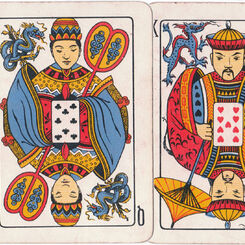
Khanhoo
Khanhoo by Charles Goodall & Son, 1895.
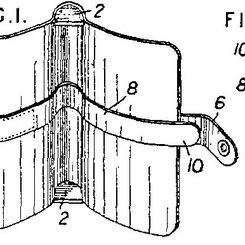
Leather Card Case Patent Application
In 1932, a patent was granted to Colin Hart and George Franklin for a leather case in the form of a ...
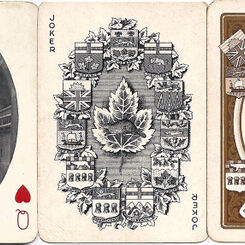
Ocean to Ocean Canada Souvenir
“Ocean to Ocean” Canadian Pictorial Souvenir packs by Chas Goodall & Son Ltd, c.1906 & 1911.
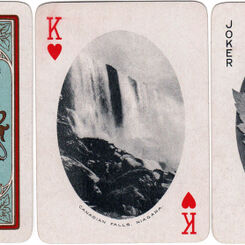
Ocean to Ocean Souvenir of Canada, c.1905
Ocean to Ocean Souvenir of Canada by Chas Goodall & Son Ltd, c.1905.
47: Welch’s postcards and De La Rue’s redrawing
There are a number of court card designs that have never actually been produced as cards. It's a sha...
Goodall c.1845-60
Goodall’s earliest cards were traditional in appearance but in around 1845 ‘modernised’ courts were ...
Music Manuscripts
Artwork featuring playing cards in Music Manuscripts
Draughts League Medals
Arthur Charles Prince worked for De la Rue as a playing card cutter and later was promoted to superv...
Pope Joan Trays
Some traditional Pope Joan boards comprise a circular tray, others are square, divided into sections...
Most Popular
Our top articles from the past 60 days


