


The Evolution of Whist and Bridge Boxed Sets, 1870s – 1930s
Boxed sets of cards, markers, scorers and rule booklets have been around for many decades. Some of the "shop perfect" items in my collection are well over 100 years old.
For collectors of whist and bridge ephemera there are some wonderful examples of past elegance available at remarkably modest prices. Boxed sets of cards, markers, scorers and rule booklets have been around for many decades. I currently have a large number dating from the 1870s to the 1930s and beyond. Part of the fun is to use all of the clues available to identify from which point in the evolution of whist to contract bridge a particular item comes. Condition is important for collectors, but does not necessarily demonstrate age. Some of the “shop perfect” items in my collection are well over 100 years old, whereas tattier, much-used items can be of relatively recent origin. It is also important to note that packs of cards or mini-books of rules contained in the boxes may have been added by the original users, or later at the point of sale, and offer no true indication of a set’s age or source without other evidence. More often than not, the original playing cards are missing, which removes one of the key identifying factors.
In what follows I have attempted to illustrate the evolutionary stages from Whist to Contract Bridge through the boxed sets sold as the process evolved. In doing so I modified Julian Laderman’s proposed timescales by the addition of a specific period for Royal Auction Bridge[1]. I recognise, as he does, that they are only a rough guide. Whist had been played for some hundreds of years before the first attempt at introducing a form of pre-play bidding. Thereafter there was:
- Bridge or Bridge-whist: 1897–1910
- Auction Bridge: 1908–1930
- Royal Auction Bridge: 1914–1930
- Contract Bridge: from 1927
Additional update about Julian Laderman
Julian Laderman died on 9 February 2023, aged 74. He was a great friend and fellow collector of games paraphernalia. He was also one of the most successful and prolific writers on bridge in modern times. He had been Professor of Mathematics and Computer Science at Lehman College in his beloved Bronx until he took early retirement to devote himself to his second passion – bridge – and became an award-winning author. All his work (six titles are listed below) reflects his maths background, but is infused with a wonderful, dry sense of humour and the ability to write about and explain complex issues in readily understood language. He was a constant speaker on the US bridge circuit, helping to promote bridge amongst potential younger players and explaining the intricacies of play to those of us already hooked.
Publications by Julian Laderman
- A Bridge to Inspired Declarer Play
- A Bridge to Simple Squeezes
- Still Not Finding the Squeezes?
- Useful Probability for Bridge Players
- Bumblepuppy Days
- Play Bumblepuppy Bridge
In practice, of course, some people will have continued to play whist throughout these years, ignoring the new developments; some adherents to auction bridge will have played long after the Laws for Contract Bridge were published, and so on. The manufacturers of card-playing materials were well aware of this and some of the transitional periods are evident from the boxes, rule books and score pads which they produced.
Whist
Probably my earliest whist box set dates from the middle of the 19th century. It is essentially Victorian in style with its black lacquered wood exterior, ornate brass inlays and delicate, removable mahogany tray. I surmise that the box is pre-1870 because the tray is designed for coin-shaped counters rather than the whist markers with pop-up pegs which became popular in the last quarter of the century (see below).

Above: A black Whist box with gilt lettering.

Above: The divided interior of a wooden Whist box.
Here are six further whist box sets produced between 1870 and 1900, identified as such by their inscriptions and contents. The first is “The Windsor” whist box by Charles Goodall & Son. Described in the catalogue as covered in red “Moroccan Leather” and with a silk lining, the complete set would have included two packs of cards as well as the two hardwood and ivory Camden Whist Markers[2]. No detective work is needed here as both details are inscribed in gold lettering on the drop-down front flap. Otherwise, the font on the lid is easily recognised as Goodall, as it was also used on their contemporary Bezique and Patience sets.

Above: A maroon leather Whist box.

Above: An open maroon Whist box with empty card compartments.

Above: A Goodall & Son “Camden” Whist Marker with wooden scoring pegs.
The next set is equally clearly a Chas. Goodall & Son product. It is labelled “Whist” on the top of the box, and carries the maker’s name and “The Sandringham Whist Cabinet” inside the lid, together with a list of contents. It is designed to carry two packs of Mogul cards, a rule book and two of the more advanced and increasingly popular “Foster Whist Markers” on sale from the 1890s[3].
Sadly, in my set, the two packs of Mogul cards are missing, as they almost always are, from underneath the moveable tray, as is the book of rules, but the two Foster Whist Markers are intact. Had the original rule book been enclosed it would have looked like this and been dated somewhere in the 1890s. This copy, by Captain Crawley[4], is dated 1899 and was contained in the following set, again from Goodall & Son.
This box is covered in what the Goodall catalogue describes as “imitation long-grained leather” in black, with a red silk lining, a lid-strap to hold the rule booklet in place and two diminutive Tom Thumb Markers resting on two packs of medium-sized cards. The relative size of this box can be seen from the Tom Thumb markers, measuring 5½ × 3 cm, compared with the standard Camden Marker size of 9¼ × 5¼ cm.
The origin of the next box is more difficult to determine. It is a leatherette-covered wooden box with a lacquered fan of playing cards on top. It does not look like a typical Goodall & Son product, but whoever made it designed it to contain a pair of “Camden Whist Markers” in the lid, which were produced from 1870 onwards. No other whist markers in my extensive collection fit the spaces available, so I believe this was how the set was sold, obviously also with cards and a rule book. But who made it and precisely when remains a mystery.
Next, amongst the 19th-century Whist sets is a wooden box with a stainless-steel button catch. It is not attributed to a particular maker, but both the cards (Piatnik) and the two whist markers are marked “Made in Austria”, so I see no reason to suggest that the set is anything but a genuine Austrian import. By the later years of the nineteenth century a wide variety of manufacturers worldwide were copying the Goodall design of marker, with or without the permission of the designer.
I conclude my brief review of Whist sets with an example which is very easy to date and identify. This tan leather case with its silk lining, containing cards and unmarked whist markers, has two evident identifiers. First, it carries the retailer’s insignia, H. B. Drew & Co., 42 King’s Road, Brighton, in silver lettering inside the lid. This was a London company which opened a branch in Brighton in 1894.
The clincher, however, is the silver mark on the tiny clasp which dates the piece as made in London in 1896. If only it was this easy to date some other items. Both packs of playing cards, and advertising material contained in the box, are from De La Rue and are undoubtedly original to the box as sold.
Bridge-Whist, 1897–1910
In the last years of the 19th century the game moved on with the introduction of a form of pre-play bidding, albeit a very basic one, and the new game became very popular.
“Bridge”, sometimes called Bridge-Whist, was played under rules set by the Portland Club, London, in 1895 and the Whist Club of New York in 1897. The only set in my collection about which I am absolutely sure that it was produced for Bridge-Whist is this one, produced sometime around 1908–10.
This set is in pristine condition and has barely, if ever, been used. Hence my earlier comment that the state of repair of a particular box is not necessarily an indication of its age. The contents of this box are obviously original, including the 16th edition of a leather-bound book “Bridge” by Professor Hoffman dated 1908[5], which describes bridge as “a new development of Whist, which having been a few years ago introduced at some of the London Clubs, has since found its way into much wider circles, and appears to have firmly established itself in public favour”. The booklet advertises a range of Bridge “cabinets” from Goodall’s “complete with Cards, Scoring Blocks and Rules, handsomely finished, in a variety of choice leathers”. The booklet, and the black leather-backed, delightfully named “ACME Bridge tablet” score sheets[6], both indicate the points-scoring system established for Bridge-Whist. The set also includes two copies of a folded paper insert offering “Bridge Hints presented by Chas. Goodall, & Son, Ltd.”. The two packs of Goodall cards were those used between 1897 and 1925.

Above: The side of Goodall & Son’s “Windsor” Whist box.

Above: A wooden Goodall Whist box with gilt lettering.

Above: Goodall & Son’s “Sandringham Whist Cabinet” with Foster Whist Markers.

Above: Whist for All Players by Captain Crawley, 11th edition, 1899.

Above: A black leatherette Whist box.

Above: An open Goodall “Tom Thumb” Whist Marker case.
I am torn about the date of my next example. This splendid heavy metal box is lined in purple velvet and contains two elaborately designed removable metal containers for the two packs of cards (not original), together with a lid recess for a book of rules. The box was originally completely silver-plated but the top has suffered the rigours of over-cleaning to reveal the copper underneath.
The design screams late Victorian and the term “Bridge” on the lid suggests it was produced around 1900. However, this type of “blue bird/bamboo” design was popular both around the turn of the century and again in the 1920s, but, given the overall style of the set, I suspect it is from the turn of the century rather than later.

Above: A heavy Bridge box decorated with playing-card suits.

Above: An open Bridge case with two metal card containers.

Above: A plain wooden Bridge box.

Above: An open wooden Bridge box with floral playing cards and scoring pegs.
Auction Bridge, 1908–1930
The Bridge-Whist rules and scoring arrangements were very basic, so it was not long before those overseeing the game sought improvements. The Portland Club approved the first set of rules for Auction Bridge in 1909 and as early as 1914 the Club approved its first set of rules for the next variation – Royal Auction Bridge. This left the producers of game materials working in a rapidly changing marketplace. New sets, therefore, had to cater for the different versions of the game played by their customers.
I have only one box, maker unknown, that is identified solely with Auction Bridge, which suggests a production date of 1909–1914. It might have been produced later, but by that time most producers covered themselves by using the generic term Bridge or the more widespread new variation, Royal Auction Bridge.
Royal Auction Bridge, 1914–1930
This next glorious, leather-covered set is beautifully adorned with an Oriental bird and tree motif in gold and other extravagant indented patterns.
It contains the original red leather-backed scoring pads carrying the scoring systems for all three variants of the game at this stage: Bridge (Bridge-Whist), Auction Bridge and Royal Auction Bridge, placing it firmly at this point in the evolution of the game, sometime between 1914 and the late 1920s.

Above: A worn brown Whist box with a lockable case.

Above: An open Whist or Bridge set with wooden markers, cards and a guide.

Above: A crocodile-pattern leather Bridge box.

Above: An open Bridge set with score sheets, pencils and a rules guide.
I have a number of sets which are similarly designed to be flexible but are labelled “Bridge”. First is a box in dark green leatherette which contains matching green-backed scoring pads catering for the three early versions of Bridge. All the contents of this set are produced by De La Rue as, I believe, was the box. This includes the two packs of cards, the DLR “ONTO Bridge pencils” and scoring pads, together with “The Guide to Royal Auction Bridge” by Ernest Bergholt, published by Thomas De La Rue and Chas. Goodall & Son in 1930.
Second is a brown leatherette set, also containing a copy of the Ernest Bergholt book, but dated a year earlier, in 1929. The four scoring pads are designated C.G. & S., contain the laws for Royal Auction Bridge alone and it seems likely that this set too was produced by De La Rue sometime after the takeover of Goodall’s in 1922[7].
Unusually, this set also contains compartments containing four glass trays, each sporting a suit insignia. I can only assume that these were personal ashtrays – one for each of the players. They are obviously too small for peanuts!
By the mid-1920s and beyond, some companies began experimenting with different materials. This particular example, in Bakelite, was produced in England by Seaforth and the design alone screams art deco, dating it as anywhere between the mid-1920s to the end of the 1930s. There is no record of its original contents or which card company commissioned Seaforth to produce the box.
This next example – another “Bridge” designation – has a red “leather” exterior and purple silk lining. The matching purple and gold-edged booklet contains “The Laws of Royal Auction Bridge… finally Approved and Adopted by the Committee of the Portland Club (May 1914)”. The matching score pads cater for all three of the early forms of Bridge and, along with the ONTO pencils and booklet, were produced by De La Rue. The booklet quoting the 1914 version of the Laws places this box somewhere between 1914 and the late 1920s, when the Laws were revised. This particular box was retailed by Truslove & Hanson, the fashionable bookshop and stationers in Sloane Street, London.
The advertisements in the back of the Laws advertise “Royal Auction Bridge cases ... in various leathers” and, note, these boxes are now marked on the lid as for “Royal Auction Bridge”.

Above: A metal Bridge box decorated with bamboo and birds.

Above: An open metal Bridge set with two card containers.
Other sets from this period were more confident in their designation for Royal Auction Bridge. Here are a few examples. The first is similar in design to earlier models.
This second set is also unambiguously concerned with Royal Auction Bridge. It has a traditional interior layout, with rule book and space for cards and scoring pads. However, the lid insert is a folder containing a book “Auction at a Glance” produced by L. G. Sloan, the “sole representatives for Great Britain of the United States Playing Card Company”. There is no way of knowing whether this was how it was originally sold because there are no other identifiers.
The next set is similar on the outside to the last one but is unusual in that, when opened, the cards rest in the lid and not on the base. The little leather-covered booklet is an empty, lined notebook rather than a book of rules, and the two complete scoring pads are exclusively concerned with the rules and scoring arrangements for Auction Bridge alone.
The text on the reverse of the scoring pads is presented by A. E. Manning Foster[8], one of the foremost English writers on various forms of Bridge in the early years of the 20th century until his death in 1939.
I have an identical set to this one in light tan which is obviously from the same, unidentified source. However, in this second set the four sets of matching tan scoring pads are exclusively for Contract Bridge. It would appear that the first of these two boxes pre-dated the introduction and popularity of Contract Bridge, say the mid-to-late 1920s. The second may have been sold as a Royal Auction box, but either the sellers or the first owners quickly added a more up-to-date set of scorers from the early 1930s onwards.

Above: The decorated side of the metal Bridge box.

Above: A red leather Auction Bridge box.

Above: An open Auction Bridge box with card compartments.

Above: A lacquered red Bridge box with bird-and-branch decoration.

Above: An embossed red Bridge box with a brass catch.

Above: An open red Bridge set with cards, pencils and score sheets.

Above: A black Bridge box with gilt lettering.

Above: An open dark green Bridge set with score sheets and a Royal Auction Bridge guide.

Above: A brown Bridge box with gilt lettering.

Above: An open brown Bridge set with score sheets and glass scoring markers.

Above: A black Bridge box with raised lettering and suit symbols.

Above: A second black Bridge box with embossed suit symbols.

Above: A maroon Bridge box with gilt lettering.

Above: An open purple-lined Bridge set with a scoring block.

Above: A catalogue advertisement for Royal Auction Bridge cases.

Above: A green Royal Auction Bridge box.

Above: An open green Royal Auction Bridge case with its guide booklet.

Above: Auction at a Glance in a brown leather case.

Above: A brown Royal Auction Bridge box.

Above: An open brown Royal Auction Bridge case with card compartments.

Above: A dark Royal Auction Bridge box.

Above: An open dark case with card packs and score sheets.

Above: A green Royal Auction Bridge box.

Above: An open green case with Contract Bridge score sheets and playing cards.
Contract Bridge, 1927 onwards
The Laws of Contract Bridge were first approved by the Whist Club of New York in 1927, and were essentially endorsed by the Portland Club for use in the UK and British Empire in 1929.
In 1931, A. E. Manning published the 9th edition of his “Auction Bridge Made Clear”, which first appeared in 1921. Even in this short book specifically about Auction Bridge, the last 60 pages are devoted to “The Laws of Contract Bridge”. In introducing the Laws, he quotes a letter from the Portland Club to other London Clubs announcing that “The Portland Club consider that there appears now to be a sufficient need for a British Code of Laws covering the variety of Auction Bridge which is known as ‘Contract’”. The letter goes on to explain that “the Portland Club are not at present attempting to formulate a new game” and therefore “are provisionally accepting the American scoring and are adapting the existing Laws of ‘Auction’ to fit the newer game of ‘Contract’.” The letter continues: “The fact that ‘Contract’ is now being played at the Portland Club as an alternative game is not an indication that the Portland Club propose to adopt it in place of ‘Auction’, nor an expression of the view that ‘Contract’ will supersede ‘Auction’ as a Club game.”
Given this degree of indecision on the part of the game’s law-makers, it is not surprising that throughout the 1930s card producers kept their options open when producing their boxed sets.
By 1933 – when the W.D. & H.O. Wills playing-card promotion was launched – one of the “gifts”, the Bridge boxed set complete with cantilevered card holders, had an enclosed rule sheet with the laws for Contract Bridge on one side and for Auction Bridge on the other[9]. Other producers followed suit well into the 1930s while the transition to Contract Bridge was taking place.
All of the last three sets featured here contained scoring blocks with the C.G. & S. Ltd. initials on the front, but both “International Laws of Contract Bridge” and “International Auction Bridge Scoring” on the back. The blocks, and these very varied sets, were all produced by De La Rue, now designated as the “Official Publishers to the Portland Club”.

Above: A red Bridge box from the Contract Bridge period.

Above: An open Contract Bridge set with an International Laws scoring card.

Above: A green Bridge box.

Above: An open green Bridge set with Contract Bridge score sheets.

Above: A patterned Bridge box.

Above: An open patterned Bridge set with score sheets, pencils and playing cards.
However, during the 1930s serious card players on both sides of the Atlantic rapidly switched their allegiance to Contract Bridge, which was evidently a much better game. It is difficult to know just when card producers felt sufficiently confident to drop the references to Bridge-Whist, Auction and Royal Auction Bridge altogether.
Footnotes
- Julian Laderman, Bumblepuppy Days, Masterpoint Press, 2014. ←
- The more up-market sets in leather would have contained the higher-spec hardwood and ivory “Camden” markers, whereas contemporary cardboard sets with cards would have contained the all-wood “Pall Mall” version. Both types of marker were also sold in pairs without cards in cardboard boxes. ←
- See Tony Hall, “Whist & Gaming Counters and Markers”, The World of Playing Cards, June 2015. ←
- See Tony Hall, “The Personalities and Books which shaped the game of Whist, 1860–1900”, The World of Playing Cards, October 2018. ←
- This is the 16th edition, “revised and enlarged”, of a booklet which can only be some ten years at most since its first edition, and thus indicates just how popular this modification to the game of Whist had become. ←
- However, the Hoffman book advertises an even more elaborate scoring pad called “The Climax”! One can only wonder what additional feature could justify such a title! ←
- De La Rue took over Goodall & Son in 1922 and continued to use the name and designs for many years. Sometimes they quoted both names, as here; at other times just the DLR designation on a continued Goodall design. ←
- Alfred Edye Manning-Foster was frequently described as the “Grand Old Man of Bridge”. He was a prominent British bridge player and writer. He was the founder and editor of Bridge Magazine. He was also the founder and, until shortly before his death, the president of the British Bridge League. He did much to promote Duplicate Bridge, although personally preferred Rubber, and helped to promote Contract Bridge but was concerned about the development of conventions which threatened to make Bridge less of a game played for fun. ←
- See Tony Hall, “The W.D. & H.O. Wills Playing Card promotion of the early 1930s”, June 2015, The World of Playing Cards. ←

By Tony Hall
United Kingdom • Member since January 30, 2015
I started my interest in card games about 70 years ago, playing cribbage with my grandfather. Collecting card game materials started 50 years or so later, when time permitted. One cribbage board was a memory; two became the start of a collection currently exceeding 150! Once interest in the social history of card games was sparked, I bought a wooden whist marker from the 1880s which was ingenious in design and unbelievably tactile. One lead to two and there was no stopping. What happened thereafter is reflected in my articles and downloads on this site, for which I will be eternally grateful.

Activity for The Evolution of Whist and Bridge Boxed Sets, 1870s – 1930s
Sign in to comment or save this article.

Related Articles
The Paraphernalia of Card Play
Innovation and novelties in the accessories on the card table.
Copechat Paramount Sorting System
Preserving the past: a specimen deck showcasing edge-notched cards and their ingenious sorting syste...
Goodall 1879-1880 Sample Book
Complete contents of a sample book by Goodall & Sons
Card Game Items and contemporary advertisements
It is often difficult to identify the origin, manufacturer and date of a card game boxed set and oth...
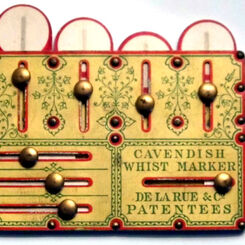
Whist marker boxes
The Camden Whist marker was being advertised by Goodall and son in 1872 as a new product.
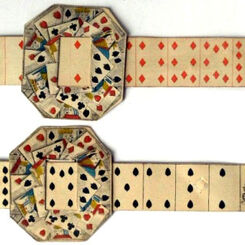
A New Look at the Evolution of Whist Markers and Gaming Counters
This article aims to illustrate the evolution of whist and gaming counters from the 18th century to ...
Isle of Man playing cards by De La Rue & Goodall
Two different versions of Isle of Man playing cards from 1870 and 1914.
Marie and Laurent’s Wedding
Wedding invitation and thank you card in the form of playing cards. France, 2019.
67: Adverts and related material after 1900
The final page of material relating to playing cards from British periodicals.
Bezique Markers, 1860-1960
Bezique is a two-player melding and trick-taking game. Dr. Pole introduced Bezique to England in 186...
Goodall & Son Patience Boxed Sets
Goodall & Son produced a huge variety of Patience Boxed Sets at different times and for different co...
Pashas
“Pasha” is one of Charles Goodall’s brands which first appeared in c.1898 and was retained until aft...
Progressive Whist Cards - page 2
Wireless Whist itself, in many forms...
A Pair of Transformation Packs
Two similar but fascinatingly different hand-drawn transformation decks by the same artist, c.1875
Majority Calling and Value Bidding in Auction Bridge; a little bit of history
The centuries-old game of Whist mutated through various stages into Contract Bridge as we know it to...
Draughts League Medals
Arthur Charles Prince worked for De la Rue as a playing card cutter and later was promoted to superv...
Boudoir
“Boudoir” playing cards were introduced by Chas Goodall & Son in 1906 in a new, slimmer size.
Games Leaflets
Thos De la Rue & Co. & Gibson's Games Leaflets.
Swastika designs
Swastika design playing cards by De La Rue, c.1925.
Spanish suited pack for Nestlé
Spanish-suited pack produced by Chas Goodall & Son Ltd for South America
Most Popular
Our top articles from the past 60 days


