


Babita Basavaraj – Dashavatar Ganjifa
A modern ganjifa artist and an ancient deck
Mysore – one of India’s great ganjifa centers – is famous for its detailed, lifelike paintings and gold leaf work on its cards. Babita Basavaraj’s dashavatar deck delivers on both.
Consider the translucent fins and delicate scales of the fishes swimming around the Matsya (fish avatar) suit pip cards, or the colors playing off the surface of the conch shells decorating the Rama suit, or the gleam of ornate arches setting off the raja cards.

Above: Matsya and Rama pip and Buddha raja cards from Dashavatar deck by Babita Basavaraj (2026).

Above: Map of India with Mysore.
The deck follows the standard dashavatar pattern composition with ten suits, each devoted to an avatar of Vishnu. Each suit contains ten pip and two court cards: the mantri or manthri (minister) lower court card and the raja (king) upper one. The raja cards are distinguished by the arches above the image.
I caught up with Basavaraj on the phone and learned a bit about her evolution into a master ganjifa artist. She started when she was 14 and continued her education under both traditional art faculties and ganjifa gurus. Over time, she became the teacher, training 60 aspiring ganjifa artists and choosing the best two to become her assistants.
Today, her studio follows the centuries-old pattern of artisan workshops, with trainees doing preparatory work such as gluing card layers together and putting down background colors, and Basavaraj coming in to do the delicate strokes that require a master’s brush. Gold foil is converted into paste, applied to the card, then burnished with agate stone, with line work done on top of the gold.
Like many modern ganjifa artists, cards are only a part of what Basavaraj creates; with demand for ganjifa decks down, an artisan must have an array of wares on offer. You can see images of various items decorated with ganjifa art in “Mysore Ganjifa – Raghupathi Bhat Workshop Cards”, which covers the city-backed 2024–2025 ganjifa workshop that Basavaraj helped organize.
Matsya

Matsya suit cards from Dashavatar deck by Babita Basavaraj (2026).
Above: Matsya suit cards from Dashavatar deck by Babita Basavaraj (2026).
Kurma

Kurma suit cards from Dashavatar deck by Babita Basavaraj (2026).
Above: Kurma suit cards from Dashavatar deck by Babita Basavaraj (2026).
Varaha

Varaha suit cards from Dashavatar deck by Babita Basavaraj (2026).
Above: Varaha suit cards from Dashavatar deck by Babita Basavaraj (2026).
Narasimha

Narasimha suit cards from Dashavatar deck by Babita Basavaraj (2026).
Above: Narasimha suit cards from Dashavatar deck by Babita Basavaraj (2026).
Vamana

Vamana cards suit from Dashavatar deck by Babita Basavaraj (2026).
Above: Vamana cards suit from Dashavatar deck by Babita Basavaraj (2026).
Parashurama

Parashurama suit cards from Dashavatar deck by Babita Basavaraj (2026).
Above: Parashurama suit cards from Dashavatar deck by Babita Basavaraj (2026).
Rama

Rama suit cards from Dashavatar deck by Babita Basavaraj (2026).
Above: Rama suit cards from Dashavatar deck by Babita Basavaraj (2026).
Krishna

Krishna suit cards from Dashavatar deck by Babita Basavaraj (2026).
Above: Krishna suit cards from Dashavatar deck by Babita Basavaraj (2026).
Buddha

Buddha suit cards from Dashavatar deck by Babita Basavaraj (2026).
Above: Buddha suit cards from Dashavatar deck by Babita Basavaraj (2026).
Kalki

Kalki suit cards from Dashavatar deck by Babita Basavaraj (2026).
Above: Kalki suit cards from Dashavatar deck by Babita Basavaraj (2026).

By Lev Golinkin
United States • Member since May 26, 2026
I'm a US-based author and journalist. I've been collecting playing cards since I was about 8 years old, when I got mesmerized by the various decks that were used in Soviet Ukraine, where I'm from. I collect mainly European decks such as those by Dondorf, Grimaud, and Piatnik. I love courts above all else, and am drawn toward historical and artistic decks.

Activity for Babita Basavaraj – Dashavatar Ganjifa
Sign in to comment or save this article.

Related Articles

Hindu Astro-Mythological Tarot
A hand-painted Ganjifa pack adapts tarot’s major and minor structure to Hindu astrological and mytho...

Ramayana Ganjifa: Sonepur
Come for the tale, stay for the motorcars.

Dashavatar Darchiri Ganjifa by Sawantwadi Palace
The luxury dashavatar line from the Sawantwadi royal palace.

Ramayana Ganjifa: Chikiti and Paralakhemundi
Scenes from India’s timeless epic portrayed in miniature.

From the Workshop of Niranjan Maharana
A National Award-winning artist plies his trade on ganjifa cards – and more.

Dasamahaviya Ganjifa
Sacred feminine power bursts forth from these ganjifa decks

Navadurga Ganjifa
Major Hinduism goddess and her manifestations

Dasavatara Ganjifa by Sawantwadi Lacquerwares
Traditional Dasavatara Ganjifa from Sawantwadi Palace in Maharashtra.

Saptamatrika “Seven Mothers” Ganjifa
Feminine powers from Hinduism celebrated on ganjifa cards

The Avatar Tas (Ganjifa)
Rules for The Avatar Tas (Ganjifa), the five-player Bengali Dashabatar Tash game played with a Ganji...

Decks of Divinity
The circular Ganjifa cards of Odisha are hand-painted by Chitrakar makers and used in traditional ga...
Nabagunjara Ganjifa
An ancient game from the Odisha region of India.
Mughal Ganjifa - Playing Cards from India
Indian playing cards, known as Ganjifa, feature intricate designs with twelve suits and are traditio...
Handmade Ganjifa Birds Playing Cards
This set of Ganjifa cards is a beautiful example of traditional cards from India.
Ganjifa™ - Indo-French ganjifa by Asha Industries
A colourful pack of round cards with Ganjifa designs by Asha Industries, Mumbai, India, 2002.
Divine Art
Divine Art Playing Cards by Sunish Chabba & Guru Playing Card Company, 2016.
Guru Ganjifa
Sunish Chabba is working on an initiative to revive traditional Ganjifa, the card game most popular ...
Dashavatar Ganjifa from Sheopor
‘Ganjifa’ playing cards made in Sheopor in the North of Madhya Pradesh province in Central India. Th...
Suicide King
The King of Hearts, holding a sword behind his head, is sometimes nicknamed the “Suicide King”. He c...
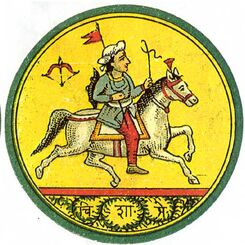
Dashavatara Ganjifa by Chitrasala Press
Chromo-lithograph Ganjifa cards by the Chitrasala Press, around 1950. Ten suits of twelve cards, eac...
Most Popular
Our top articles from the past 60 days


