


Naqsh
Ganjifa family’s mysterious cousin

Above: Bishnupur and Paralakhemundi Map
Naqsh refers to both a game and a deck of cards made specifically to play it. Its relationship to ganjifa in general is unclear – it definitely has the look and feel of ganjifa cards, but is more like a cousin than a core family member. Regular ganjifa decks are divided into twelve-card suits, with at least eight suits (96 cards in total) per deck, and used for trick-taking games. Naqsh decks have four or five identical sets of twelve cards (48 or 60 cards in total) and are used for a game somewhat akin to blackjack.
The most well-known version of naqsh decks comes from Bishnupur (West Bengal). They, like Bishnupur’s dashavatar decks (dashabatar tash), have been created by the Fouzdar family for generations.
Artist: Subal Fouzdar

Above: Pip, ghodi, and mir cards from Naqsh deck by Subal Fouzdar (2002).

Above: Pip, ghodi, and mir cards from Naqsh deck by Subal Fouzdar (2002).

Above: Pip, ghodi, and mir cards from Naqsh deck by Subal Fouzdar (2002).

Above: Pip, ghodi, and mir cards from Naqsh deck by Subal Fouzdar (2002).
Above: Pip, ghodi, and mir cards from Naqsh deck by Subal Fouzdar (2002).

Above: Pip cards from Naqsh deck by Subal Fouzdar (2002).

Above: Pip cards from Naqsh deck by Subal Fouzdar (2002).

Above: Pip cards from Naqsh deck by Subal Fouzdar (2002).

Above: Pip cards from Naqsh deck by Subal Fouzdar (2002).
Above: Pip cards from Naqsh deck by Subal Fouzdar (2002).

Above: Pip cards from Naqsh deck by Subal Fouzdar (2002).

Above: Pip cards from Naqsh deck by Subal Fouzdar (2002).

Above: Pip cards from Naqsh deck by Subal Fouzdar (2002).

Above: Pip cards from Naqsh deck by Subal Fouzdar (2002).
Above: Pip cards from Naqsh deck by Subal Fouzdar (2002).
Just like ganjifa, there are ten pip and two court cards: the lower court card of ghodi (mare) and the higher one of mir (king). The ghodi card shows a horseman and the mir card has elephant riders (with the elephant either choking or hugging a leopard). The ghodi card is worth eleven points and the mir card twelve.
The numeral cards each have a number of objects from one to ten. These include a girl under a tree (one point), two wrestlers, four conch shells, seven swords, and so on.
Artist: Sital Fouzdar

Above: Pip, ghodi, and mir cards from Naqsh deck by Sital Fouzdar (2005).

Above: Pip, ghodi, and mir cards from Naqsh deck by Sital Fouzdar (2005).

Above: Pip, ghodi, and mir cards from Naqsh deck by Sital Fouzdar (2005).

Above: Pip, ghodi, and mir cards from Naqsh deck by Sital Fouzdar (2005).
Above: Pip, ghodi, and mir cards from Naqsh deck by Sital Fouzdar (2005).
Bishnupur’s naqsh cards come in large circular, small circular and rectangular formats.
Artist: Prakash Chandra Mahapatra

Ahove: Pip, ghodi, and mir cards from Naqsh deck by Prakash Chandra Mahapatra (1990).

Ahove: Pip, ghodi, and mir cards from Naqsh deck by Prakash Chandra Mahapatra (1990).

Ahove: Pip, ghodi, and mir cards from Naqsh deck by Prakash Chandra Mahapatra (1990).

Ahove: Pip, ghodi, and mir cards from Naqsh deck by Prakash Chandra Mahapatra (1990).
Above: Pip, ghodi, and mir cards from Naqsh deck by Prakash Chandra Mahapatra (1990).
There’s also a 60-card version that comes from Paralakhemundi in Odisha, the state next to West Bengal. It’s executed in the folksy style of the region and contains an elephant rider as ghodi, the same rider under a canopy as mir, and simple pips for the numeral cards. It’s unclear how widespread the 60-card version is or was.
Footnotes
- All card images courtesy of: Indira Gandhi National Centre for the Arts, Digital Cultural Resources, IGNCA.
- The vast majority of the information in this article comes from “Naqsh Card Game, Goddess Lakhmidevi and Diwali” by eminent ganjifa scholar and collector Kishor N. Gordhandas in the Asia InCH Encyclopedia.
- IGNCA, Subal Fouzdar.
- IGNCA, Sital Fouzdar.
- IGNCA, Prakash Chandra Mahapatra.

By Lev Golinkin
United States • Member since May 26, 2026
I'm a US-based author and journalist. I've been collecting playing cards since I was about 8 years old, when I got mesmerized by the various decks that were used in Soviet Ukraine, where I'm from. I collect mainly European decks such as those by Dondorf, Grimaud, and Piatnik. I love courts above all else, and am drawn toward historical and artistic decks.

Activity for Naqsh
Sign in to comment or save this article.

Related Articles

Bird Ganjifa by Sawantwadi Palace
Ten of parrots? Avian splendor and Vishnu avatars, courtesy of the Sawantwadi royal family.

Ratha-Hathi and Ratha-Ghoda Ganjifa
Chariots, horses, and elephants: a traditional ganjifa from Odisha.

Hindu Astro-Mythological Tarot
A hand-painted Ganjifa pack adapts tarot’s major and minor structure to Hindu astrological and mytho...

Ramayana Ganjifa: Chikiti and Paralakhemundi
Scenes from India’s timeless epic portrayed in miniature.

Indian Musical Ganjifa by Sawantwadi Palace
A marriage of music, art, and playing cards.

Navadurga Ganjifa
Major Hinduism goddess and her manifestations

Kama Sutra Indo-French Ganjifa
India’s erotic heritage on Western-style cards

Dasavatara Ganjifa by Sawantwadi Lacquerwares
Traditional Dasavatara Ganjifa from Sawantwadi Palace in Maharashtra.

Ashtamali “Eight Wrestlers” Ganjifa
Lord Krishna’s conquests on ganjifa cards.

The Avatar Tas (Ganjifa)
Rules for The Avatar Tas (Ganjifa), the five-player Bengali Dashabatar Tash game played with a Ganji...

Bengali Dashavatar Ganjifa: Dashabatar Tash
An ancient Bengali version of the Dashavatar Ganjifa pattern.
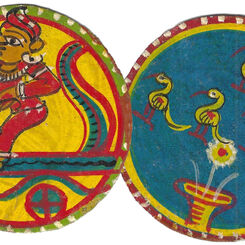
Handmade Ganjifa Birds Playing Cards
This set of Ganjifa cards is a beautiful example of traditional cards from India.
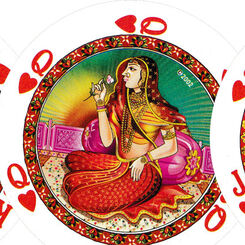
Ganjifa™ - Indo-French ganjifa by Asha Industries
A colourful pack of round cards with Ganjifa designs by Asha Industries, Mumbai, India, 2002.
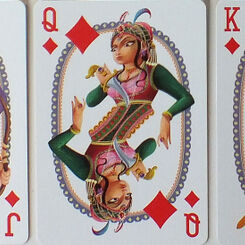
Bharata Playing Cards
Bharata Playing Cards - Series 2, based on Indian folk art, published by Sunish Chabba, 2018.
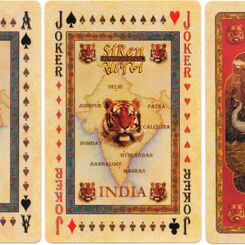
SiRen International
“SiRen International” playing cards based on traditional style of Indian miniature painting, 1998
Dashavatar Ganjifa from Sheopor
‘Ganjifa’ playing cards made in Sheopor in the North of Madhya Pradesh province in Central India. Th...
Teen Patti Playing Cards
Anjali DSouza, an illustrator from Chennai, India has designed a pack of cards using Indian truck ar...
Dashavatara Ganjifa by Chitrasala Press
Chromo-lithograph Ganjifa cards by the Chitrasala Press, around 1950. Ten suits of twelve cards, eac...
The History of Playing Cards
Playing cards appear in European records in the late 14th century, but their earlier history lies fu...
Art in Playing Cards
Playing cards have long served as miniature canvases—hand-painted, gilded, engraved and printed with...
Most Popular
Our top articles from the past 60 days


