


Ratha-Hathi and Ratha-Ghoda Ganjifa
Chariots, horses, and elephants: a traditional ganjifa from Odisha.

Above: Brahmapur and Chikiti, Odisha.
Straightforward and folksy is the rule for this type of deck, which follows the usual ganjifa composition. There are eight suits, with each suit containing ten pip and two court cards: the pradhan (minister) lower court card and the raja (king) upper court card.
Each pradhan card portrays a rider on an elephant for a Ratha-Hathi deck or a horse for a Ratha-Ghoda deck (the pradhan mount is the only thing that differentiates one deck from the other, which is why they're usually discussed together). Each raja card shows a figure in a chariot. The pip cards use either stylized objects similar to ones in nabagunjara decks or birds as the pip symbols.
Unlike many other ganjifa deck variants, Ratha-Hathi/Ratha-Ghoda is actually used for gameplay: you can see games in progress in places like Digapahandi and Chikiti in Odisha’s Ganjam region. (See here for a video from filmmaker Manas Ranjan.)
Artist: Sitakanta Mahapatro


Above: Pip, pradhan, and raja cards from Ratha-Hathi deck by Sitakanta Mahapatro, 1988.


Above: Pip cards from Ratha-Hathi deck by Sitakanta Mahapatro, 1988.


Above: Pip cards from Ratha-Hathi deck by Sitakanta Mahapatro, 1988.
The bold, folksy artwork of Odisha comes through in this delightful feathered Ratha-Hathi deck by Sitakanta Mahapatro of Brahmapur. (Note: The IGNCA database has his last name spelled with both an “o” and an “a” at the end.)


Above: Raja, pip, pradhan, and raja cards from Ratha-Hathi deck by Sitakanta Mahapatro, 1988.
Sitakanta Mahapatro created a second Ratha-Hathi deck with symbols instead of birds for the pips.
The Ratha-Hathi/Ratha-Ghoda deck seems like an everyman’s version of Mughal Ganjifa, which is arguably the earliest type of ganjifa, introduced to India from Persia. There’s great similarity between the two.
Unlike the vast majority of ganjifa decks, neither Ratha-Hathi/Ratha-Ghoda nor Mughal Ganjifa is centered around a religious or mythological motif. Both contain the same number of suits. Both have similar court cards, the one difference being that in Mughal Ganjifa, the raja figures are seated on thrones instead of chariots. Both use stylized objects for pips, the difference, again, being that Mughal Ganjifa’s are regal accoutrements like crowns and swords whereas Ratha-Hathi/Ratha-Ghoda employs simpler, more everyday symbolism.
That’s not to imply the two decks are related, only that they share commonalities.
Artist: Appana Mahapatro


Above: Raja, pip, pradhan, and raja cards from Ratha-Hathi deck by Appana Mahapatro, 1986.


Above: Pip, pradhan, and raja cards from Ratha-Hathi deck by Appana Mahapatro, 1986.
Above, a Ratha-Hathi deck by Appana Mahapatro from Chikiti, which is nearby Brahmapur. The similarity in styles between the two decks is readily apparent. (It’s unclear whether the two artists are related.)
References
- All images courtesy: Indira Gandhi National Centre for the Arts, Digital Cultural Resources, IGNCA.
- IGNCA, Sitakanta Mahapatro deck, bird version; Sitakanta Mahapatro deck, regular version; Appana Mahapatro deck.

By Lev Golinkin
United States • Member since May 26, 2026
I'm a US-based author and journalist. I've been collecting playing cards since I was about 8 years old, when I got mesmerized by the various decks that were used in Soviet Ukraine, where I'm from. I collect mainly European decks such as those by Dondorf, Grimaud, and Piatnik. I love courts above all else, and am drawn toward historical and artistic decks.

Activity for Ratha-Hathi and Ratha-Ghoda Ganjifa
Sign in to comment or save this article.

Related Articles

Georgia
Souvenir playing cards from Georgia feature eight landmark views on the aces and Georgian national c...

Bird Ganjifa by Sawantwadi Palace
Ten of parrots? Avian splendor and Vishnu avatars, courtesy of the Sawantwadi royal family.

Hindu Astro-Mythological Tarot
A hand-painted Ganjifa pack adapts tarot’s major and minor structure to Hindu astrological and mytho...

Ramayana Ganjifa: Sonepur
Come for the tale, stay for the motorcars.

Dashavatar Darchiri Ganjifa by Sawantwadi Palace
The luxury dashavatar line from the Sawantwadi royal palace.

Ramayana Ganjifa: Chikiti and Paralakhemundi
Scenes from India’s timeless epic portrayed in miniature.

Indian Musical Ganjifa by Sawantwadi Palace
A marriage of music, art, and playing cards.

Dasamahaviya Ganjifa
Sacred feminine power bursts forth from these ganjifa decks

Dasavatara Ganjifa by Sawantwadi Lacquerwares
Traditional Dasavatara Ganjifa from Sawantwadi Palace in Maharashtra.

Saptamatrika “Seven Mothers” Ganjifa
Feminine powers from Hinduism celebrated on ganjifa cards

Ashtamali “Eight Wrestlers” Ganjifa
Lord Krishna’s conquests on ganjifa cards.

Decks of Divinity
The circular Ganjifa cards of Odisha are hand-painted by Chitrakar makers and used in traditional ga...
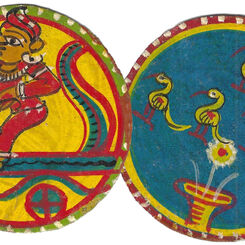
Handmade Ganjifa Birds Playing Cards
This set of Ganjifa cards is a beautiful example of traditional cards from India.
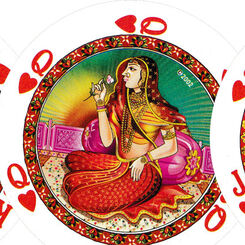
Ganjifa™ - Indo-French ganjifa by Asha Industries
A colourful pack of round cards with Ganjifa designs by Asha Industries, Mumbai, India, 2002.
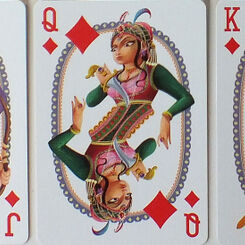
Bharata Playing Cards
Bharata Playing Cards - Series 2, based on Indian folk art, published by Sunish Chabba, 2018.
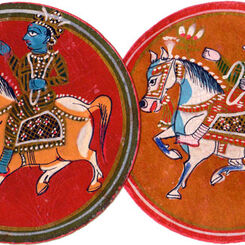
Dashavatar Ganjifa from Sheopor
‘Ganjifa’ playing cards made in Sheopor in the North of Madhya Pradesh province in Central India. Th...
Teen Patti Playing Cards
Anjali DSouza, an illustrator from Chennai, India has designed a pack of cards using Indian truck ar...
Dashavatara Ganjifa by Chitrasala Press
Chromo-lithograph Ganjifa cards by the Chitrasala Press, around 1950. Ten suits of twelve cards, eac...
The History of Playing Cards
Playing cards appear in European records in the late 14th century, but their earlier history lies fu...
Art in Playing Cards
Playing cards have long served as miniature canvases—hand-painted, gilded, engraved and printed with...
Most Popular
Our top articles from the past 60 days


