


Saptamatrika “Seven Mothers” Ganjifa
Feminine powers from Hinduism celebrated on ganjifa cards

Above: Raghurajpur and Brahmapur, where the two decks were made.
Ferocious warrior goddesses unfold across two ganjifa decks that explore the Saptamatrika (“Seven Mothers”) of Hinduism. First we’ll consider the source material, then see how the ganjifa artists rendered it on the cards.
Hinduism’s mythology and religious tradition are extraordinarily complex, with different, sometimes conflicting, versions of the story. Here’s the Saptamatrika tale from the sacred text Devi Mahatmya as I best understand it.
The gods were overwhelmed in a battle against demons. To sway the tide, the goddess Devi drew forth the feminine warrior powers of male gods which manifested themselves as fierce goddesses. Six of them became known as the six Mothers. Earlier, another goddess, the terrifying, macabre Kali, had emerged from Devi herself. After Kali killed the demons Chanda and Munda, Devi named her Chamunda. She later came to be considered as the seventh Mother.

Brahmani court card from saptamatrika deck by Banamali Mahapatra (2000).

Brahmani pip cards from saptamatrika deck by Banamali Mahapatra (2000).

Brahmani court card from saptamatrika deck by Sitakanta Mahapatro (2002).

Brahmani pip cards from saptamatrika deck by Sitakanta Mahapatro (2002).
Above: Brahmani court and pip cards from Saptamatrika decks by Banamali Mahapatra (2000) and Sitakanta Mahapatro (2002).
Confusingly enough, both Saptamatrika decks we’re looking at contain eight suits – seven dedicated to the Seven Mothers and an eighth to another deity. This was likely done because the vast majority of ganjifa decks have an even number of suits. Adding the eighth deity brings the deck to eight suits (96 cards total).
The Seven Mothers are:
- Brahmani, the sakti (feminine power) of the god Brahma, who rides a swan
- Maheshwari, the sakti of Shiva, who rides the bull Nandi
- Kaumari, the sakti of Kartikeya/Skanda, who rides a peacock
- Vaishnavi, the sakti of Vishnu, who rides the half-man, half-bird Garuda
- Varahi, the sakti of Varaha (an avatar of Vishnu), who rides a buffalo/boar
- Indrani, the sakti of Indra, who rides the elephant Airavata
- Chamunda, who emerged out of Devi and rides a corpse/owl/jackal
Both decks come from Odisha: one, by Banamali Mahapatra, is from Raghurajpur while the other, by Sitakanta Mahapatro, is from Brahmapur. The two styles are wildly different. The Raghurajpur deck has sharp outlines and bright colors, each little detail in clear focus. Brahmapur’s deck is more flowing and stylized, with bold, hasty strokes.
Artist: Banamali Mahapatra

Maheshwari court card from Saptamatrika deck by Banamali Mahapatra (2000).

Maheshwari pip cards from Saptamatrika deck by Banamali Mahapatra (2000).

Kaumari court card from Saptamatrika deck by Banamali Mahapatra (2000).

Vaishnavi court card from saptamatrika deck by Banamali Mahapatra (2000).
Above: Maheshwari court and pip cards and Kaumari and Vaishnavi court cards from Saptamatrika deck by Banamali Mahapatra (2000).

Varahi court card from saptamatrika deck by Banamali Mahapatra (2000).

Indrani court card from saptamatrika deck by Banamali Mahapatra (2000).

Chamunda court card from saptamatrika deck by Banamali Mahapatra (2000).

Possibly Durga court card from saptamatrika deck by Banamali Mahapatra (2000).
Above: Varahi, Indrani, Chamunda, and possibly Durga court cards from Saptamatrika deck by Banamali Mahapatra (2000).
Banamali Mahapatra’s version shows what appears to be the same deity on both court cards; it’s unclear which one is the pradhan, lower court card, and which is the raja, higher court card. The pip symbols are depictions of each goddess’s vahana, or mount. It’s also unclear who Mahapatra devoted the eighth suit to; it might be the goddess Durga.
Artist: Sitakanta Mahapatro

Maheshwari court card from Saptamatrika deck by Sitakanta Mahapatro (2000).

Kaumari court card from Saptamatrika deck by Sitakanta Mahapatro (2000).

Vaishnavi court card from Saptamatrika deck by Sitakanta Mahapatro (2000).

Vaishnavi pip cards from Saptamatrika deck by Sitakanta Mahapatro (2000).
Above: Maheshwari and Kaumari court cards and Vaishnavi court and pip cards from Saptamatrika deck by Sitakanta Mahapatro (2000).

Varahi court card from Saptamatrika deck by Sitakanta Mahapatro (2000).

Indrani court card from Saptamatrika deck by Sitakanta Mahapatro (2000).

Chamunda court card from Saptamatrika deck by Sitakanta Mahapatro (2000).

Ganesha court card from Saptamatrika deck by Sitakanta Mahapatro (2000).
Above: Varahi, Indrani, Chamunda, and Ganesha court cards from Saptamatrika deck by Sitakanta Mahapatro (2000).
As with the deck above, it’s hard to tell which of the two court cards is the pradhan and which is the raja. The goddesses are still shown on their mounts; the pip symbols are attributes traditionally carried by the goddesses. The eighth suit is dedicated to the elephant-headed god Ganesha, who is often portrayed safeguarding the Sapta Matrika in Hindu iconography.
Footnotes
- All ganjifa images courtesy: Indira Gandhi National Centre for the Arts, Digital Cultural Resources, IGNCA
- IGNCA, Ganjifa cards database.
- IGNCA, Banamali Mahapatra.
- IGNCA, Sitakanta Mahapatro.

By Lev Golinkin
United States • Member since May 26, 2026
I'm a US-based author and journalist. I've been collecting playing cards since I was about 8 years old, when I got mesmerized by the various decks that were used in Soviet Ukraine, where I'm from. I collect mainly European decks such as those by Dondorf, Grimaud, and Piatnik. I love courts above all else, and am drawn toward historical and artistic decks.

Activity for Saptamatrika “Seven Mothers” Ganjifa
Sign in to comment or save this article.

Related Articles

Nirmal Dashavatar Ganjifa
A deck with an animated style.

A 16-Suit Dashavatar Ganjifa by Banamali Mahapatra
A masterpiece from a ganjapa virtuoso

Brahmapur Dashavatar Ganjifa
A folksy take on the classic Indian pattern.

Hindu Astro-Mythological Tarot
A hand-painted Ganjifa pack adapts tarot’s major and minor structure to Hindu astrological and mytho...

Dashavatar Darchiri Ganjifa by Sawantwadi Palace
The luxury dashavatar line from the Sawantwadi royal palace.

Dasamahaviya Ganjifa
Sacred feminine power bursts forth from these ganjifa decks

Navadurga Ganjifa
Major Hinduism goddess and her manifestations

Dasavatara Ganjifa by Sawantwadi Lacquerwares
Traditional Dasavatara Ganjifa from Sawantwadi Palace in Maharashtra.

Ashtamali “Eight Wrestlers” Ganjifa
Lord Krishna’s conquests on ganjifa cards.

The Avatar Tas (Ganjifa)
Rules for The Avatar Tas (Ganjifa), the five-player Bengali Dashabatar Tash game played with a Ganji...

Bengali Dashavatar Ganjifa: Dashabatar Tash
An ancient Bengali version of the Dashavatar Ganjifa pattern.

Decks of Divinity
The circular Ganjifa cards of Odisha are hand-painted by Chitrakar makers and used in traditional ga...
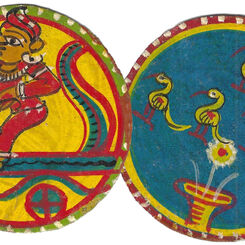
Handmade Ganjifa Birds Playing Cards
This set of Ganjifa cards is a beautiful example of traditional cards from India.
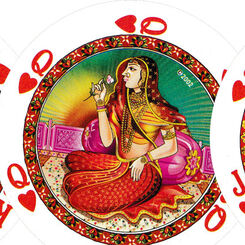
Ganjifa™ - Indo-French ganjifa by Asha Industries
A colourful pack of round cards with Ganjifa designs by Asha Industries, Mumbai, India, 2002.
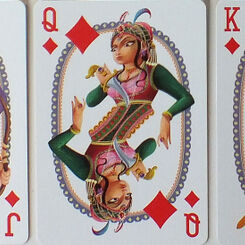
Bharata Playing Cards
Bharata Playing Cards - Series 2, based on Indian folk art, published by Sunish Chabba, 2018.
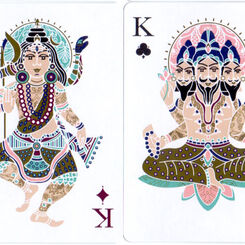
Divine Art
Divine Art Playing Cards by Sunish Chabba & Guru Playing Card Company, 2016.
SiRen International
“SiRen International” playing cards based on traditional style of Indian miniature painting, 1998
Dashavatar Ganjifa from Sheopor
‘Ganjifa’ playing cards made in Sheopor in the North of Madhya Pradesh province in Central India. Th...
Dashavatara Ganjifa by Chitrasala Press
Chromo-lithograph Ganjifa cards by the Chitrasala Press, around 1950. Ten suits of twelve cards, eac...
The History of Playing Cards
Playing cards appear in European records in the late 14th century, but their earlier history lies fu...
Current Trends
Articles and Explore tags gaining attention


