

The Emperors of Russia
Three decks celebrating the House of Romanov.
The splendor of the House of Romanov is on full display in three similar souvenir decks reviewed here.
1. The Emperors of Russia
Romanovs – the rulers of Imperial Russia – are featured on this thoughtful published deck by AKM. The courts display 12 out of the 14 emperors and empresses from Peter the Great and Catherine the Great to Nicholas II, the last emperor dethroned and eventually murdered by the Bolsheviks. It appears the single-figure images of the rulers are taken from actual paintings – for example, compare Alexader I (Jack of Spades) to his portrait – a nice historical touch. Each monarch’s name is written in Russian and English along with their dates of birth, death, and reign.
The Aces of Clubs and Spades carry the lesser and greater coats-of-arms of the Russian Empire, respectively. The arms of the House of Romanov are on the Ace of Diamonds; I believe the Ace of Hearts shows the dynastic coat-of-arms (the insignia of the Romanov ruling dynasty as opposed to the entire Romanov family), but am not sure.


The Emperors of Russia playing cards published by AKM, St.Petersburg, 2004.
The jokers represent the darker moments of Romanov rule. One is Alexander Menshikov, a favorite of Peter I who ruled the empire in all but name after Peter died before being overthrown and exiled to Siberia. The other joker is Grigori Rasputin, the licentious mystic who wielded enormous influence over Alexandra, Nicholas II’s wife. Rasputin was infamously murdered by being poisoned, shot, beaten, and drowned by Russian nobles. His sordid figure and the control he had over the empress helped hasten the downfall of the already-weak tsarist regime.
See also: Russian Emperors►
Historical Note: the term "Tsar" remained in daily popular usage and folklore until the end of the monarchy in 1917, and the two titles Emperor / Tsar are often used interchangeably. This might cause potential confusion since there were 5 earlier Romanov tsars between 1613-1696 (one of whom, Fedor III, is included in deck 3) - making a total of 19 Romanovs until the fall of the monarchy in 1917.
2. Russian Tsars souvenir playing cards
Our second deck is published by the Bronze Horseman (Mednyi Vsadnik). It, too, has Romanov figures taken from historical portraits on the court cards, but unlike the AKM deck, it puts monarchs on the aces as well. Because of that, it has all 14 Romanov emperors and empresses, plus two Romanov tsars – Michael I and Alexis I – who ruled Russia before 1721, when Peter the Great proclaimed Russia an empire and adopted the title of emperor.


Russian Tsars souvenir playing cards published by the Bronze Horseman (Mednyi Vsadnik), St Petersburg, c.2022.
Alexander Menshikov and Grigori Rasputin once again fill the roles of jokers. The Great Imperial Crown of Russia is featured on the back.
3. Romanow #1141 by Piatnik
Rounding out our decks is Piatnik’s Romanow #1141, one of their series featuring the rulers of various European countries that was created in the 1990s–2000s. Unlike the previous two decks, Piatnik’s courts don’t seem to be taken from actual portraits. The deck includes Tsar Feodor III, a ruler not found on the other two decks. The aces feature ornate frames.


Romanow #1141 by Piatnik, 1997. These designs were reprinted in 1999 at the St Petersburg Colour Printing Plant titled “Peterhof”.
There are three jokers – two are the already familiar Menshikov and Rasputin while the third is Ernst Johann von Biron. He, too, was a favorite at the Russian court (his patron was Empress Anna) and, like Menshikov, he was overthrown and exiled to Siberia. Unlike Menshikov, von Biron was eventually pardoned and returned to court. The back of Piatnik’s deck contains a mystery: what appears to a medallion with the imperial crown and a fancy letter “A” made out of either metal or precious stones. I haven’t been able to find what this refers to. The deck’s case has an oval cutout so which shows the medallion when the cards are in the case.

By Lev Golinkin
United States • Member since May 26, 2026
I'm a US-based author and journalist. I've been collecting playing cards since I was about 8 years old, when I got mesmerized by the various decks that were used in Soviet Ukraine, where I'm from. I collect mainly European decks such as those by Dondorf, Grimaud, and Piatnik. I love courts above all else, and am drawn toward historical and artistic decks.

Activity for The Emperors of Russia
Sign in to comment or save this article.

Related Articles
Piatnik’s 200th Anniversary
A special philatelic souvenir for Piatnik’s 200th anniversary, combining playing cards an...
Shamrock Irish Heritage playing cards
A celebration of some of Ireland’s most famous patriots, politicians and poets.
Budapest souvenir
Colour views of the Hungarian capital, Budapest, on all the courts and Aces.
CCCP playing cards
Soviet and other Communist celebrities depicted on every card, designed by Vladislav Pankevitch.
Treasures of the Hermitage / Shedevry Ermitazha
‘Treasures of the Hermitage Museum’ souvenir playing cards (‘Shedevry Ermitazha’), Russia.
Saint Petersburg vintage playing cards
Saint Petersburg vintage photography playing cards.
Peterhof souvenir playing cards
Peterhof souvenir playing cards (Petergof suvenirnye igral’nye karty) published by Mednyi Vsadnik (B...
Treasures of the Russian Museum
Treasures of the Russian Museum / Russkii Muzei : suvenirnye igral’nye karty.
El Al Airlines
Pack designed by Jean David (1908-93) for El Al Airlines. The courts are named after Biblical charac...
Folklore No.169
Austrian Folklore deck first published by Piatnik in 1934.
Cosmopolitan № 2121 playing cards
“Cosmopolitan” № 2121 playing cards designed by Russian artist Valeri Mishin, 1996
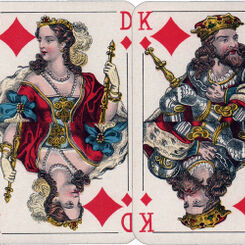
Piatnik No.97
Non-standard French-suited cards published by Ferd Piatnik & Sõhne, Vienna, c.1940s.
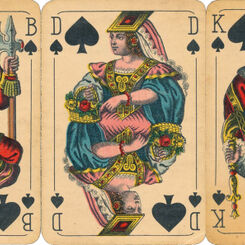
Vienna (ex-Lyon) pattern
‘Vienna pattern’ derived from archaic Lyon pattern by Ferd Piatnik & Söhne A.G., c.1926-1934.
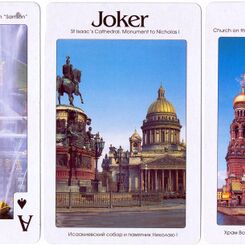
St Petersburg Souvenir
St Petersburg Souvenir playing cards, 2004
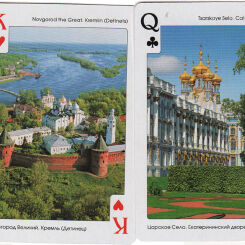
Russia Souvenir Playing Cards
Russia Souvenir Playing Cards published by The Bronze Horseman, c.2004.
Peterhof
“Peterhof” deck manufactured at the St Petersburg Colour Printing Plant in 1999.
Kaiser Jubiläum
Kaiser Jubiläum Imperial playing cards made in Austria by Ferd Piatnik & Sons, Vienna.
48: Ferdinand Piatnik & Sons
Ferd. Piatnik produced a very large range of cards with many different standard and non-standard pat...
Russian Style
Russian style playing cards first published in 1911.
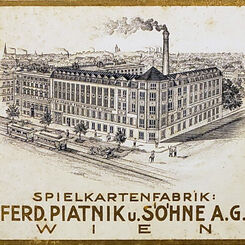
Ferd. Piatnik & Söhne
Ferdinand Piatnik was born in Ofen on October 14, 1819.
Current Trends
Articles and Explore tags gaining attention


