


Wheel of Time
A deck exploring the visual traditions and social worlds of historical Rus.

Above: Front of the Wheel of Time box (Колесо времени), a historical reconstruction by Evgenia Zhade.
Presented as a historical reconstruction project, this deck was created by artist Evgenia Zhade and publisher Aleksey Orleansky. Issued in a limited edition, it explores the attire, weaponry, and daily life of Rus from the 10th through the 17th centuries, mapping each suit to a distinct social and cultural stratum:
- Diamonds: This suit represents the wealthy eastern trading stratum, with merchants, rich attire, and animal and floral medallions evoking Rus' trade contacts with the East.
- Spades: This suit represents the pastoral and peasant world, with sheep, rams, plain living, and a more austere palette.
- Clubs: This suit represents the craft and domestic labour stratum, with spinning, household work, and ornament rooted in Scythian and early Slavic animal style traditions.
- Hearts: This suit represents the feminine domestic and lyrical sphere, including the home, carrying water, courtship, and harvest.
Although the suits depart from the classical Western convention, where they are largely abstract and carry no social meaning, the deck’s illustrated pip cards use transformation-inspired designs. The suit symbols are placed within historical scenes and ornamental compositions while retaining their recognisable forms, so each card functions as a small ethnographic vignette.
Evgenia Zhade consistently weaves historically rooted elements of ancient Rus' and Slavic ornamentation into the deck:
- The falcon on the Spade Jack echoes the Rurikid princely emblem, a diving falcon associated with the later "trident" sign.
- The raven on the Club Jack is a folkloric bird associated with omens, with a possible Norse parallel. This is fitting for a deck rooted in the "from the Varangians to the Greeks" trade route.
- Interlace and knotwork ornament on the decorative pip cards echoes miniatures in illuminated manuscripts and carving in white stone.
- Animal style motifs, including hares, horses, and birds, reflect a legacy of Scythian and Sarmatian decorative traditions and early Slavic traditions.
- Kolty and pendants in the ornamentation are stylised versions of genuine temple ring jewellery worn by noblewomen.
- Faces resembling masks in the higher pip cards are a probable reference to protective ritual masks worn by mummers.
The deck contains 52 playing cards measuring 89 × 58 mm, along with two Jokers and two descriptive cards. The card back directly echoes the deck's title. It features a spoked wheel evoking the Slavic solar symbol (kolovrat), surrounded by foliage and two crescent moons representing lunar symbols dating from before Christianisation. See the back .

Above: The aces share a common composition: a warrior set against a landscape, holding a shield bearing the suit's emblem.

Above: The Kings are distinguished from the Jacks by the richness of their dress and attributes.

Above: Each Queen wears attire specific to her historical period.

Above: The Jacks form the most ethnographically vivid group. The Jack of Clubs is a hooded figure with a raven and a dagger; it is the deck's most enigmatic image.


Above: The lower numbered cards (2–6) are rendered as genre scenes, while the higher numbered cards (7–10) shift towards purely decorative ornament, with the suit symbol woven throughout.

Above: The two Jokers form a deliberate pair: a jester holding a fan of playing cards and a peasant cradling a piglet. Each is framed by its own plant symbolism: rowan, a ward against evil spirits, and oak, Perun's sacred tree.
The card back plays directly on the deck's title. It features a spoked wheel evoking the Slavic solar symbol (kolovrat), surrounded by foliage and two crescent moons representing lunar symbols dating from before Christianisation.

By Dmitriy Staroverov
Russian Federation • Member since July 27, 2026
I'm a playing cards collector from Russia, Moscow. My area of interest is B.Dondorf decks, collection of historic Russian and Chinese decks throughout its history. I'm a medical doctor, ICU Specialist.

Activity for Wheel of Time
Sign in to comment or save this article.

Related Articles

Ruslan and Lyudmila
The Russian art collective Karte-Mesto! presents Pushkin's epic poem.
Saga aka King Arthur
Capturing the spirit of medieval legend on playing cards.
Allegories and Myths
Semi-transformation playing cards from artist Violeta Monreal.
Introduction to Collecting Themes
Playing cards can be broadly categorised into standard and non-standard designs, with collectors app...

Russian folk art playing cards
Russian folk art playing cards produced by Natalia Silva, USA, 2017.
Novosibirsk Fair
Novosibirsk Fair playing cards designed by Sergei A. Grebennikov, Russia, 1997.
Lubok playing cards
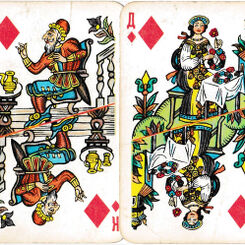
Lubok playing cards designed by Victor M. Sveshnikov. Russia, 1984.
Matryoshka playing cards
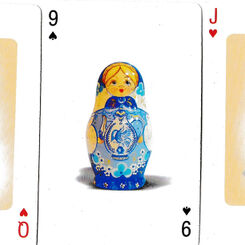
The first nested doll set was carved in 1890.
Palekh and Kholui lacquer miniatures
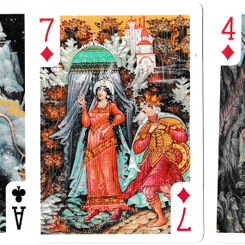
Palekh and Kholui lacquer miniatures.

Russian Emperors
Russian Emperors playing cards / “Rossiiskie imperatory karty igral’nye” produced and illustrated b...

Russian Beer
Russian Beer playing cards / “Russkoe pivo karty igral’nye” produced in 2006
Dead Souls
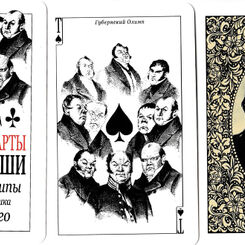
Dead Souls, or “Mertvye dushi igral’nye karty” produced in 2006 by Aleksei Orleanskii.
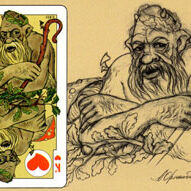
East Slavonic Mythology
East Slavonic Mythology designed by Aleksey Orleansky (1994) featuring creatures from the watery und...
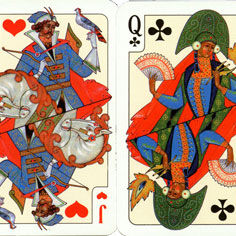
Palekh by Aleksey Orleansky
In the style of religious icon paintings, these court card figures wear costumes reminiscent of the ...
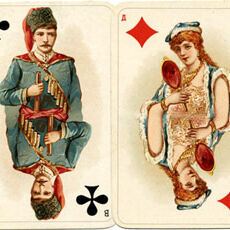
Russian Historical playing cards
Russian “Historical” playing cards with designs by Nikolay Karazin, 1897.
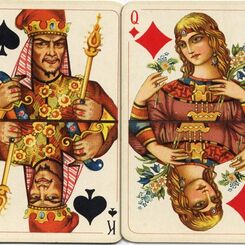
Slavonic
Playing cards depicting Slavonic history, costumes, folklore, mythology and traditional life, includ...
Russian Style
Russian style playing cards first published in 1911.
Russian “Historical”
Russian “Historical extra fine No.204” Playing Cards depicting Ancient Dynasties, 1920s.
Master of the Banderoles
Playing Cards by the Master of the Banderoles, one of the earliest professional printmakers.
The History of Playing Cards
Playing cards appear in European records in the late 14th century, but their earlier history lies fu...
Most Popular
Our top articles from the past 60 days


