


López y Compañía satirical pack
Caricature and popular graphic humour in mid-19th century Barcelona.

The base of the ace of cups is a setting for a cat stalking a mouse.
López y Compañía’s satirical pack is primarily a work of caricature and humour, with a deliberately grotesque treatment of the human figure. The court figures depart from conventional Spanish-suited courts, with exaggerated features and costumes that give them a comic character. The coin suit is especially inventive. Instead of simply repeating conventional coins, they are small circular medallions containing faces and caricatured heads, a sequence of miniature comic portraits. The ace bears the inscription “Con Real Privilegio Esclusivo De S. M.” around the shield, referring to the Royal Privilege of Invention granted to Antonio López on 31 July 1855 for “un método para pintar naipes aplicado á la imprenta”, a method for colouring playing cards applied to printing.¹


The colouring is vivid, although not always precisely registered, giving some cards an appearance reminiscent of hand colouring. López’s contemporary advertising, however, emphasised the durability and consistency of his colours. One advertisement invited customers to place a card in a glass of water for as long as they wished, claiming that the colours would remain unaltered. This suggests that permanence and uniformity, rather than the slightly irregular registration visible on surviving examples, were the principal qualities being promoted. The engraver's name «Cabanach» can be seen on the four of coins.

The surviving López material belongs to a transitional period in which different printing and colouring techniques were available. The precise nature of the process protected by the 1855 privilege remains unclear, and it would be premature to equate it with any one particular printing technique. By the later 1860s, Fulladosa y Compañía was using newer methods, including lithography, to reproduce López designs. Yet the emphasis on colour permanence continued: later Fulladosa advertisements described its cards as “pintados con colores permanentes”, suggesting that durable colour remained an important selling point of the business.
The ornamental elements are equally exuberant: huge cups, elaborate costumes, plumed hats and exaggerated facial expressions. Other suit symbols acquire decorative additions. The four of coins contains a vignette of two comical figures seated at a table playing cards. Much of the humour comes from pushing the established visual language of playing cards towards absurdity. Theatrical, carnivalesque and deliberately absurd are perhaps the most appropriate terms for the overall effect.


López y Compañía satirical playing cards, Barcelona 1861–62. © The Trustees of the British Museum number 1982,U.4571.1-48 ►
López’s satirical experiment should also be viewed within the broader nineteenth-century Spanish tradition of using popular printed imagery, including playing cards, for comic and satirical purposes. Rather than merely illustrating a conventional Spanish pack, López transformed its familiar structure into a medium for caricature and visual humour.
¹ The precise nature of López's patented method remains unclear. The 1855 privilege describes it simply as “un método para pintar naipes aplicado á la imprenta”, and the surviving cards provide evidence of colour printing but do not by themselves establish exactly how the patented process worked. By the later 1860s, newer printing methods were being adopted, and Fulladosa subsequently reproduced some López designs lithographically, showing that the designs themselves outlived the particular production methods with which López had begun.
References
Arxiu Històric de la Ciutat de Barcelona : Catàleg de la Col·leció de Naips (2018) ►
British Museum : López and Company (click ‘Related objects’)►
Ferro Torrelles, Víctor : López y Compañía, una vida de inventor, La Sota Número 44, Octubre 2015.
Willshire, W. H.: A Descriptive Catalogue of Playing and Other Cards in the British Museum, Trustees of the British Museum, 1876, reprint 1975. (Spanish 36)

By Simon Wintle
Spain • Member since February 01, 1996
I am the founder of The World of Playing Cards (est. 1996), a website dedicated to the history, artistry and cultural significance of playing cards and tarot. Over the years I have researched various areas of the subject, acquired and traded collections and contributed as a committee member of the IPCS and graphics editor of The Playing-Card journal. Having lived in Chile, England, Wales, and now Spain, these experiences have shaped my work and passion for playing cards. Amongst my achievements is producing a limited-edition replica of a 17th-century English pack using woodblocks and stencils—a labour of love. Today, the World of Playing Cards is a global collaborative project, with my son Adam serving as the technical driving force behind its development. His innovative efforts have helped shape the site into the thriving hub it is today. You are warmly invited to become a contributor and share your enthusiasm.

Activity for López y Compañía satirical pack
Sign in to comment or save this article.

Related Articles

A Catalan-style pack of c.1860
López y Compañía and the Barcelona cardmaking tradition.

Tradition with a touch of fantasy
A fanciful variation by López y Compañía within the Spanish-suited tradition.

Antonio López y Compañía
Innovation and invention in nineteenth-century Spanish playing cards.
Hand-drawn transformation cards, c1870
Whimsical pen-and-ink drawings copied from the Maclure, Macdonald & Macgregor transformation pack.
Bibaraja
Amusing designs of boys as circus performers by Alberto Muñiz Sánchez.

Toros: De El Cordobés a Espartaco
Publicity pack for the Spanish newspaper Ya with caricatures of famous bullfighters by Fernan...
El Jueves playing cards
Caricatures of 52 famous Spaniards for the satirical magazine “El Jueves”.
Baraja Mística
‘Baraja Mística’ satirical playing-cards featuring revelling clergy published by Litografía Fernánde...
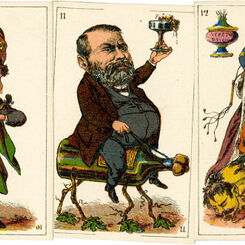
Spanish 19th century Political pack
Satirical playing cards manufactured by Francar y Cía depicting political situation.
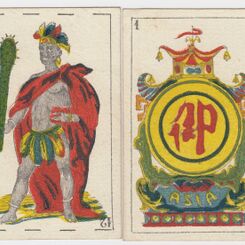
Four Continents playing cards
made by Fulladosa y Compañía of Barcelona
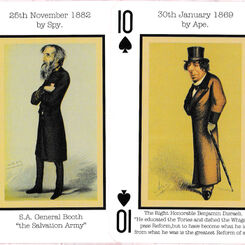
Vanity Fair 1868-1914
Vanity Fair 1868-1914 playing cards published by Billy Bembo, United Kingdom, 1995.

Wall Street Most Wanted
“Wall Street Most Wanted” playing cards, USA, 2003.
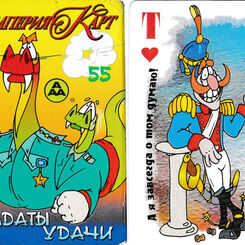
Soldaty Udachi
“Soldaty Udachi” (Soldiers of Fortune) Army and Police humour playing cards, Russia, 2001.
Klutz Card Deck
Klutz Card Deck with comic courts.

Bicycle Emotions
Bicycle Emotions playing cards with custom emotions on the courts to help you bluff at cards, 2013. ...
El Tripero
Hand-drawn semi-erotic, satirical playing cards by Lautaro Fiszman ‘El Tripero’, 2002.
Jeu Grotesque
Jeu Grotesque was first published in France c.1800.
Repoker Político
Political caricature playing cards designed by Antonio Olveira, published by the Malaga newspaper “D...
Adolfo Matarelli Transformation
Matarelli was a well known caricaturist who first illustrated Carlo Collodi's famous Pinocchio story...
Mr Punch’s Playing Cards
Mr Punch’s Playing Cards, 1896.
Most Popular
Our top articles from the past 60 days


