


Whist No. 28
Gorgeous luxury deck from J. Müller & Cie, Schaffhouse.
Whist No.28, a J. Müller luxury pattern with exquisite chromolithography and shading, is a delight. The courts (especially the Jacks and Kings) bear the too cool to care affectation of high school yearbook portraits. The aces are plain, the corners golden, the joker a standard Müller edition.
The deck is the third iteration of this pattern. As Joop Muller explains¹, the first one was stencil-colored from c.1880 while the second, from c.1919, was printed in chromolithography. The third version differs from the previous two in that the Jack of Clubs carries the Swiss, as opposed to the Red Cross flag. See the box


Above: Whist No.28 produced by J. Müller & Cie, Schaffhouse, Switzerland, 1920s. 52 cards + joker in box.
References
- DXPO deck of the month : December 2023 ►
- WWPCM : Luxus-bild ►

By Lev Golinkin
United States • Member since May 26, 2026
I'm a US-based author and journalist. I've been collecting playing cards since I was about 8 years old, when I got mesmerized by the various decks that were used in Soviet Ukraine, where I'm from. I collect mainly European decks such as those by Dondorf, Grimaud, and Piatnik. I love courts above all else, and am drawn toward historical and artistic decks.

Activity for Whist No. 28
Sign in to comment or save this article.

Related Articles
Cheating at Whist and Bridge
The Blackleg in the Drawing-Room: Cheating and the Victorian Gentleman.
Pictures of Early Whist writers and their stories
The Invisible Experts: Tracking the Elusive Faces of Whist History.
Solo Whist
A distinctive British trick-taking game that emerged in the mid-19th century.
The Molassine Company and its link to Whist and Bridge
A savvy marketing strategy blending Victorian decorative design with Edwardian practicality.
Foster’s Self-Playing Whist Cards
In 1890 R. F. Foster published the first edition of “Foster’s Whist Manual” which was to become the ...
The Personalities and Books which shaped the game of Whist, 1860-1900
All the books described here are from Tony Hall's own collection, put together over years because of...
Johannes Müller c.1840
Facsimile edition of Swiss suited deck first published by Johannes Müller in c.1840.
Progressive Whist Cards - page 2
Wireless Whist itself, in many forms...
Majority Calling and Value Bidding in Auction Bridge; a little bit of history
The centuries-old game of Whist mutated through various stages into Contract Bridge as we know it to...

Dondorf
The luxury playing card factory founded in Frankfurt am Main by Bernhard Dondorf in 1833 existed for...
Swiss Spanish-Suited Cards, c.1875
Spanish-suited playing cards manufactured by J. Müller for export to Latin American countries, c.187...
Swiss Scenic Ace Souvenir Cards, c.1860
Souvenir pack with Scenic Aces made by J. Müller (Diessenhofen), c.1860. The courts are conventional...
Swiss Scenic Ace Souvenir Cards, c.1850
Souvenir pack with Scenic Aces made by Müller (Diessenhofen), c.1850.
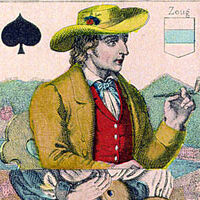
Swiss Regional Costumes Playing Cards, c.1890
This Swiss Regional Costume pack can be seen as an early form of tourist souvenir which subsequently...
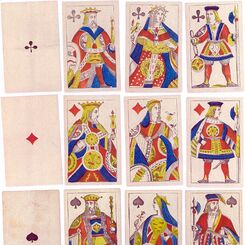
Swiss Piquet Playing Cards, c.1850-60
Piquet playing-cards made by J. Müller, Diessenhofen, c.1850-60. The full-length court cards are fol...
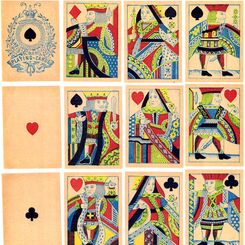
Swiss Mogul Cards, 1880-1890
English type 'Mogul' playing cards manufactured in Switzerland by John Müller for export to India, c...

Swiss French Suited Playing Cards, c.1840
French-suited playing-cards in the Paris pattern appeared in Switzerland around the end of the sixte...
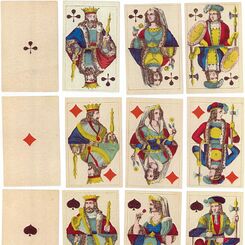
Müller (Diessenhofen), c.1840-50.
Playing Cards made by J. Müller, Diessenhofen, c.1840-50 with court cards coloured differently ...
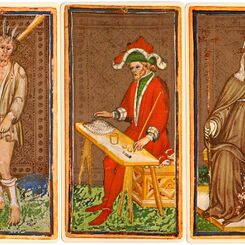
The Visconti-Sforza Tarot, c.1460
This pack of tarot cards appears to have have been made in the Bembo workshop in Cremona for Bianca ...
Art in Playing Cards
Playing cards have long served as miniature canvases—hand-painted, gilded, engraved and printed with...
Current Trends
Articles and Explore tags gaining attention


