


Good Neighbor Inca & Maya playing cards
Incan and Mayan culture represented in striking designs by Ariel Baynes.
As part of the era’s “Good Neighbor” cultural exchange initiatives, the American Association of University Women in Washington, D.C., commissioned the artist Ariel Baynes to create this double pack depicting the culture of the Incans and the Mayans from source material in the Columbus Memorial Library, Pan American Union. “Ariel Baynes” was the pen name of the artist Martha Baynes Smith. She achieved artistic cohesion across the court cards and jokers by using the same set of colours in both packs, namely, red, orange, turquoise and black.
Inca
The kings in this pack are taken from pictures of Inca rulers. Each wears a gold mask, with a protruding tongue representing wise speech and authority. Since no queens are found in Incan art, the four queens are drawn from pictures of cat goddesses. The jacks and the Joker are warriors. The back design in red and black is an Inca god.


Maya
These designs were drawn from the Dresden Codex. The King of Spades wears a hummingbird headdress, while the other kings wear feathered serpent headdresses. The queens, too, wear elaborate headdresses. The jacks depict jaguars, as Mayan priests sometimes wore jaguar masks. The back design in turquoise and black represents Kukulcan, a feathered serpent deity.


Good Neighbor Inca & Maya playing cards designed by Ariel Baynes. Made by Brown & Bigelow, St. Paul, MINN., for the American Association of University Women, Washington, D.C., USA, 1941. 2 x 52 cards + 1 Joker (extra cards with explanatory text missing). Size: 57.5 x 89 mm. All images © 1941 Ariel Baynes
An extra card in each set provides further background information; however, these are unfortunately missing from the set being reviewed here. Although the jokers are dated 1941, the Hochman Encyclopedia of American Playing Cards gives the issue date as 1948.

By Roddy Somerville
France • Member since May 31, 2022
Roddy started collecting stamps on his 8th birthday. In 1977 he joined the newly formed playing-card department at Stanley Gibbons in London before setting up his own business in Edinburgh four years later. His collecting interests include playing cards, postcards, stamps (especially playing cards on stamps) and sugar wrappers. He is a Past President of the Scottish Philatelic Society, a former Chairman of the IPCS, a Past Master of the Worshipful Company of Makers of Playing Cards and Curator of the WCMPC’s collection of playing cards. He lives near Toulouse in France.

Activity for Good Neighbor Inca & Maya playing cards
Sign in to comment or save this article.

Related Articles

Sandia Casino American Indian playing cards
Southwest Collection I: Pueblo culture displayed on casino cards.
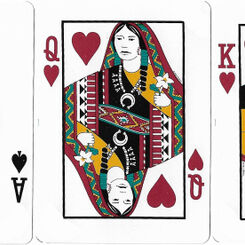
Arrowhead Playing Cards from San Felipe’s Casino Hollywood
A gorgeous and well-researched celebration of Native American culture.
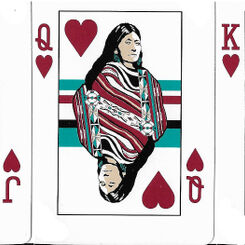
San Manuel Casino
Native American-themed playing cards used by tribal casinos.

Alaska scenic playing cards
Alaska scenic playing cards featuring scenes of Alaskan life, USA, c. 1960.

Alabama Crimson Tide 1972
Photos of American football players representing the University of Alabama in 1972.

Trip or Trap
Fighting drug abuse in the flower power era using humour and ridicule.

Vargas Girls
‘Vargas Girls’ paintings by Alberto Vargas in a deck of cards published by Creative Playing Card Co ...
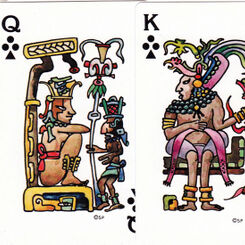
Maya Deck
The Maya Deck produced by Stancraft for Hoyle, 1976.

Stancraft “Split Deck”
Stancraft “Split Deck”, 1979.

Binary Playing Cards
Promotional deck for Honeywell Computers by Brown & Bigelow c.1968 with the cards marked in binary n...
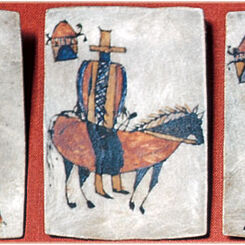
Apache cards by Tonto Naipero
Apache rawhide playing cards by ‘Tonto Naipero’, c.1871.
Ojibwa Native Indian Cards
Ojibwa Native Indian playing cards hand manufactured on birch bark in imitation of standard French /...

Remembrance
“Remembrance” playing cards, courtesy of the American Legion, manufactured by Brown & Bigelow, c.194...
Michie Tavern Museum
Historic Michie Tavern Museum playing cards by Brown & Bigelow.
Apache Playing Cards
Apache Indian Playing Cards made on rawhide, first recorded 1875.

Stancraft
Stancraft Playing Cards were manufactured by Brown & Bigelow of whom they were a subsidiary.

Hoyle
A subsidiary of Brown & Bigelow was established in 1927 to bring Hoyle products to the retail market...

Submarine Cards
Lighting in submarines involved wearing red goggles to preserve night vision for viewing instrument ...

Nutrimientos Purina
Nutrimientos Purina (Purina pet foods) advertising playing cards produced by Miguel Galas S.A. (Brow...
Brown & Bigelow
Brown & Bigelow of St Paul, Minnesota, was a leading producer of playing cards in the U.S. from the ...
Current Trends
Articles and Explore tags gaining attention


