



Soldaten Tarock
Piatnik was known for their magnificent quality of chromo-lithographic printing, and this facsimile, or reprint, of “Soldaten Tarock No. 217” is virtually as magnificent as the original.

Das Soldaten Tarock
Right: the Jack of Hearts is a sailor →
In 1918 the Austrian manufacturer Ferd. Piatnik & Söhne A.G. published a non-standard propaganda tarock deck, intending to emulate Germany’s success in World War l, titled “Soldaten Tarock No. 217”. Piatnik was known for their magnificent quality of chromo-lithographic printing, and this facsimile, or reprint, is virtually as magnificent as the original edition in depicting details of soldiers' uniforms, life at sea and military history. The trump cards are single-ended whilst the court cards are double-ended. Trump IX is titled “Standing guard at the Adriatic”. Trump XX depicts an air battle over Ferrara in Italy.

Above: eight full-length trump cards from Piatnik's reprint of “Soldaten Tarock” (1918), which have large Roman numerals at each end. The scenes depicted are from World War I. Trump II shows Line Ship Lieutenant Lerch. Trump XXI pictures a German submarine sailing victoriously into New York Harbour with the German flag flying over the Stars and Stripes (implying that the United States had been invaded)!

Above: complementing the stunningly printed trumps (above) the double-ended court cards are also printed in shades of pink, mauve, orange, blue, green, brown, yellow, red, grey and variations of each. There are no indices. Originally printed in 1918 by Ferd. Piatnik & Sohne A.G., WIEN, XIII/4. Hutteldorferstr. 229-231. Whilst the original deck was printed by chromo-lithography, the re-issue utilizes today’s modern printing methods. The Queens have descriptive comments on each card but the male court cards do not. Diamonds represent Germany; Hearts Austria-Hungary; Spades Turkey and Clubs represent Bulgaria. The Queens represent women devoted to war related charity and social work. The Cavaliers represent mounted officers and the Jacks the various soldiers and sailors. Copies of this re-print deck can be obtained online. Images and notes courtesy Rod Starling.
REFERENCES
Starling, Rod: "Something New and Topical" in 'Clear The Decks', the Newsletter for 52 Plus Joker (edited by Judy Dawson), USA, March 2011
• See also: Christie's Website, Sale 1680 / Lot 83 →

By Rod Starling (1936-2023)
United States • Member since January 09, 2013
Rod Starling was one of the founding members of the 52 Plus Joker card collectors club. He authored many articles for the club's quarterly newsletter, Clear the Decks. His collection encompasses both foreign and American decks. Rod also authored a book titled The Art and Pleasures of Playing Cards.

Activity for Soldaten Tarock
Sign in to comment or save this article.

Related Articles
Tarock Nr. 71 by Ferd. Piatnik & Söhne
Special tarock deck for the Tyrolean game Droggn.
CCCP playing cards
Soviet and other Communist celebrities depicted on every card, designed by Vladislav Pankevitch.

Some Facts About Facsimiles
A short note on facsimile decks: what counts as a facsimile, how reprints differ from originals, and...
Tell Wilmoś
Facsimile of ‘Wilhelm Tell’ Hungarian deck by Salamon Antal, Keczkemét, 1860.
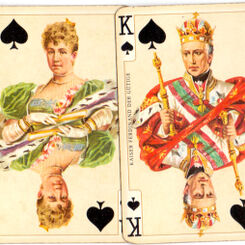
Kaiser Jubiläum
Kaiser Jubiläum Imperial playing cards made in Austria by Ferd Piatnik & Sons, Vienna.
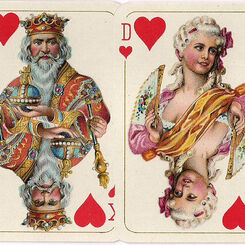
Baroque No.2118
“Baroque” by Ferd Piatnik & Sons, Vienna, reflecting a bygone era of fashion.
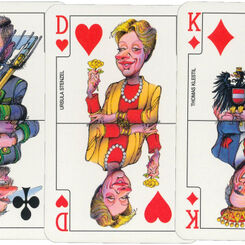
Die Neue ÖVP
Promotional deck for the Austrian People’s Party (ÖVP) printed by Piatnik, 1996.
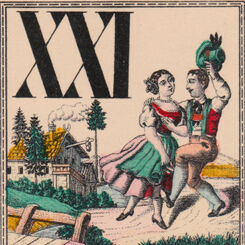
Tarok c.1900
Piatnik & Söhne “Industrie und Glück” Tarock c.1905-1910.
Vienna Melange
“Vienna Melange” Playing Cards by Piatnik with a historical feel representing the four races that ma...
Tarocco Neoclassico
Gumppenberg published several new decks by artists or engravers of the day. The designs are clear an...
Tarocchino Lombardo, c.1835
“Tarocchino Lombardo c.1835”, a facsimile edition of 2500 by Edizione del Solleone, Italy, 1981.
Bavarian Military Cards
The King of Acorns is supposed to represent Prince Otto; the King of Leaves is Maximilian II; the Ki...
Army & Navy No.303
Over the years eight different Aces of Spades were used with this brand and the Joker was also modif...
Army No.303
The Joker is particularly persuasive, whilst the Ace of Spades has a battle scene involving artiller...
Löschenkohl’s Botanical Playing Cards
Löschenkohl produced a second copper engraved deck, the Botanical Playing Cards, in 1806. This deck,...
Löschenkohl’s Musical Playing Cards
Johann Hieronymus Löschenkohl (1753-1807) produced a copper engraved deck of playing cards titled “D...
Piatnik Tarock
Deck of "Industrie und Glück" or "Rural Scenes" tarock cards manufactured by Ferd Piatnik & Söhne, V...
Tarock Cards
The earliest Tarot decks originated in Italy in the fifteenth century, with Italian suit symbols. Ho...
Hofamterspiel, c.1460
Hofamterspiel, c.1460
Most Popular
Our top articles from the past 60 days


