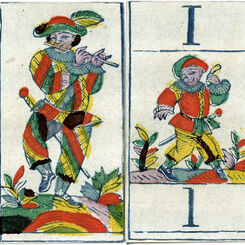
Uncut Sheet by Johann Jobst Forster

Published April 15, 2024 Updated April 18, 2024

A proof sheet containing twelve court cards of conventional French type.

GermanyJohann Jobst Forster

An uncut sheet in the British Museum collection contains twelve court cards of the conventional single-ended French-suited type, published by Johann Jobst Forster, Nuremberg, early 18th century. Two of the knaves bear shields with respectively “Joh Jobst” and “Forster”. An Austro-Hungarian eagle has been incorporated into the design of one of the jacks. The court cards are not named, as yet uncoloured and without suit symbols, which would have been applied later using stencils.

Many French regional patterns were exported and subsequently copied elsewhere. These cards by Johann Forster have many resemblances to an old Lyons pattern.
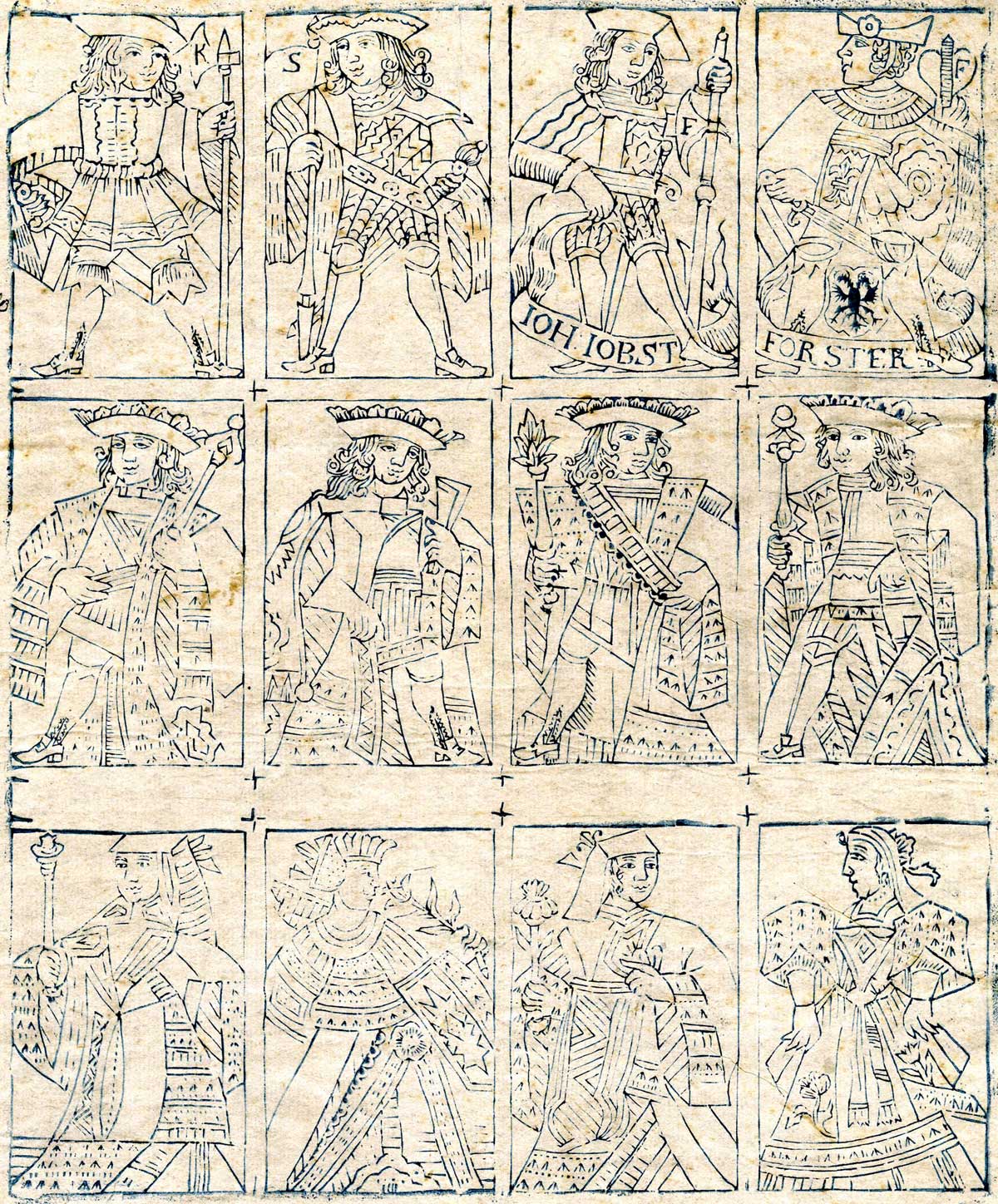
an uncut sheet containing twelve court cards of conventional 18th century type printed by Johann Jobst Forster, Nuremberg, 18th C. © The Trustees of the British Museum

Above: an uncut proof sheet containing twelve court cards printed by Johann Jobst Forster, Nuremberg, early 18th C. © The Trustees of the British Museum • number 1896,0501.1116

Reference

O’Donoghue, Freeman M: Catalogue of the collection of playing cards bequeathed by Lady Charlotte Schreiber (Sheets German 46), Trustees of the British Museum, London, 1901 [digital version here]

avatar
1,487 Articles

By Simon Wintle

Spain • Member since February 01, 1996 • Contact

I am the founder of The World of Playing Cards (est. 1996), a website dedicated to the history, artistry and cultural significance of playing cards and tarot. Over the years I have researched various areas of the subject, acquired and traded collections and contributed as a committee member of the IPCS and graphics editor of The Playing-Card journal. Having lived in Chile, England, Wales, and now Spain, these experiences have shaped my work and passion for playing cards. Amongst my achievements is producing a limited-edition replica of a 17th-century English pack using woodblocks and stencils—a labour of love. Today, the World of Playing Cards is a global collaborative project, with my son Adam serving as the technical driving force behind its development. His innovative efforts have helped shape the site into the thriving hub it is today. You are warmly invited to become a contributor and share your enthusiasm.

Related Articles

Animal Tarot by Johann Jobst Forster

Animal Tarot by Johann Jobst Forster

French-suited 78-card animal tarot deck of the Bavarian type.
1825 Cartomancy deck by Johann Ernst Backofen

Cartomancy deck by Johann Ernst Backofen

German-suited Cartomancy deck published by Johann Ernst Backofen, Nürnberg.

1825 Fantasy deck by Joseph Fetscher

Fantasy deck by Joseph Fetscher

Fantasy French-suited pack produced by Joseph Fetscher, Munich, c.1825.

1830 Bavaria pattern

Bavaria pattern

Classic German-suited Bavarian pattern by Joseph Fetscher, Munich, early 19th century.

Standard French-suited Bavarian deck by Göbl

Standard French-suited Bavarian deck by Göbl

French-suited Bavarian deck by Andreas Benedict Göbl, late 18th c.

1820 Historical playing cards by Joseph Fetscher

Historical playing cards by Joseph Fetscher

Historical playing cards by Joseph Fetscher, Munich, c.1820.

Illustrated piquet cards

Illustrated piquet cards

Bavarian piquet cards with oriental illustrations produced by Andreas Benedict Göbl, Munich, late 18...

Bavarian pattern by Ernst Jegel

Bavarian pattern by Ernst Jegel

Bavarian pattern published by Ernst Jegel, Nuremberg, late 19th C.

Conrad Jegel proof sheets

Conrad Jegel proof sheets

Two uncut German-suited proof sheets by Conrad Jegel, Nuremberg.

1835 Fantasy Bavarian pack

Fantasy Bavarian pack

An early Bavarian-style deck by Johann Conrad Jegel, Nürnberg, Germany , c.1835.

Johann Jobst Forster

Johann Jobst Forster

Deck made by Johann Jobst Forster, Nürnberg, first half of 18th century in the Paris pattern.

1920 Poker No. 140

Poker No. 140

Dondorf Poker-Karte No. 195, re-issued as Poker No. 140 for the "Argentina Compañia General de Naveg...

German playing cards

German playing cards

Card-playing rapidly became popular in medieval Bavaria and German printers were quick to supply the...

No.407 Naipe Español by F. X. Schmid

No.407 Naipe Español by F. X. Schmid

Naipe Español No.407 by F. X. Schmid, c.1980.

VICTORIA 4500 by F. X. Schmid (Argentina) S.A.

VICTORIA 4500 by F. X. Schmid (Argentina) S.A.

Naipe Español VICTORIA 4500 by F. X. Schmid (Argentina) S.A.

Naipe PAYADOR by F.X. Schmid (Argentina) S.A.

Naipe PAYADOR by F.X. Schmid (Argentina) S.A.

Naipe Español "PAYADOR ®"

1885 T O Weigel, Leipzig, 1885

T O Weigel, Leipzig, 1885

Cards from a pack designed by Ludwig Burger, 1885

1480 Early German Engraved Playing-cards

Early German Engraved Playing-cards

During the second half of the fifteenth century, with printing technology commercially established a...

Playing cards in the Upper Rhine region

Playing cards in the Upper Rhine region

Documentary evidence suggests that card playing established itself in Italy in 1376, and then spread...