




26th Yankee Division
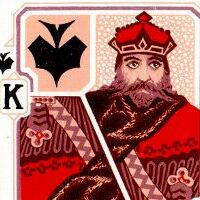
“26th Yankee Division Playing Cards” was designed by Alban B. Butler, Jr and printed by the Press of the Woolly Whale, New York, in 1933.
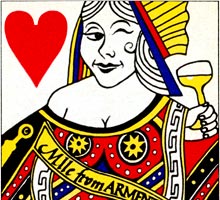
This war deck was issued to commemorate the signing of the Armistice. It is often known as “Mademoiselle from Armentiers” but the name is actually “26th Yankee Division Playing Cards”, to whom it was dedicated. The four Queens represent the four Mademoiselles made famous by the popular WW1 song “Parlez Vous” or “Mademoiselle from Gay Paree”. The Kings and Jacks are soldiers of various ranks. The deck was designed by Alban B. Butler Jr and printed by the Press of the Woolly Whale, New York, in 1933. The owner of this publishing house was Melbert B. Cary, who had belonged to 26th Yankee Division and whose collection of playing cards is now owned by Yale University. The logo of the Press of the Woolly Whale is on the ace of spades and the box
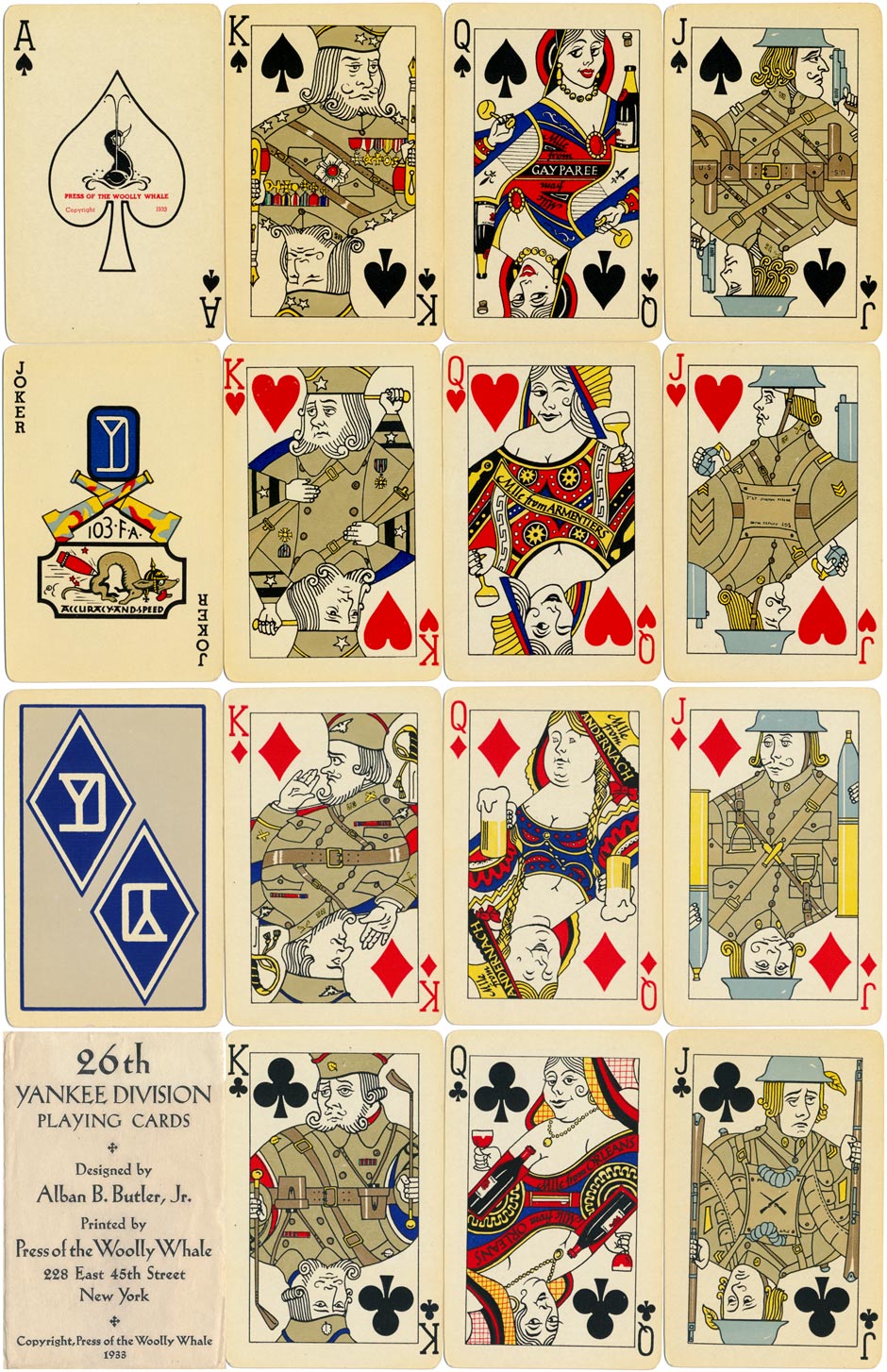
Above: “26th Yankee Division Playing Cards”, designed by Alban B. Butler, Jr and printed by the Press of the Woolly Whale, New York, 1933 in a limited edition. Images courtesy Barney Townshend.
The Press of the Woolly Whale also published the book MLLE from ARMENTIERS shortly after the first World War, which tells of the history, origin and background of the song of the same name. The original song was expanded by WWI troops to many hundreds of verses. When first published it was a requirement to prove you were an American ex-serviceman to be able to buy it.
CREDITS & REFERENCES
Image of the box courtesy Roddy Somerville.
Dawson, Tom & Judy: The Hochman Encyclopedia of American Playing Cards, U.S. Games Systems Inc., 2000
Segeth, Uwe-Volker: Spielkarten Jugendstil und Art Déco, Edition Christian Brandstätter, Wien, 1994
• Wikipedia: Melbert Cary.
• Press of the Woolly Whale Collections.

By Barney Townshend
United Kingdom • Member since October 06, 2015
Retired Airline Pilot, interested in: Transformation Playing Cards, Karl Gerich and Elaine Lewis. Secretary of the EPCS. Treasurer of the IPCS.

Activity for 26th Yankee Division
Sign in to comment or save this article.
Related Articles
Schweizer Trachten
Schweizer Trachten No.174 (Costumes Suisses) by Dondorf.
Carl Arnold Transformation
Transformation playing cards designed by Carl Johann Arnold (1829-1916), the court artist for King F...
Hycrest Modern Royalty
Published by the Hycrest Playing Card Co., New York, c.1931. The large suit symbol behind each figur...
Past-L-Eze Playing Cards
On “Past-L-Eze” playing cards Kings, Queens and Jacks are no longer stodgy and conventional but plea...

Submarine Cards
Lighting in submarines involved wearing red goggles to preserve night vision for viewing instrument ...
Brussels Euro Joker Club 1998
Brussels Euro Joker Club's 10th Anniversary deck, with artwork by Yvette Cleuter, was produced in a ...

Ceska Graficka Unie AS
Playing Cards printed by Ceska Graficka Unie AS, Prague, Czechoslovakia, 1890-1925.
Le Jeu de Marseille
Having deconstructed traditional, bourgeois playing card symbolism they produced new, liberated desi...
Luxus Club Karte No.184
Another of Dondorf's masterpieces of chromolithography, the detailed artwork on these cards has mult...

Carnival Playing Cards, 1925
The Carnival Playing Card deck designed by Harry D. Wallace (1892-1977) and first published in 1925....
Dilkhus playing cards for India
Van Genechten was one of the most competent cardmakers in Turnhout and they produced almost every ki...

Leonor Fini
The originality of Leonor Fini's work is evident in these playing card designs. The imagery of her p...
Salvador Dalí
Based on the standard French ‘Paris’ pattern, Dalí composed his playing card figures out of geometri...

Graciela Rodo Boulanger
Boulanger's paintings and graphic art works are easily recognized. The Latin American influence is a...
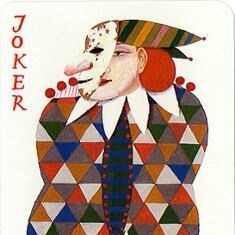
Karl Korab (Ed. Hilger)
Karl Korab was born in 1937 in Falkenstein (Lower Austria), the son of a forester. As a child he exp...
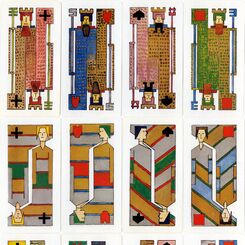
Arnold Schönberg
In around 1909 he created three sets of playing cards. His inventiveness was driven by a passion for...
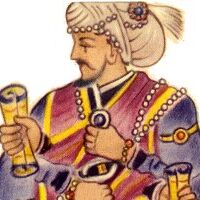
Cashmere
Bernhard Altmann is from the “The House of Cashmere” and these playing cards honour their best known...
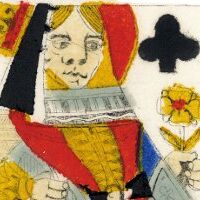
Karl Gerich No.1
The first entry in the catalogue, dating from c.1982, shows full-length figures with their symbols o...
Gedimino Stulpai
Gedimino Stulpai playing cards made in Lithuania by Spindulys Printing Co., Kaunas, depicting Lithua...
The History of Playing Cards
Playing cards appear in European records in the late 14th century, but their earlier history lies fu...
Most Popular
Our top articles from the past 60 days


Peter Burnett
19 November 2025, 09:47SavedSaved this article to Peter's Collection