


Playing Card Terminology Glossary
Welcome to the World of Playing Cards Glossary, an evolving resource for playing card terminology, meanings, and definitions. Based on the foundational work of Paul Bostock, this guide covers the essential language used by collectors and historians. We view its incompleteness as a feature—a starting point for a community-driven project. We invite you to contribute new terms, suggest refinements, and help us build upon Paul's work to create a living reference for the art and history of playing cards.
| Term | Glossary Entry |
|---|---|
| Brick |
Brick a carton of 12 decks. These can be popular with card sellers. A half-brick holds 6 decks. Brick a carton of 12 decks. These can be popular with card sellers. A half-brick holds 6 decks.
Contributed by:
 Paul Bostock
|
| Bridge Size cards |
Bridge Size cards conventional standard cards tend to come in a narrower size (‘Bridge’) and a broader size (‘Poker’). Sizes vary by manufacturer but the bridge cards are typically around 2¼” x 3¼ ”. Bridge Size cards conventional standard cards tend to come in a narrower size (‘Bridge’) and a broader size (‘Poker’). Sizes vary by manufacturer but the bridge cards are typically around 2¼” x 3¼ ”.
Contributed by:
Paul Bostock
|
| Carat Case |
Carat Case is the name for high-end plastic card boxes. Some of the contemporary card designers have added printing on these cases to great effect. Carat Case is the name for high-end plastic card boxes. Some of the contemporary card designers have added printing on these cases to great effect.
Contributed by:
Paul Bostock
|
| Cello/ Cellophane wrapper |
Cello/ Cellophane wrapper modern cards usually have a cellophane wrapper inside the card case, tightly wrapping the cards. This becomes important for people who are playing for money: if the cards are seen to be taken from a sealed box and then taken out of the cellophane, this gives players a strong assurance that the cards are ‘honest’. For further security, those that visited USPC during our last Convention saw – but were not allowed into - a specially segregated area for printing casino decks. Cello/ Cellophane wrapper modern cards usually have a cellophane wrapper inside the card case, tightly wrapping the cards. This becomes important for people who are playing for money: if the cards are seen to be taken from a sealed box and then taken out of the cellophane, this gives players a strong assurance that the cards are ‘honest’. For further security, those that visited USPC during our last Convention saw – but were not allowed into - a specially segregated area for printing casino decks.
Contributed by:
Paul Bostock
|
| Corner Index |
Corner Index an index placed at the card corner. Samuel Hart ‘Saladee’s patent’ of 1864 was the first deck to have corner indices. They are now standard. Corner Index an index placed at the card corner. Samuel Hart ‘Saladee’s patent’ of 1864 was the first deck to have corner indices. They are now standard.
Contributed by:
Paul Bostock
|
| Court Cards |
Court Cards Jack, Queen, King. Court Cards Jack, Queen, King.
Contributed by:
Paul Bostock
|
| Diptych |
Diptych come from ancient fine art, a diptych being a hinged pair of panels seen together. Generally it is a now any pair of images intended to be viewed as one. The Australian single-card collectors (and possibly others) call these put-‘togethers’. 
Above: A great diptych Joker design by Rick Davidson from Origins: Shadows of History, 2017. Diptych come from ancient fine art, a diptych being a hinged pair of panels seen together. Generally it is a now any pair of images intended to be viewed as one. The Australian single-card collectors (and possibly others) call these put-‘togethers’. 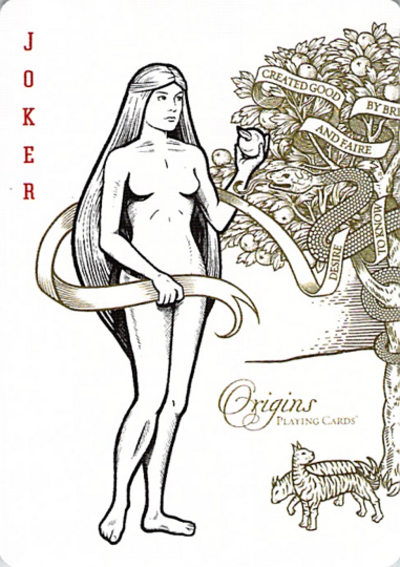
Above: A great diptych Joker design by Rick Davidson from Origins: Shadows of History, 2017.
Contributed by:
Paul Bostock
|
| Double-ended |
Double-ended Most modern standard cards look the same if you rotate them 180˚ to swap ends. Hence the description ‘double ended’. Duplex is a fancier term for double-ended. 
Above: Double-ended cards, made by the Card Factory of the Emperor’s Foundling Hospital, Russia, c1870 Double-ended Most modern standard cards look the same if you rotate them 180˚ to swap ends. Hence the description ‘double ended’. Duplex is a fancier term for double-ended. 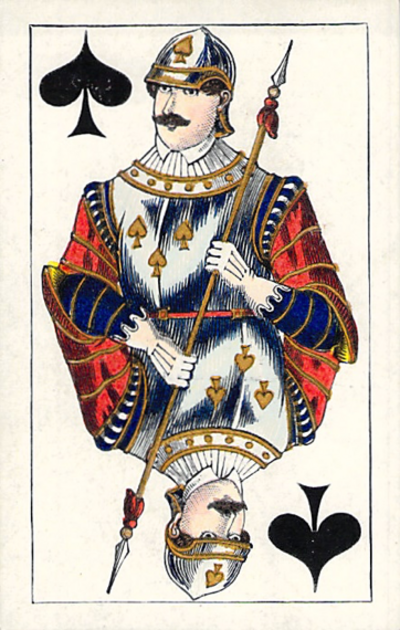
Above: Double-ended cards, made by the Card Factory of the Emperor’s Foundling Hospital, Russia, c1870
Contributed by:
Paul Bostock
|
| Finish |
Finish The card finish is the key element in making them slide smoothly, which is important for players, cardists and magicians. The finish is also a barrier against water. The old finish was a glaze or sizing (a term used by artists in the preparation of paper). From the 19th century, different surfaces were experimented with: linen finish, pneumatic and so on. These reduce contact area and help a layer of air keep the cards apart. Finish The card finish is the key element in making them slide smoothly, which is important for players, cardists and magicians. The finish is also a barrier against water. The old finish was a glaze or sizing (a term used by artists in the preparation of paper). From the 19th century, different surfaces were experimented with: linen finish, pneumatic and so on. These reduce contact area and help a layer of air keep the cards apart.
Contributed by:
Paul Bostock
|
| Foil/ Foiling |
Foil/ Foiling a recent technique where metallic foil decoration is used to in the design of boxes or backs. Lotrek has pioneered foiling on the fronts, eg his 2017 Diamond Award winner ‘Golden Oath’. Foil/ Foiling a recent technique where metallic foil decoration is used to in the design of boxes or backs. Lotrek has pioneered foiling on the fronts, eg his 2017 Diamond Award winner ‘Golden Oath’.
Contributed by:
Paul Bostock
|
| Full-length |
Full-length the older style of cards with court cards standing up (also called ‘single-ended’). 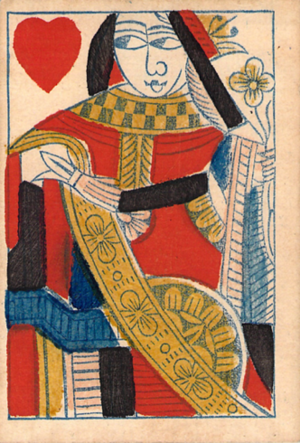
Above: Full length English cards by Hunt c1799 Full-length the older style of cards with court cards standing up (also called ‘single-ended’). 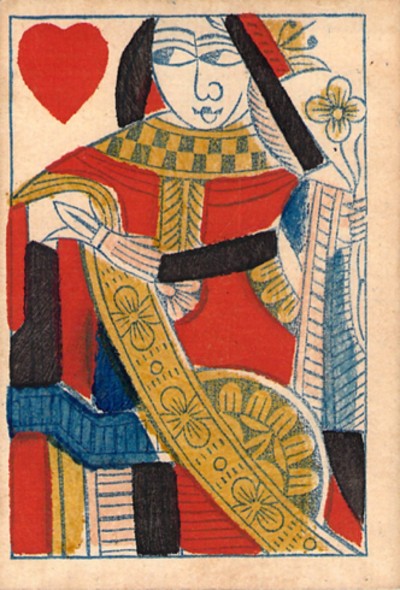
Above: Full length English cards by Hunt c1799
Contributed by:
Paul Bostock
|
| Gaff |
Gaff a card or set of cards that has been altered - usually for magic tricks. Gaff a card or set of cards that has been altered - usually for magic tricks.
Contributed by:
Paul Bostock
|
| Ganjifa |
Ganjifa are the traditional circular cards of India. I am very fond of them – just look at that picture! 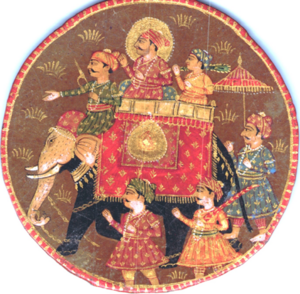
Above: Indian Ganjifa, single court card c. 1875. Ganjifa are the traditional circular cards of India. I am very fond of them – just look at that picture! 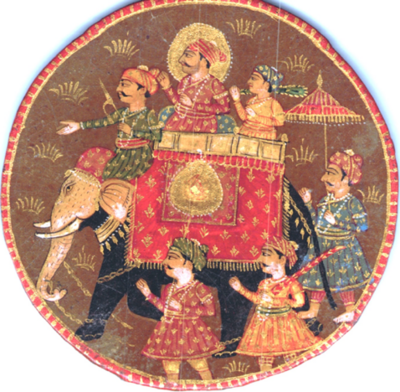
Above: Indian Ganjifa, single court card c. 1875.
Contributed by:
Paul Bostock
|
| Half brick |
Half brick a carton of 6 decks (see brick) Half brick a carton of 6 decks (see brick)
Contributed by:
Paul Bostock
|
| Illustrated or pictorial cards |
Illustrated or pictorial cards are non-standard and were very popular in the 18th Century Europe. All 52 cards can be used like a modern story-board to tell a story from history (eg. The Spanish Armada above) or to illustrate a theme (eg Cries of London). Illustrated or pictorial cards are non-standard and were very popular in the 18th Century Europe. All 52 cards can be used like a modern story-board to tell a story from history (eg. The Spanish Armada above) or to illustrate a theme (eg Cries of London).
Contributed by:
Paul Bostock
|
| Index |
Index usually a digit (1-10) or letter (J Q K) plus a suit sign but sometimes a picture. The index is sometimes the only identification on the card and provides much easier identification for card players. Index usually a digit (1-10) or letter (J Q K) plus a suit sign but sometimes a picture. The index is sometimes the only identification on the card and provides much easier identification for card players.
Contributed by:
Paul Bostock
|
| Indices |
Indices plural of index. Indices plural of index.
Contributed by:
Paul Bostock
|
| Knave |
Knave older term for the Jack. Knave older term for the Jack.
Contributed by:
Paul Bostock
|
| Label Seal |
Label Seal contemporary tuck cases are often sealed with a small stamp. This can be decorative but it mainly serves as a security assurance – see the entry for ‘cello/ cellophane’. Label Seal contemporary tuck cases are often sealed with a small stamp. This can be decorative but it mainly serves as a security assurance – see the entry for ‘cello/ cellophane’.
Contributed by:
Paul Bostock
|
| Non-standard |
Non-standard any deck or single card that does not conform to a standard pattern. See an example shown above the entry for ‘index’. Non-standard any deck or single card that does not conform to a standard pattern. See an example shown above the entry for ‘index’.
Contributed by:
Paul Bostock
|
| Number Cards |
Number Cards are 1-10 i.e. anything but the courts. Number Cards are 1-10 i.e. anything but the courts.
Contributed by:
Paul Bostock
|
| Numerals |
Numerals an older term for number cards. Numerals an older term for number cards.
Contributed by:
Paul Bostock
|
| Pattern |
Pattern is a somewhat academic term, but it does become useful for following the development of different designs. The term denotes an accepted standard design that persisted in a country, region or sometimes just one town over a period of time. Standards can and usually do evolve slowly over time (except in France which has a legal standard!). Pattern is a somewhat academic term, but it does become useful for following the development of different designs. The term denotes an accepted standard design that persisted in a country, region or sometimes just one town over a period of time. Standards can and usually do evolve slowly over time (except in France which has a legal standard!).
Contributed by:
Paul Bostock
|
| Pictures, Picture cards |
Pictures, Picture cards Jack, Queen, King. Pictures, Picture cards Jack, Queen, King.
Contributed by:
Paul Bostock
|
| Pip, Pips |
Pip, Pips the suit signs on cards and also a name for the number cards of each suit. Pip, Pips the suit signs on cards and also a name for the number cards of each suit.
Contributed by:
Paul Bostock
|
| Poker Size cards |
Poker Size cards conventional standard cards tend to come in a narrower size (‘Bridge’) and a broader size (‘Poker’). Sizes vary by manufacturer but the bridge cards are typically around 2½ ” x 3¼ ”. 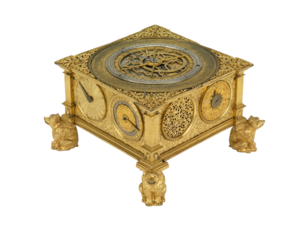
Above: Table Clock by Caspar Buschman 1586(!) Poker Size cards conventional standard cards tend to come in a narrower size (‘Bridge’) and a broader size (‘Poker’). Sizes vary by manufacturer but the bridge cards are typically around 2½ ” x 3¼ ”. 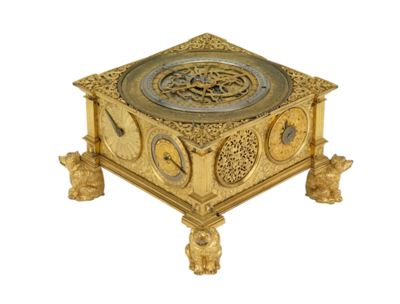
Above: Table Clock by Caspar Buschman 1586(!)
Contributed by:
Paul Bostock
|
| Repurposed cards |
Repurposed cards - the name given when cards are adapted for a new use – it could be something as simple as folding a card up to fix a wobbly table. For centuries, simple card was not a household item. Cards were re-made as calling-cards, invitations to, all sorts of events , library files, advertisements etc. hundreds of uses now being known. Very often the second use is the sole reason for the survival of old cards. This is an important category! Repurposed cards - the name given when cards are adapted for a new use – it could be something as simple as folding a card up to fix a wobbly table. For centuries, simple card was not a household item. Cards were re-made as calling-cards, invitations to, all sorts of events , library files, advertisements etc. hundreds of uses now being known. Very often the second use is the sole reason for the survival of old cards. This is an important category!
Contributed by:
Paul Bostock
|
| Secondary use |
Secondary use cards - same as ‘repurposed’. Secondary use cards - same as ‘repurposed’.
Contributed by:
Paul Bostock
|
| Security strip |
Security strip a band that wraps around a cellophane wrapper for ease of removal (this will remind some people of old cigarette wrapping). Part of the ‘no-tampering’ assurance (see cello/cellophane). Security strip a band that wraps around a cellophane wrapper for ease of removal (this will remind some people of old cigarette wrapping). Part of the ‘no-tampering’ assurance (see cello/cellophane).
Contributed by:
Paul Bostock
|
| Single-ended |
Single-ended the older style of cards in which the court cards are portrayed standing up. These were replaced by double-ended cards in the 19th Century. Single-ended the older style of cards in which the court cards are portrayed standing up. These were replaced by double-ended cards in the 19th Century.
Contributed by:
Paul Bostock
|
| Standard cards |
Standard cards this is a term that is readily easy to understand but difficult to pin down. These are the regular cards used by card players for games, with more-or-less understood design features (such as a King holding a sword and facing left), but the details can vary somewhat between manufacturers and evolve over time. Different standards have evolved in different regions, sometimes at the level of single towns, sometimes across many countries. For the level of variety, see ‘Suit Sytems’. Standard cards this is a term that is readily easy to understand but difficult to pin down. These are the regular cards used by card players for games, with more-or-less understood design features (such as a King holding a sword and facing left), but the details can vary somewhat between manufacturers and evolve over time. Different standards have evolved in different regions, sometimes at the level of single towns, sometimes across many countries. For the level of variety, see ‘Suit Sytems’.
Contributed by:
Paul Bostock
|
| Stock |
Stock the physical card material, as in “these cards were made with our finest stock”. The stock really does make an important difference, most obviously from cheap grey and rough cards to smooth luxury cards. Flexibility and friction are also very important to magicians and cardists (and card throwers). 
Above: Modern Hungarian cards: ace of acorns (really, and it’s complicated!) and seven of leaves. Closely related to the German suit system. Stock the physical card material, as in “these cards were made with our finest stock”. The stock really does make an important difference, most obviously from cheap grey and rough cards to smooth luxury cards. Flexibility and friction are also very important to magicians and cardists (and card throwers). 
Above: Modern Hungarian cards: ace of acorns (really, and it’s complicated!) and seven of leaves. Closely related to the German suit system.
Contributed by:
Paul Bostock
|
| Suit Systems |
Suit Systems the suits seen in American decks are properly called ‘French suits’ as they originated in France. There are other systems: German cards have Leaves, Hearts, Bells and Acorns. The four symbols together make the suit system. Possibly the earliest is ‘Spanish’ (my term, you’ll see ‘Latin’, ‘Italian’ etc – bear in mind that the country boundaries have changed extensively). These are found in Italy, Spain, Portugal and much of South America, and the suits are Swords, Coins, Cups and Batons. Suit Systems the suits seen in American decks are properly called ‘French suits’ as they originated in France. There are other systems: German cards have Leaves, Hearts, Bells and Acorns. The four symbols together make the suit system. Possibly the earliest is ‘Spanish’ (my term, you’ll see ‘Latin’, ‘Italian’ etc – bear in mind that the country boundaries have changed extensively). These are found in Italy, Spain, Portugal and much of South America, and the suits are Swords, Coins, Cups and Batons.
Contributed by:
Paul Bostock
|
| Symmetrical cards |
Symmetrical cards were designed in the late 1990s and gained a brief popularity. The traditional A♠ is not symmetrical top to bottom, and this leads to the possibility of cheating, or at least bending the rules. It is particularly useful in bridge, or any game with a partner or team. It could be agreed in advance that playing any card upside down (as viewed by the player placing it on the table) would be a message to the partner (e.g. don’t lead a card in this suit). In practice they cause errors and are not popular. 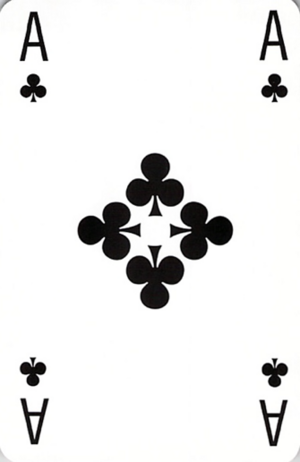
Above: Symmetrical cards, WCMPC Bridge 2007. Note the similarity here. These lead to mistakes in poor lighting and for those with mild eyesight problems. Symmetrical cards were designed in the late 1990s and gained a brief popularity. The traditional A♠ is not symmetrical top to bottom, and this leads to the possibility of cheating, or at least bending the rules. It is particularly useful in bridge, or any game with a partner or team. It could be agreed in advance that playing any card upside down (as viewed by the player placing it on the table) would be a message to the partner (e.g. don’t lead a card in this suit). In practice they cause errors and are not popular. 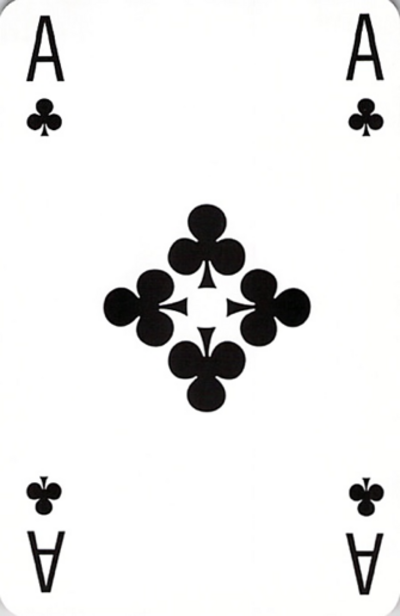
Above: Symmetrical cards, WCMPC Bridge 2007. Note the similarity here. These lead to mistakes in poor lighting and for those with mild eyesight problems.
Contributed by:
Paul Bostock
|
| Tax ace |
Tax ace Old English packs carried a tax on the Ace of Spades. The Ace had elaborate printing that was difficult to forge. These ‘tax aces’ are the reason why the Ace of Spades took on a special, fancy design. 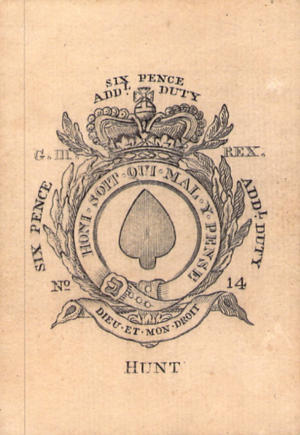
Above: English Tax Ace by Hunt, c1799. This influenced all later A♠ eg. these Dougherty Indicators c 1896. Tax ace Old English packs carried a tax on the Ace of Spades. The Ace had elaborate printing that was difficult to forge. These ‘tax aces’ are the reason why the Ace of Spades took on a special, fancy design. 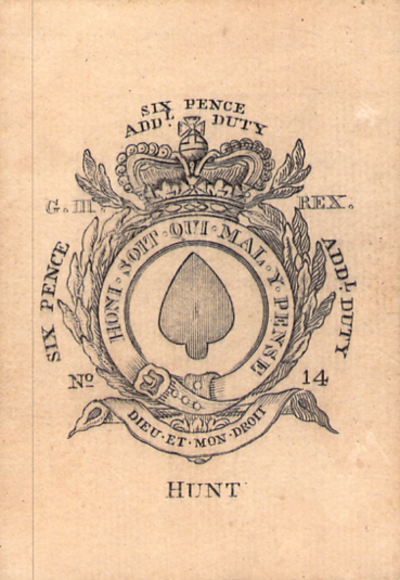
Above: English Tax Ace by Hunt, c1799. This influenced all later A♠ eg. these Dougherty Indicators c 1896.
Contributed by:
Paul Bostock
|
| Tax Stamp |
Tax Stamp In the past, and in many countries, cards were taxed. This was “to discourage gambling”, but really this is just another example in the long tradition of the state getting money out of the individual any way it can. 
Above: Tax Stamp: here, the faint crown and initials applied to a set by Hart c 1763. This stamp was used in England from 1756 - 1765. Also, German tax stamp on the 100th Anniversary cards made by Dondorf, 1933. Tax Stamp In the past, and in many countries, cards were taxed. This was “to discourage gambling”, but really this is just another example in the long tradition of the state getting money out of the individual any way it can. 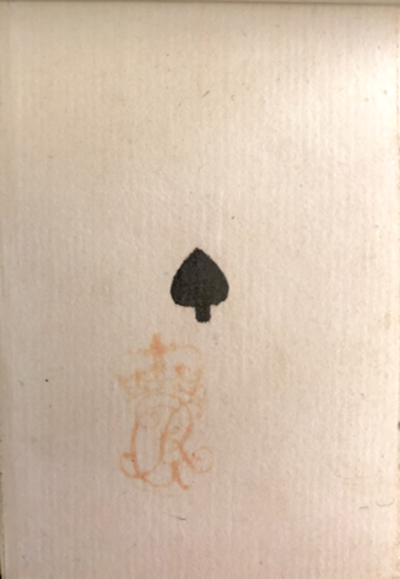
Above: Tax Stamp: here, the faint crown and initials applied to a set by Hart c 1763. This stamp was used in England from 1756 - 1765. Also, German tax stamp on the 100th Anniversary cards made by Dondorf, 1933.
Contributed by:
Paul Bostock
|
| Telescopic case |
Telescopic case a two-part box with an inner card sleeve enclosed on five sides, open at the top, and an outer sleeve enclosed on five sides and open at the bottom. So-called as the movement of the two pieces resembles the action of a classic telescope. Telescopic case a two-part box with an inner card sleeve enclosed on five sides, open at the top, and an outer sleeve enclosed on five sides and open at the bottom. So-called as the movement of the two pieces resembles the action of a classic telescope.
Contributed by:
Paul Bostock
|
| Transformation cards |
Transformation cards are cards in which the pips have been incorporated so as to appear naturally in an artistic scene. These are best understood by seeing some examples (above). There are two sorts: regular transformation cards are more or less mass-produced while ‘hand-drawn transformations are literally added onto the cards by the artist – so these are always unique. Both types are popular and collectable (and therefore equally expensive!) 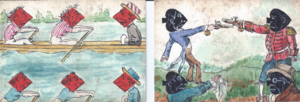
Above: Transformation cards: the pips are very ingeniously and colourfully used here. From a wonderful Fournier Museum facsimile (bought in 2010). Transformation cards are cards in which the pips have been incorporated so as to appear naturally in an artistic scene. These are best understood by seeing some examples (above). There are two sorts: regular transformation cards are more or less mass-produced while ‘hand-drawn transformations are literally added onto the cards by the artist – so these are always unique. Both types are popular and collectable (and therefore equally expensive!) 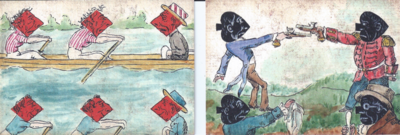
Above: Transformation cards: the pips are very ingeniously and colourfully used here. From a wonderful Fournier Museum facsimile (bought in 2010).
Contributed by:
Paul Bostock
|
| Tuck or Tuck Case |
Tuck or Tuck Case the most common modern package, a box with a folding top that tucks in. Tuck or Tuck Case the most common modern package, a box with a folding top that tucks in.
Contributed by:
Paul Bostock
|
| Uncut Sheet |
Uncut Sheet typically, cards are printed as one full set on a large sheet of card. Before machinery, they would be printed in smaller groups. In either case, this single page is an ‘uncut sheet’. The example shown would also be described as ‘uncoloured’. On the older cards, colours were added by hand to a page like this (using stencils). 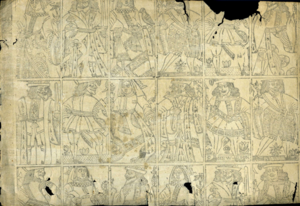
Above: Uncut sheet by ‘C Hewson’ from c. 1685 Uncut Sheet typically, cards are printed as one full set on a large sheet of card. Before machinery, they would be printed in smaller groups. In either case, this single page is an ‘uncut sheet’. The example shown would also be described as ‘uncoloured’. On the older cards, colours were added by hand to a page like this (using stencils). 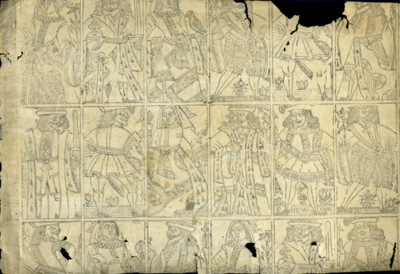
Above: Uncut sheet by ‘C Hewson’ from c. 1685
Contributed by:
Paul Bostock
|
| Woodblock |
Woodblock was the technology used for printing the early court cards only beginning to be replaced in the 1830s. Wooden blocks were cut away leaving just the outlines for the court card pictures, ready for printing. The colours and the pip signs were added later by hand using stencils (one for each colour). Woodblock was the technology used for printing the early court cards only beginning to be replaced in the 1830s. Wooden blocks were cut away leaving just the outlines for the court card pictures, ready for printing. The colours and the pip signs were added later by hand using stencils (one for each colour).
Contributed by:
Paul Bostock
|
| Wrapper |
Wrapper generally refers to any paper wrapper for a set of cards. More specifically, in many countries the wrapper was taxed and made of flimsy paper which tore easily. This prevented a second tax-free sale. 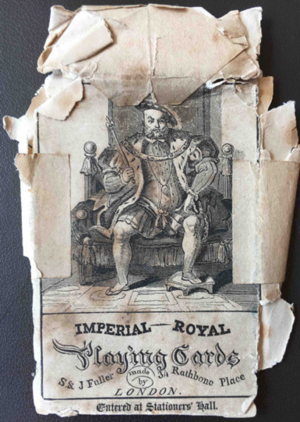
Above: Wrappers: S & J Fuller “Imperial Royal” from 1830 and Thomas De La Rue around 1900. Two Henry VIIIs is just a co-incidence! Wrapper generally refers to any paper wrapper for a set of cards. More specifically, in many countries the wrapper was taxed and made of flimsy paper which tore easily. This prevented a second tax-free sale. 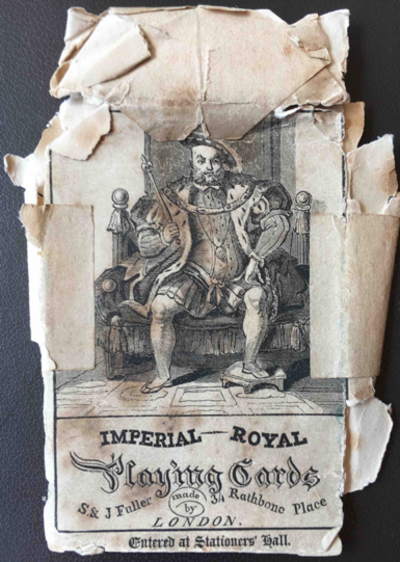
Above: Wrappers: S & J Fuller “Imperial Royal” from 1830 and Thomas De La Rue around 1900. Two Henry VIIIs is just a co-incidence!
Contributed by:
Paul Bostock
|