


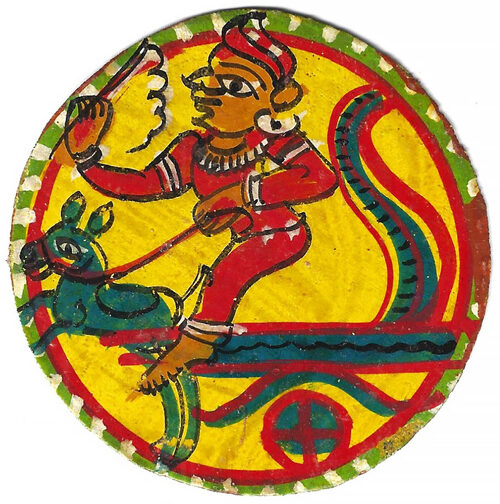
Ganjifa refers to a family of card games that originated in Persia and spread to India during the Moghul period, An early form consisted of a 96-card pack divided into eight suits, each with ten numeral and two court cards — the king (mir) and minister (wazir).
The term appears to have been used generically for playing cards across a wide region. Although its early history remains uncertain, a 15th century reference by the Mamluk historian Yusuf ibn Taghribirdi suggests that ganjifa (kanjifah) was already known in the Islamic world. The game likely spread from Persia to India under the Mughal Empire, where it flourished in richly painted, often circular formats, while in Persia it declined after being prohibited under Abbas II. Today, “ganjifa” is most often associated with the Indian tradition, while ganjafeh or ganjafa refer more specifically to the Persian form.
The games played often involve trick-taking, and the rules can vary depending on the region and variant of the game being played.
| Image | Details | Year | Country | Published |
|---|