


Mamluk Cards and the Making of the European Deck
Mamluk “naib” cards — four suits with named courts — offer a persuasive clue to how playing cards reached Europe in the 1370s, travelling through Mediterranean port cities and trade routes to become the ancestor of the European pack.
What follows focuses on the origins of the standard Anglo-American playing cards. We are told, for example, that the Chinese had playing cards from around 800 CE (AD) onwards. However, these cards bear little relation to modern sets. Chinese chess and domino cards suggest that these were meant as portable or ‘travel’ versions of other games – a great idea, but not the one behind the structure of our modern cards.
Our playing-card sets have several familiar characteristics that make them what they are. One is the existence of four suits, designated with their own symbols (symbols that don’t appear to mean anything outside of a card set). Another is the division into two groups, the plain pip or numeral cards and the higher-ranking court cards. Lastly, the court cards have named ranks and show pictures.
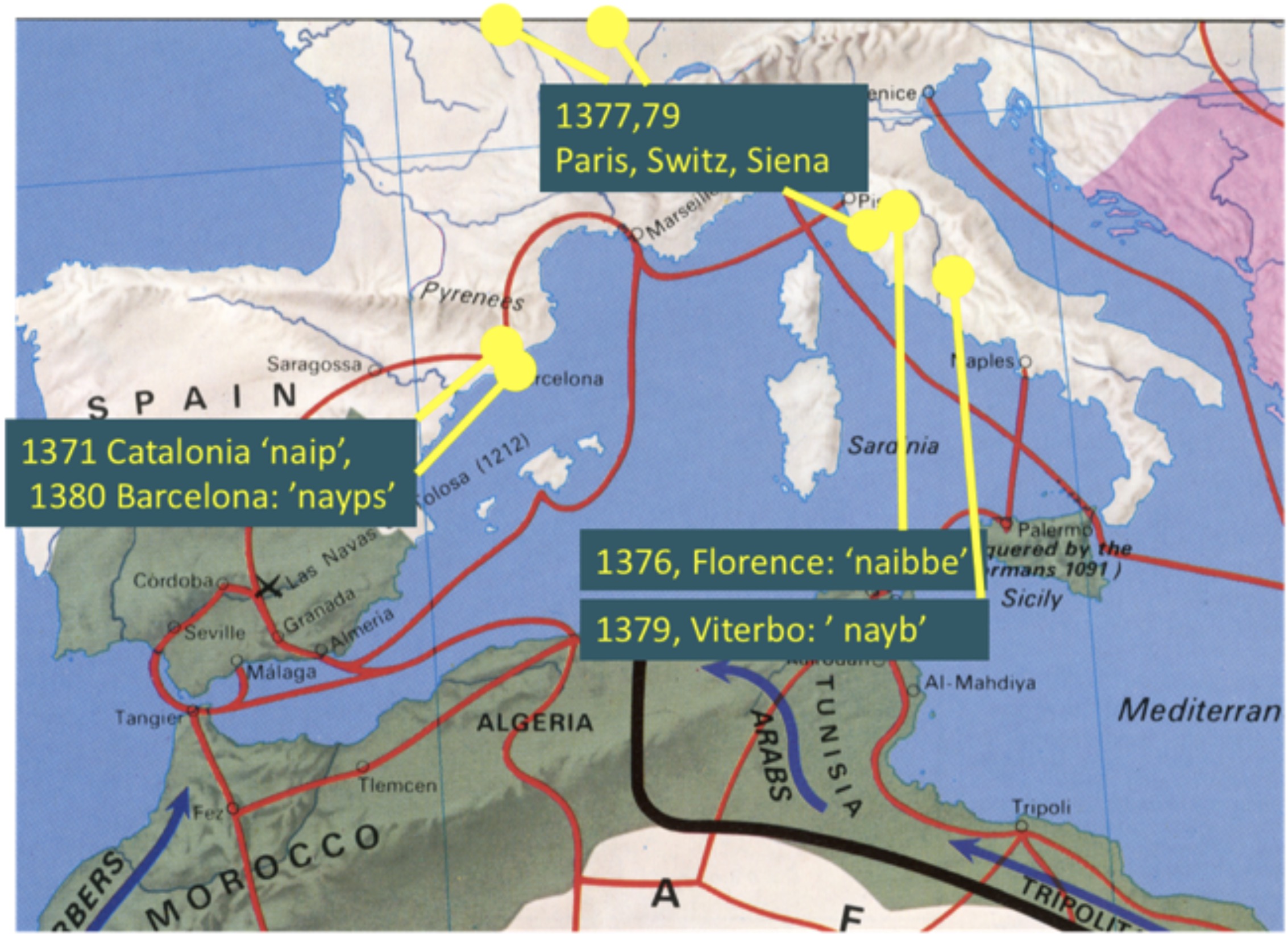
Above: early European references to playing cards (1371–79), plotted against the medieval Mediterranean world. The red lines indicate major mediaeval trade routes; the coloured areas show contemporary political regions. The first recorded ‘naib/nayb’ mentions cluster at port cities along these routes, suggesting transmission into Europe through established trading networks.
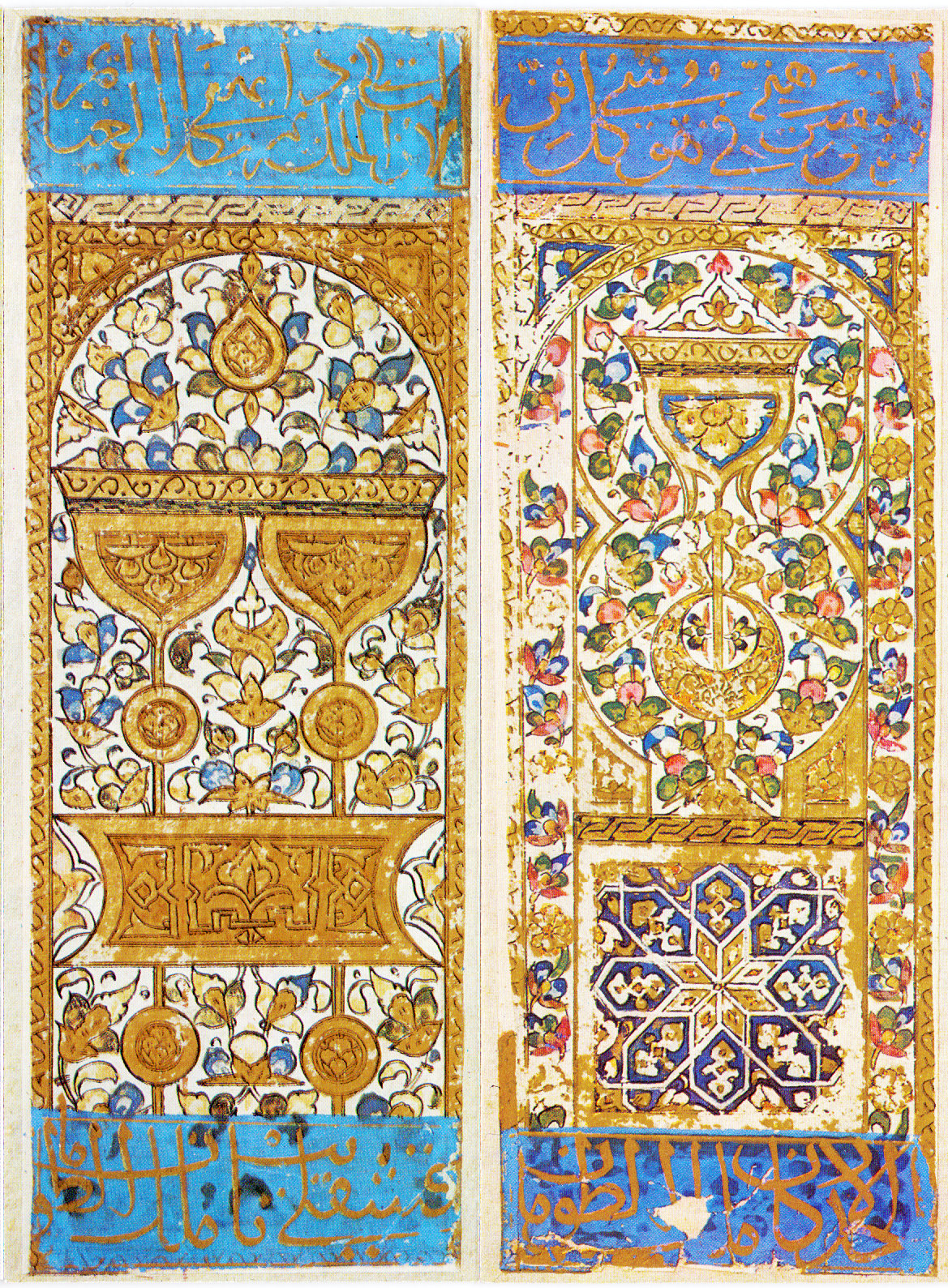
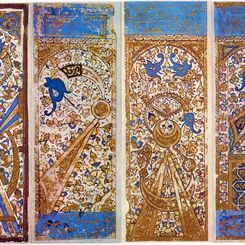
Above: Mamluk cards — King and Lieutenant of Cups (Topkapi Palace group, 15th–early 16th century). Court cards with named ranks, but rendered without human figures: the suit is identified by the cup emblems and ornamental calligraphy.
Two court cards from the Mamluk naib pack (Topkapi Palace group, 15th–early 16th century): the King and Lieutenant (naib) of Cups. Rank is shown through inscriptions and ornament, rather than human figures. The paired cup emblems identify the suit, while the blue calligraphic panels and rich decoration mark these as high-status cards—key evidence for how a structured four-suit pack could have travelled into Europe via Mediterranean trade routes.
A great collection of the earliest references to European playing cards has been assembled, and these have been superimposed onto a map of Europe with the contemporary trading routes. Playing cards started to arrive in Europe from 1376, and the illustration above shows that they tended to arrive at ports bordering the Mediterranean Sea.
Bearing this in mind, it is interesting to note a set of ‘Mamluk’ cards, identified in the Top Kapi Palace, Istanbul, by Leo Mayer in the 1930s. These are thought to date from XV or early XVI century. The cards have the ‘Spanish’ suits of Coins, Cups (curved) Swords and straight batons.
The 47 surviving cards show that a full pack had four suits of fourteen cards. Each suit’s courts have bands of a distinct color (the blue in the images below) and there are four named cards – a ruler, two lieutenants and a member of the royal entourage. However: there are no pictures of people, probably for religious or cultural reasons.
There is a good reason for taking these cards very seriously, and that is the word “naib”. Various spellings of this word appear in the first references to cards in the areas close to the Mediterranean. It is the Arabic word for the Lieutenant, and we assume also the term used for the games played with this pack. Europeans adopted this word, rather than taking the obvious and available European terms (i.e. “cartas de jogar”, “Cartes à jouer” and so on.
What does that suggest to you? I emphasize the question because it is such a critical one. To me, it very strongly implies that cards came to Europe from what we now call the Middle East or North Africa, and that the naib game and its name were both adopted along with the cards. While we may never know for sure, I find these the most convincing ancestors of our card decks.
References
- Aurelia Books (Brussels & Louvain), 1972; printed by Cartamundi
- Times Atlas of World History, 1970s Edition
Based on a talk given at the 52 Plus Joker Convention, Erlanger, Kentucky, 2017.

By Paul Bostock
United Kingdom • Member since May 07, 2024
Paul has been a collector of playing cards since his early teenage years, the mid 1970s. In the last 20 years or so he has specialised in standard English cards and their story. His collection, including many other English Standards, are featured on his website plainbacks.com. Paul is currently editor of Clear the Decks, the Journal of 52 Plus Joker, the American club for playing card collectors, and is a member of the IPCS Council, an EPCS member and a Past Master of the Worshipful Company of Makers of Playing cards, a City of London livery company.

Activity for Mamluk Cards and the Making of the European Deck
Sign in to comment or save this article.

Related Articles

Arab No. 2141
Piatnik ventures into Orientalism.
The archaic “Classic Madrid” Pattern
Centralisation, standardisation and consolidation of the Spanish card tradition.
La baraja de Almagro
De la chimenea al monumento nacional: la baraja de Almagro y el renacer del corral de comedias.
History of Tarot and Playing Cards: Timeline & Origins
An alternative history of tarot and playing cards – from Mamluk Egypt to the invention of tarot in R...
Early German playing cards
Some early examples of popular German playing cards from the XV and XVI centuries.
Qajar dynasty playing cards at the British Museum
Two small groups of Qajar-period playing cards from Iran (Persia), photographed in 2017 in the Briti...
David Roberts
“David Robert” playing cards with artwork after Roberts’ Sketches in Egypt and Nubia.
The Combination of Images and Text on early playing cards
When playing cards have titles or legends these reference a written/literary tradition of some form....
Suicide King
The King of Hearts, holding a sword behind his head, is sometimes nicknamed the “Suicide King”. He c...
1: Playing Cards and their History: An Introduction and some links to other sites
What was considered the first mention of playing cards in England is in 1463 when Edward I banned th...
Netherlands
Playing cards have been known in the Low Countries since the 14th century
History of Blackjack
Over the years the origin of Blackjack, like many other games, has eluded researchers for a long tim...
Moorish playing cards
These two uncoloured, uncut sheets of early Moorish playing cards were formerly preserved in the Ins...
Paris Pattern
The Paris pattern was established as such around the middle of the seventeenth century (based, perha...
Mamluk Playing Cards
Nã'ib, the game of lieutenants... these cards are amongst the earliest Arabic playing cards ext...
Italian Playing Cards
The first reliable evidence that playing cards were being used in Italy is from 1376, when a game ca...
The History of Playing Cards
Playing cards appear in European records in the late 14th century, but their earlier history lies fu...
History of English Playing Cards & Games
The History of English Playing Cards dates probably from the mid 15th century
Early History of Playing Cards & Timeline
Out of an apparent void, a constellation of references in early literature emerge pointing to the su...
A Moorish Sheet of Playing Cards
This article was originally published in “The Playing-Card”, the Journal of the International Playin...
Most Popular
Our top articles from the past 60 days


Stephen Scharber
07 April 2026, 17:27SavedSaved this article to Stephen Scharber's Collection
Adam Wintle
17 April 2026, 13:56SavedSaved this article to Strange Decks and Unusual Systems
Jason Somers
14 June 2026, 19:49SavedSaved this article to Jason Somers's Collection