




Tarocchino Lombardo, c.1835
“Tarocchino Lombardo c.1835”, a facsimile edition of 2500 by Edizione del Solleone, Italy, 1981.

This historic tarot deck is beautifully detailed in the Italianate style. The original was finely and delicately engraved by the highly regarded Milanese engraver/illustrator Carlo Dellarocca, whose name can be seen on the base of the King of Bastoni. It was published by Ferdinand Gumppenberg of Milan but then reprinted by Bordoni in 1889. A facsimile edition of Bordoni's reprint was published in 1981 by Edizione del Solleone and is shown here. Some of the imagery in the cards is unique and not based on earlier examples. It is here that the engraver expresses his originality.
The Hermit carries a little open flame in a holder instead of a lantern →

Above: “Tarocchino Lombardo” c.1835, a limited facsimile edition of 2500 by Edizione del Solleone, Italy, 1981. 78 cards + title card. The original deck is hand coloured. The court cards conform to tradition, but have more individuality and personality than many decks. The Major Arcana cards have several unique features. The Death card is unlabelled. The Hermit carries a little open flame in a holder instead of a lantern. The Lover ('Gli Amanti') stands between his sweetheart and a king who rests his hand on his shoulder. The young man seems to be in a quandry between love and duty and must presumably make a commitment one way or another.
This deck was a massive commercial success, achieving a popularity that spread from Lombardy to Piedmont and Liguria. Its immediate influence and widespread copying by other manufacturers (Dotti, Bordoni, Armanino) provide the strongest evidence for the contemporary view: it was seen as a market benchmark and a desirable commercial product.
A set of preliminary drawings by Carlo Dellarocca for the trumps, court cards and aces, published by Gumppenberg, is preserved in the British Museum.

Above: some cards are inscribed in graphite with numbers and titles, but the sheets have been cropped top and bottom and the inscriptions are not fully legible. © The Trustees of the British Museum
REFERENCES
British Museum : number 1896,0129.1.112-156 ►
See also: “Tarocco Neoclassico” c.1810 • Tarot Heritage website→

By Rod Starling (1936-2023)
United States • Member since January 09, 2013
Rod Starling was one of the founding members of the 52 Plus Joker card collectors club. He authored many articles for the club's quarterly newsletter, Clear the Decks. His collection encompasses both foreign and American decks. Rod also authored a book titled The Art and Pleasures of Playing Cards.

Activity for Tarocchino Lombardo, c.1835
Sign in to comment or save this article.
Related Articles
Carte Romantiche Italiane
Scenes of life and the theatre in Milan towards the second half of the 19th century.
Lo Stampatore
‘Lo Stampatore’ linocut images created by Sergio Favret, published as a deck of cards by Editions So...
Schwarze Katze (or Gioco del Gatto Nero)
Reproduction of a 40-card transformation pack with designs by “WS”, adapted for the game of Black Ca...
Il Mercante in Fiera del Solleone
Traditional Italian card game with bold designs by Costante Costantini.
Italia playing cards
Small, narrow cards designed by Osvaldo Menegazzi, bearing a strong resemblance to a Swedish pattern...
Carte Méthodique
Reproduction of a French pack by François Silvestre intended to teach heraldry, produced in Paris in...
Spielkarten in Bromsilber-Photographie
“Spielkarten in Bromsilber-Photographie” facsimile edition by Vito Arienti of Edizioni del Solleone,...
Some Facts About Facsimiles
A short note on facsimile decks: what counts as a facsimile, how reprints differ from originals, and...
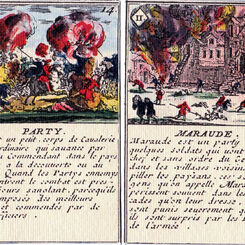
Le Jeu de la Guerre
Facsimile of “Le Jeu de la Guerre” designed by Gilles de la Boissière in 1698.
Rois de France
Cartes des Rois de France (1644) facsimile edition by Edizioni del Solleone, 1986.
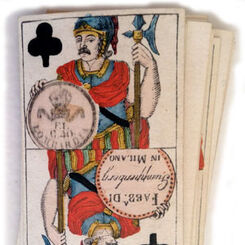
Gumppenberg of Milan
Fine playing cards made by Gumppenberg of Milan evoking the style of antiquity, c.1830
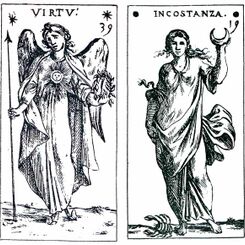
Mitelli ‘Gioco di Passatempo’
Il Gioco di Passatempo contains 40 figurative playing cards depicting moral virtues and vices, dated...
Portuguese pattern
19th century Portuguese pattern, re-printed from original woodblocks.
Serravalle-Sesia Tarot
Serravalle-Sesia Tarot published by Fratelli Avondo, c.1880.
Etruria Minchiate
The Cavaliers are man/beast creatures. The Valets (or Pages) are male for clubs and swords, and fema...
Stairs of Gold Tarot
Whilst the titles of the cards are in Italian, the Hebrew and Sanskrit letters on the Trump cards de...
Corona Ferrea
Trumps depict historical scenes primarily of the political period known as the Holy Roman Empire fro...

Tarocco Neoclassico
Gumppenberg published several new decks by artists or engravers of the day. The designs are clear an...
Soldaten Tarock
Piatnik was known for their magnificent quality of chromo-lithographic printing, and this facsimile,...
Neapolitan Pattern
Cartine da Gioco Vesuvio miniature Neapolitan pattern.
Most Popular
Our top articles from the past 60 days


Alannyë Daeris
19 November 2025, 09:47SavedSaved this article to Cartomancia Histórica
Maria Nick
21 February 2026, 11:02SavedSaved this article to Maria Nick's Collection