


Dauphiné Pattern - Portrait du Dauphiné
The Dauphiné pattern is an archaic French pattern which was manufactured in the Lyon region from the 17th century.
Dauphiné Pattern
One of nine or so regional types, the Dauphiné pattern is an archaic French pattern which was manufactured in the Lyon region during the 16th and 17th centuries. It lasted in France until the end of the 18th century, when it was replaced by the unified 'Paris' pattern by 1780. It was also used in Italy until it was superseded by Piedmont's own version of the Paris pattern. Although this latter design is now double-ended the resemblances to the earlier prototype can easily be seen.
Some of the figures in the Dauphiné pattern are common to several other early types, for example the King of Clubs who carries a sword and orb, and the Jack of Clubs (top right) with one hand on his hip. The Dauphiné pattern was produced by workshops in and around Grenoble, Romans & Valence.
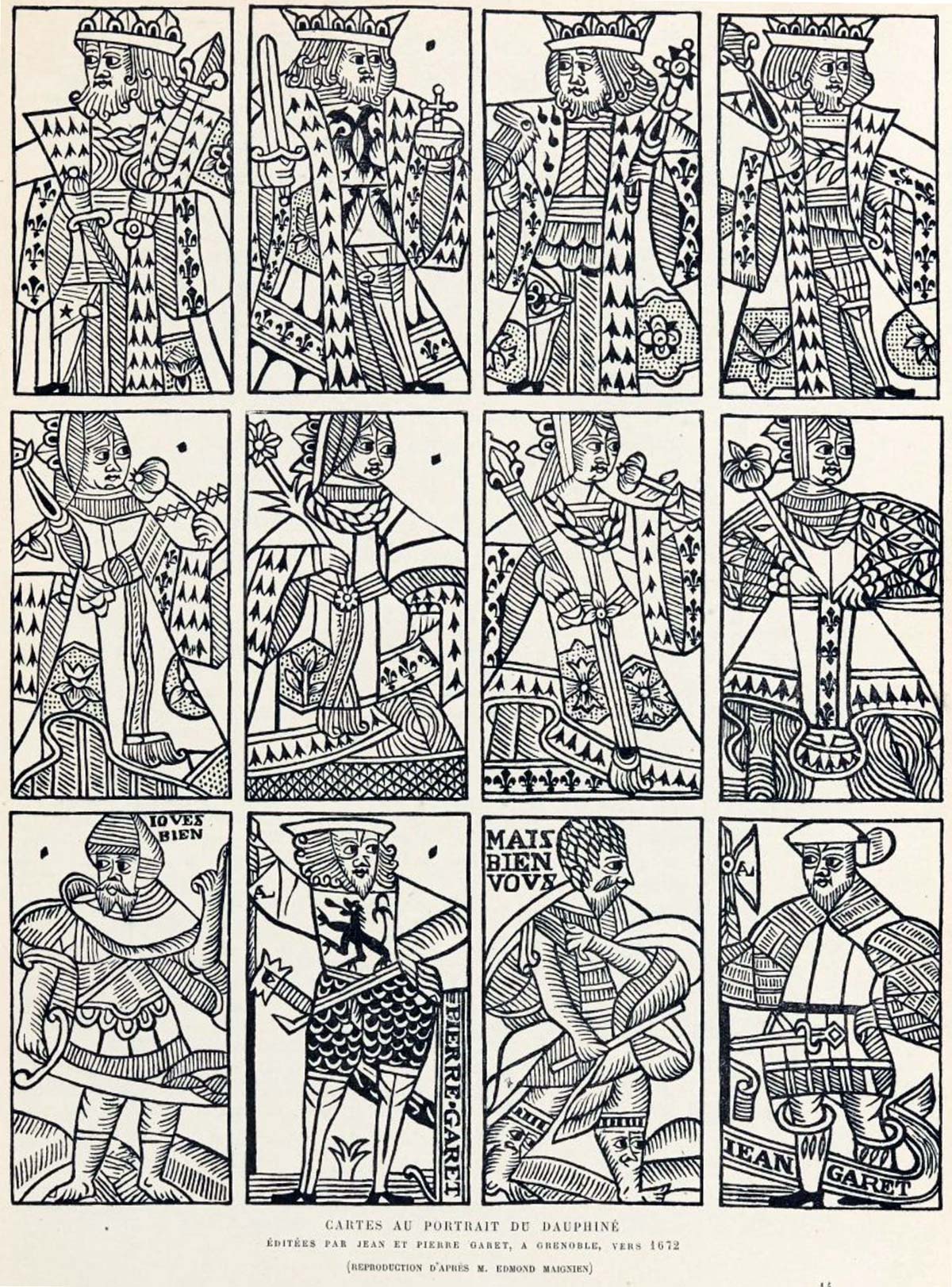
Above: image of Dauphiné pattern by Jean & Pierre Garet c.1672, from d'Allemagne, Henry-René : Les cartes à jouer du XIVe au XXe siècle, Hachette et Cie, Paris, 1906, vol.1, p.105.
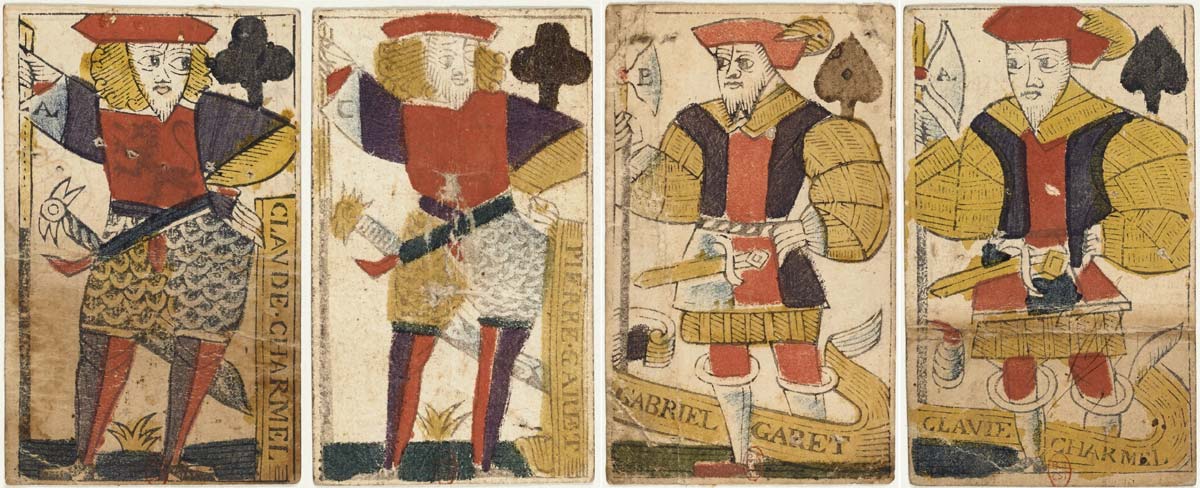
Above: Dauphiné pattern cards by Pierre Garet, Gabriel Garet & Claude Charmel, Grenoble, 1675-1699. Source gallica.bnf.fr • Cartes de tête issues de jeux au portrait du Dauphiné►
“The Dauphiné pattern was always somewhat heavy and uncertain. At the end of the 17th century, however, its engraving, very similar to that of contemporary popular books, is solid, if not elegant, and decorative. Then, quickly, came the decline” - Seguin, Jean-Pierre, Cinq siècles de cartes à jouer en France, Bulletin du vieux papier (Paris), 1963.
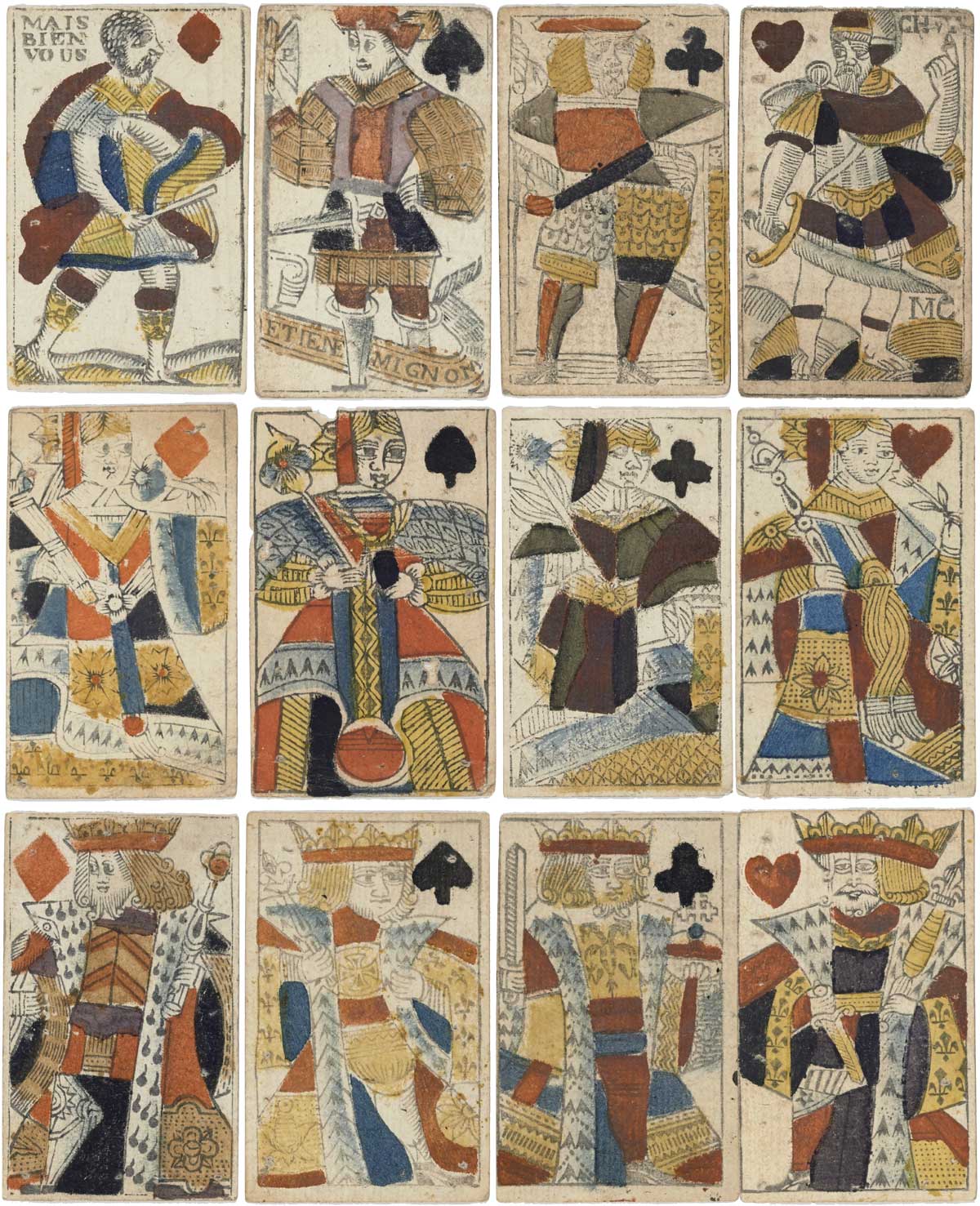
Above: assorted cards from Dauphiné pattern packs by different card makers, 1650-1750. Stencil coloured woodcuts, with plain white backs with handwritten notes in brown ink indicating reuse of cards. Source gallica.bnf.fr / Bibliothèque nationale de France • Cartes à jouer issues de jeux au portrait du Dauphiné►
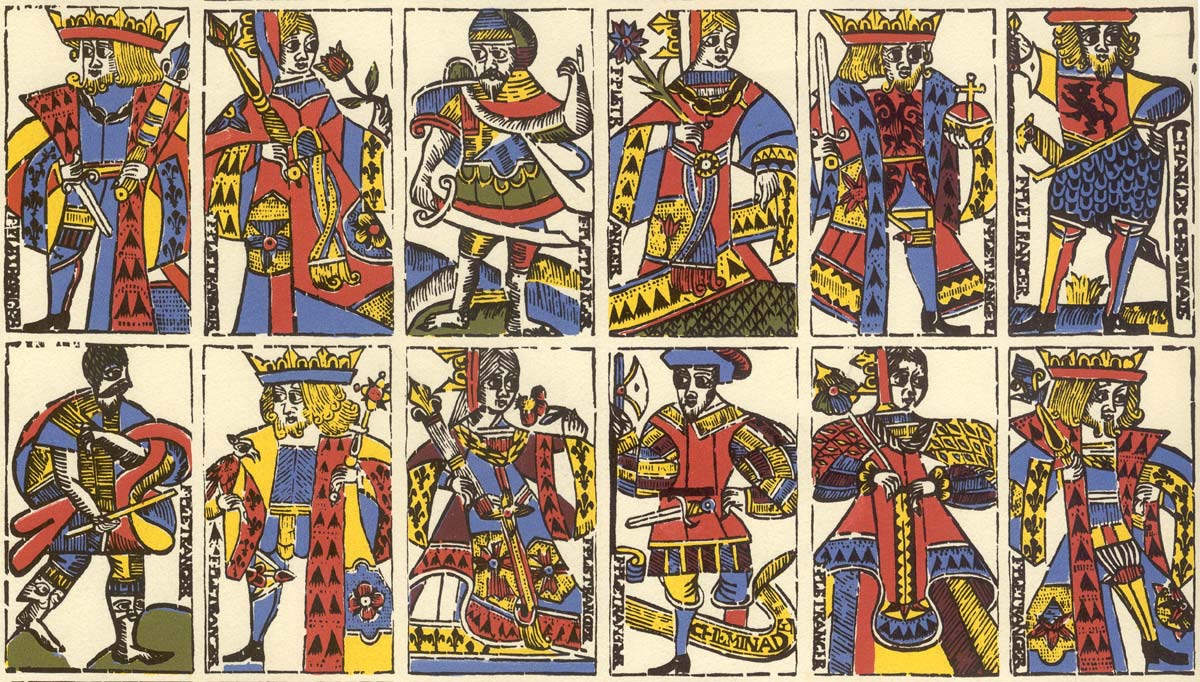
Above: cards from a facsimile print of the Dauphiné pattern, pulled from original woodblocks by P. Letranger / Charles Cheminade, c.1650. Published by Stuart Kaplan, 1986.
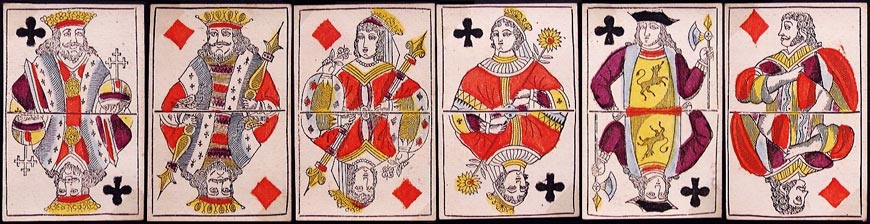
Above: cards from a double-ended version of the Dauphiné pattern by an anonymous manufacturer, possibly French or Belgian, printed from woodblocks and coloured by hand using stencils, c.1830s. The King of Clubs carries an orb and a sword, exactly as in the full-length version (shown above top row). The King of Diamonds has a falcon on his wrist, the Jack of Clubs, with a lion on his breast, stands facing the front, one hand on hip, the other on top of his halberd. The Jack of Diamonds displays what might be a north Italian influence in his style of dress.

By Simon Wintle
Spain • Member since February 01, 1996
I am the founder of The World of Playing Cards (est. 1996), a website dedicated to the history, artistry and cultural significance of playing cards and tarot. Over the years I have researched various areas of the subject, acquired and traded collections and contributed as a committee member of the IPCS and graphics editor of The Playing-Card journal. Having lived in Chile, England, Wales, and now Spain, these experiences have shaped my work and passion for playing cards. Amongst my achievements is producing a limited-edition replica of a 17th-century English pack using woodblocks and stencils—a labour of love. Today, the World of Playing Cards is a global collaborative project, with my son Adam serving as the technical driving force behind its development. His innovative efforts have helped shape the site into the thriving hub it is today. You are warmly invited to become a contributor and share your enthusiasm.

Activity for Dauphiné Pattern - Portrait du Dauphiné
Sign in to comment or save this article.

Related Articles
Charles Cheminade Tarot
Marseille Tarot cards by Charles Cheminade of Grenoble, France, early 18th century.
Most Popular
Our top articles from the past 60 days


