


Federal 52
Federal 52 (2013) was Jackson Robinson’s first Kings Wild playing card release, based on the engraved style of United States banknotes.
Federal 52 was the first Kings Wild playing card release, but not Jackson Robinson’s first Kickstarter. In early 2013 he ran small Kings Wild branded campaigns alongside his deck plans, including Kings Wild T Shirt (137 backers pledged $4,344) and Roots (77 backers pledged $2,179). He later explained that he wanted to be “ready and used to the Kickstarter system,” and to build a small backer base to “prime the pump” for what he already felt “had the potential to be a big project.” It marks a move away from the traditional, restrictive problem of paying for printing first and hoping to sell enough copies, towards using Kickstarter to assemble the backer base before committing to a full print run (see Production Methods for Small Scale Editions of Playing Cards for the older, more restrictive routes).

Above: Ace of Spades (Federal Eagle), Queen of Diamonds (Lady Liberty), and Jack of Clubs (Ulysses S. Grant).
Notable Early Kickstarter Campaigns
| Project | Comment | Amount |
|---|---|---|
| Brimstone | First to $30k | $30,983 |
| A Deck of Cards | First to $100k | $146,596 |
| Roots | Early experiment | $2,179 |
| Kings Wild T-Shirts | Early experiment | $4,344 |
| Federal 52 | First KWP project | $149,156 |
Above: Comparative funding for early high-profile deck projects (2011–2013) that influenced the Federal 52 launch.
Federal 52 launched on 14 March 2013 and raised $149,156 from 2,798 backers. In the closing hours Robinson urged supporters to overtake the then record holder, Pedale Design’s USPCC printed A Deck of Playing Cards ($146,596), and he openly stated that he wanted Federal 52 to become “the highest grossing deck project to date.”
Robinson’s approach was reference-led and labour-intensive. He described beginning by gathering “tons of reference images and engraving designs from bank notes” before he would “start sketching.” He referred to this as his “plan of attack”: collect the source material, study how engraved ornament is built, and then rebuild that within the format of a standard deck. The artwork developed from hand drawn linework and was later finished on the computer for print, with the project ultimately issued in both Bicycle-branded and unbranded editions—a choice that required licensing and approval beyond simply printing at USPCC.

Above: Robinson at work on the Federal 52 artwork, showing the intricate engraved style. See also the short film The Dream Wifin’ A Dream – The Federal 52 Project.
The pack translates the engraved aesthetics of United States banknotes, certificates and official documents directly into the language of a conventional playing deck (see the tuck box ). Robinson retained standard indices and suit symbols. The courts are redesigned, but not abstracted beyond recognition, so the deck remains playable and legible; particularly in the Kickstarter context, where a project must communicate its value quickly.
Federal 52 is notable for Robinson’s attention to production. He later advised creators to “learn everything you can about the deck production process,” noting that many horror stories came from designers who did not understand printer templates and file preparation. He also acknowledged that prior experience mattered, explaining that he had “almost 12 years of printing experience … so I had a leg up on the printing process.”
Robinson did not treat the deck as a side project, describing “the sheer amount of work that had to be done,” alongside a full time job and family life, and putting in “4–6 hours every night” while keeping up with comments and updates during the campaign.
Seen in retrospect, Federal 52 demonstrated that a designer could mobilise a community around production details, monetising not only a finished pack but the act of making it. The campaign’s reward structure, incremental stretch goals and emphasis on participation signalled an emerging model in which the independent deck was financed, shaped and validated in public. In that sense, Federal 52 stands less as an isolated success than as an early inflection point in the economics of modern playing card publishing.

Above: Spades (King: Alexander Hamilton, Series 2004 $10 Note; Queen: Lady Liberty, Series 1874 $50 Note; Jack: Grover Cleveland, Series 1928 $1,000 Note).

Above: Diamonds (King: Benjamin Franklin, Series 1914 $100 Note; Queen: Lady Liberty, Series 541 MPC 5¢ Note; Jack: Thomas Jefferson, Series 1918 $2 Note).

Above: Clubs (King: George Washington, Series 1896 $1 Note; Queen: Martha Washington, Series 1896 $1 Note; Jack: Ulysses S. Grant, Series 2004 $50 Note).

Above: Hearts (King: Abraham Lincoln, Series 2006 $5 Note; Queen: "Tiara", Series 1961 Military Payment Certificate; Jack: James A. Garfield, Series 1882 $5 Note).

Above: List of characters and banknotes from the key card included in the deck.
Notes & References

By Adam Wintle
Thailand • Member since March 15, 1997
Adam has been involved in developing the site as well as reviewing new decks and conducting research. He is particularly interested in innovation, Kickstarter and East Asian cards. He is a member of the IPCS, 52 Plus Joker, and webmaster of the EPCS.

Activity for Federal 52
Sign in to comment or save this article.

Related Articles
Peter Pan
A Peter Pan-themed deck developed through live-streamed drawing sessions, with members invited to su...
Misc. Goods Co. Playing Cards
One of the early custom playing-card projects funded through Kickstarter, and the starting point for...
AVES
A rich display of plumage by artist Karina Eibatova.
Romeo and Juliet playing cards
Romeo and Juliet playing cards illustrated by Belgian artist Virginie Carquin 2016.
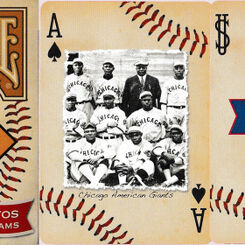
Bicycle Negro League Baseball Museum
Bicycle Negro League Baseball Museum souvenir playing cards, USA, 2012.
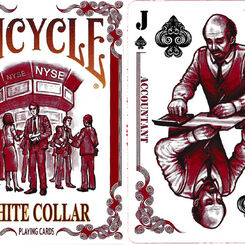
Bicycle Blue Collar / White Collar playing cards
Bicycle Blue Collar / White Collar playing cards, USA, 2014.
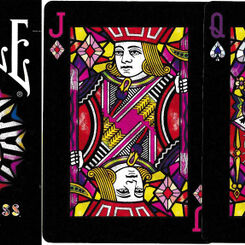
Bicycle Stained glass playing cards
Bicycle Stained glass playing cards adorned as multi-coloured stained glass, USA, c. 2018.
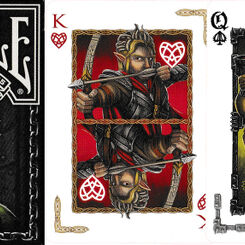
Bicycle Elves & Orcs
Bicycle ‘Elves & Orcs’ playing cards illustrated by Nathanael Iwata, USA, 2013.
Bicycle Ancient Machine playing cards
Bicycle Ancient Machine playing cards designed by concept artist Juniardi Satyanagara, USA, 2015.
Bicycle Panthera playing cards
Bicycle Panthera playing cards designed by Juniardi Satyanagara, USA, 2015.
U.S. Presidents playing cards
U.S. Presidents Bicycle playing cards designed by Johnny Whaam, USA, 2015
The Bird by Kings Wild Project
Originally titled Oriole Playing Cards, based on a deck produced by The New York Consolidated Card C...
Kings Wild Tigers Playing Cards
Kings Wild Tigers is Jackson Robinson’s 27th successful playing card Kickstarter campaign. A luxury ...
Bicycle Civil War Deck
The Civil War Deck designed by Jackson Robinson, 2017.
Bicycle Heritage
Bicycle Heritage playing cards by the United States Playing Card Company, 2012
Kingdoms of a New World
“Kingdoms of a New World” playing cards designed by Nathanael Mortensen, 2014.
Surena: The Persian Playing Cards
Diba Salimi has created a hand illustrated pack inspired by Persian ancient history, art and Persian...
Sherlock Holmes by Jackson Robinson
A 2013 Sherlock Holmes playing card review by Jackson Robinson, officially licensed by the Sir Arthu...
Kingdoms of a New World
Enter the Kingdoms of the New World with these fantasy themed playing cards by Nathanael Mortensen, ...
Bicycle No.808
The famous Bicycle playing cards were first introduced by Russell & Morgan Printing Co in 1885. More...
Most Popular
Our top articles from the past 60 days


