


Hunt & Sons, 1820-1849
Hunt & Sons (1820-1849) was the first maker to modernise the court card designs with a complete re-drawing.

Playing Cards manufactured by Hunt & Sons, 1820-1849
Having started in 1790 as Hunt, the company became Hunt & Sons in 1820. Hunt and Hall & Bancks joined forces in 1840, but kept separate aces and courts until the change to Bancks Brothers in 1849.

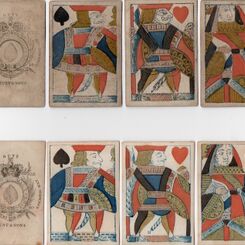
Above: 32 card pack with small size courts and George III garter ace of spades showing one shilling and six pence duty, manufactured by Hunt & Sons. Image courtesy John Sings.

Above: 'Superfine' woodblock and stencil playing cards with George III garter ace of spades manufactured by Hunt & Sons, c.1820.
Hunt & Sons (1821-1840) was the first maker to 'modernise' the court card designs with a complete re-drawing which were printed mechanically by stereotype (below). These also became the house style of their successors Bancks Brothers►

Above: standard pack with modernised courts and George IV garter ace of spades showing one shilling and sixpence duty manufactured by Hunt & Sons, c.1822. Image courtesy John Sings.

Above: playing cards with re-drawn, 'rationalised' designs and 'Old Frizzle' ace of spades by Hunt & Sons, c.1830.

Above: playing cards issued by Hunt & Sons, c.1830s. Small size cards 56mm x 84mm with 'Old Frizzle' ace of spades. The court cards had been introduced by Stopforth in the Garter period. Image courtesy John Sings. Next page: Bancks Brothers►

By Simon Wintle
Spain • Member since February 01, 1996
I am the founder of The World of Playing Cards (est. 1996), a website dedicated to the history, artistry and cultural significance of playing cards and tarot. Over the years I have researched various areas of the subject, acquired and traded collections and contributed as a committee member of the IPCS and graphics editor of The Playing-Card journal. Having lived in Chile, England, Wales, and now Spain, these experiences have shaped my work and passion for playing cards. Amongst my achievements is producing a limited-edition replica of a 17th-century English pack using woodblocks and stencils—a labour of love. Today, the World of Playing Cards is a global collaborative project, with my son Adam serving as the technical driving force behind its development. His innovative efforts have helped shape the site into the thriving hub it is today. You are warmly invited to become a contributor and share your enthusiasm.

Activity for Hunt & Sons, 1820-1849
Sign in to comment or save this article.

Related Articles
76: Transitions: Hunt & Sons
Styles change and technology develops. This means that it's possible to see transition periods in th...
Why our playing-cards look the way they do
Analysis of early playing card designs: origins, suit differences, standardization, technological ad...
75: Early American cards
An overview of some of the early cards made in the United States.
66: Adverts and related material 1862-1900
Some further material relating to cards from nineteenth and twentieth century periodicals.
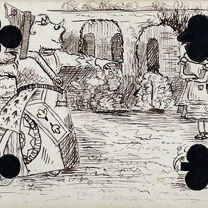
Transformation c.1880
Transformation playing cards hand-drawn on a pack manufactured by Hunt’s Playing Card Manufacturing ...
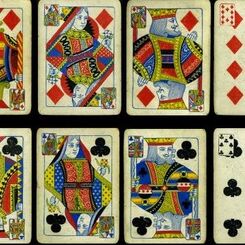
37: Late 19th Century Card-Makers and Problem Cases
After the Old Frizzle period and the tax was reduced to 3d per pack, from 1862 onwards, a number of ...
Most Popular
Our top articles from the past 60 days


