



Naipes TRIUNFO c.1925-40
Cappellano Hermanos were book publishers during the 1920s who also commenced producing playing cards around this time.


Naipes TRIUNFO
by Cappellano Hnos, publishers and playing card manufacturers, Sarmiento 1537, Bs Aires, Argentina, c.1925-40
Cappellano Hermanos were book publishers during the 1920s who also commenced producing playing cards around this time. The cards below are their first known Spanish-suited designs. The four of cups has the green 'Mercury' tax stamp used on home-produced cards at this time and the address is given as Sarmiento 1537, Bs Aires.

Above: naipes TRIUNFO made by Cappellano Hnos, Sarmiento 1537, Buenos Aires, 1920s. This is an early version of the Ace of Coins and court card design, showing the Argentine flag draped around the central medallion and simplified courts.
At some time (c.1930) the design of Naipes Triunfo was re-drawn in a more conventional style which resembles the cards of several other manufacturers of the time. The Art Nouveau logo on the Four of Cups was retained for a while, until this was also replaced in c.1945.

Above: cards from a slightly later edition of Naipes Triunfo by Cappellano Hnos, c.1930-40, with gold edges, showing the re-designed Ace of Coins and court cards which were used in all Naipes Triunfo decks thereafter. The address is given as Sarmiento 1537, Bs Aires.


By Simon Wintle
Spain • Member since February 01, 1996
I am the founder of The World of Playing Cards (est. 1996), a website dedicated to the history, artistry and cultural significance of playing cards and tarot. Over the years I have researched various areas of the subject, acquired and traded collections and contributed as a committee member of the IPCS and graphics editor of The Playing-Card journal. Having lived in Chile, England, Wales, and now Spain, these experiences have shaped my work and passion for playing cards. Amongst my achievements is producing a limited-edition replica of a 17th-century English pack using woodblocks and stencils—a labour of love. Today, the World of Playing Cards is a global collaborative project, with my son Adam serving as the technical driving force behind its development. His innovative efforts have helped shape the site into the thriving hub it is today. You are warmly invited to become a contributor and share your enthusiasm.

Activity for Naipes TRIUNFO c.1925-40
Sign in to comment or save this article.

Related Articles

Foto Joker
'Foto Joker' Spanish playing cards for Matera Color Laboratory, 2008.

Caballos Argentinos
“Caballos Argentinos” playing cards with photographs of horses and ponies on each card.

G. Berger, Buenos Aires, c.1935-50
Berger also produced a Hungarian-type "Seasons" pack with the brand name "La Estrella" and a six-poi...

Cappellano S.A. c.1920-c.1985
Originally known as Cappellano Hnos in the 1920s, and undergoing several changes of name and address...

Estudio Negrin PIRELLI, c.1960
Estudio Negrin playing cards for PIRELLI, made by Orestes A. Cappellano S.R.L., Buenos Aires, Argent...

VELCAP c.1940s
Naipes VELCAP playing cards by Orestes A. Cappellano, playing card manufacturers, Buenos Aires, Arge...

Naipes VELCAP c.1950
Naipes VELCAP playing cards by Orestes A. Cappellano, Buenos Aires, Argentina, c.1950,

VELCAP circular, c.1980
VELCAP circular playing cards made by Cappellano S.A., c.1980.

Argentinian Playing Cards - Naipes Argentinos
Playing cards were introduced to the Americas by Spanish explorers in the 16th century.

Naipes Triunfo, c.1970-80
Naipes TRIUNFO Spanish-suited playing cards by Cappellano, S.A., Florencio Varela 542, Buenos Aires,...

Nascal S.R.L., Buenos Aires, 1960-80
Nascal S.R.L., Paisandu 760, Buenos Aires c.1960-80, manufacturers of plastic playing cards.
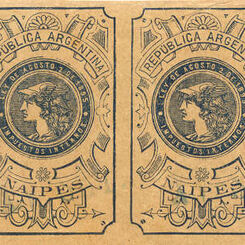
Impuestos Internos Sobre Naipes
Duty was first introduced on playing cards in Argentina in 1892, as part of the Internal Duties law,...

VELCAP, c.1960-65
Advertising pack for Lutz Ferrando y Cía Opticians, c.1960.

Fagoaga y Compañía (Casa Bertrand Domec), Buenos Aires, c.1970
Playing Cards Imported into Argentina by Fagoaga y Compañía (Casa Bertrand Domec), Buenos Aires, c.1...

Cía General Fabril Financiera S.A.
Founded in 1889 as Compañía General de Fósforos, and favoured by certain economic factors, the firm ...

Torcacita, c.1945-65
Naipes Naipes Torcacita, c.1945-65. Spanish-suited playing cards made by Orestes A. Cappellano; seve...

Naipes Triunfo, c.1965
Spanish-suited playing cards by Cappellano, S.A., Florencio Varela 542, Buenos Aires, Argentina, c.1...

Naipes Triunfo for Fernet Branca
Naipes TRIUNFO Spanish-suited playing cards for Fernet Branca by Cappellano, S.A., publishers and pl...

Naipes TRIUNFO by Orestes A Cappellano, c.1940-55
Naipes TRIUNFO Spanish-suited playing cards by Orestes A. Cappellano, publishers and playing card ma...
List of Argentinian Playing Card Manufacturers
List of Argentinian Playing Card Manufacturers from the 19th and 20th centuries.
Most Popular
Our top articles from the past 60 days


