


The Princely Hunting pack, c.1440
The Princely Hunting Pack, c.1440/45, is attributed to Konrad Witz and his workshop in Basle.
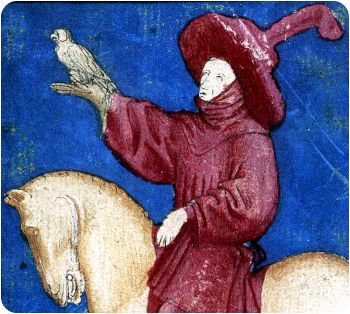
The Ambras Court Hunting pack, c.1445
Ambraser Hofjagdspiel
The Ambraser Hofjagdspiel, c.1440/45, is attributed to Konrad Witz and his workshop in Basle. It was found in a collection at the castle of Ambras (Innsbruck, Austria) in the 16th century, hence its name ‘The Court Hunting pack of Ambras’. The pack originally consisted of fifty-six cards in four suits, and the suit symbols are lures, herons, hounds & falcons... which all relate to the theme of heron hunting. The thematic consistency in the pack is remarkable and must rank as the culmination of iconographic treatment of the hunting theme in playing cards.
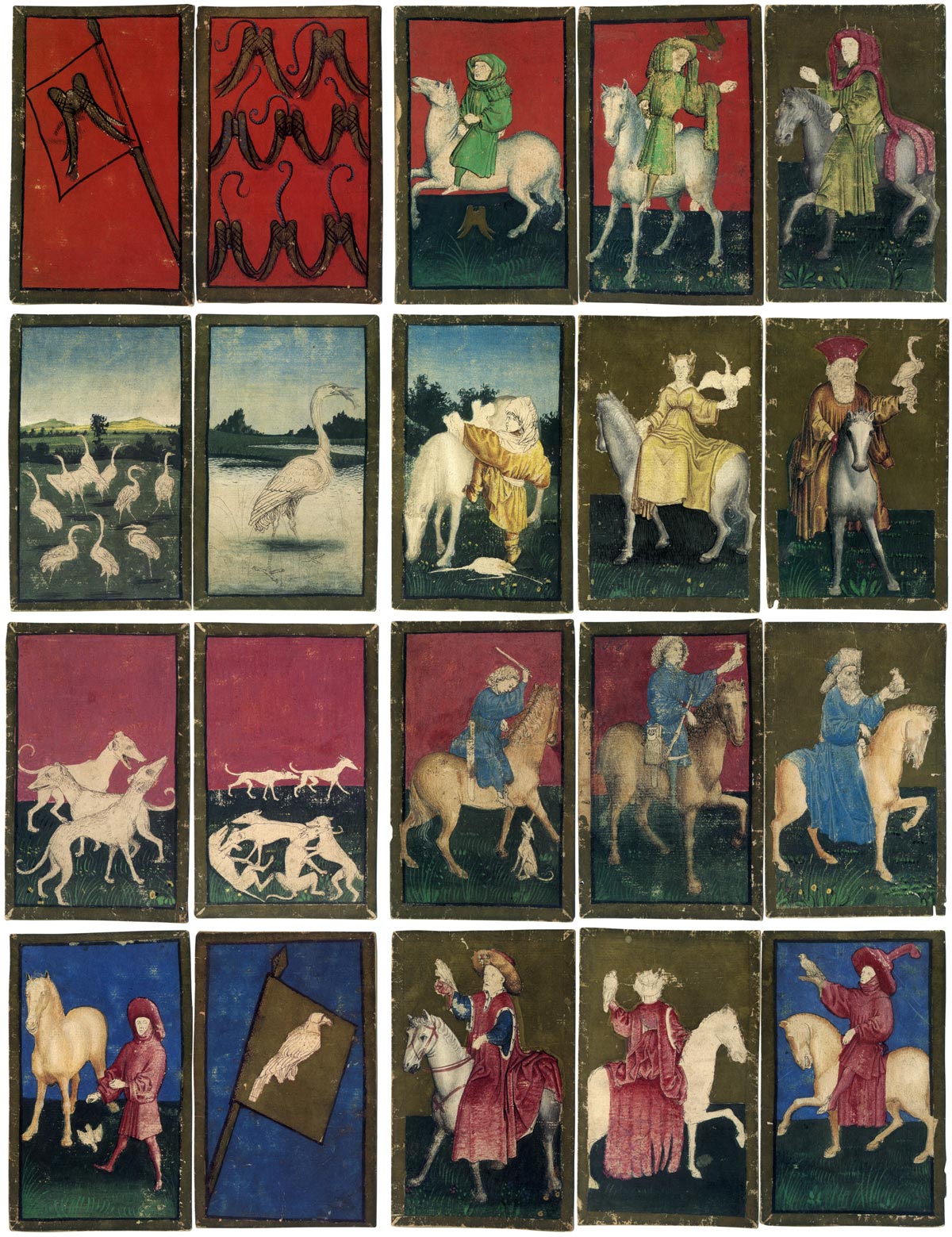
Above: cards from the facsimile edition published by Piatnik, Vienna, 1995, the original of which is in the Vienna Museum of Art History.
The pack originally consisted of fifty-six cards in four suits, size 9.5 x 15.6 cm, painted red on the reverse. The cards are executed in water colours and paints over black ink drawings on paper - they are not printed or mechanically produced in any way. Several layers of paper have been glued together to give the cards the necessary thickness. As was the practice with early Italian cards, the back paper has been cut slightly larger allowing the edges to fold over to the front, forming a border around the fronts of the cards (sometimes this border obscures part of the drawings). The suit symbols are hounds, herons, lures & falcons. The court hierarchy consists of four court cards in each suit, unnumbered and without titles, all mounted on horseback: King and Queen (with brushed gold backgrounds), Upper Knave & Lower Knave (with backgrounds matching their respective number cards). The ‘number’ cards are also unnumbered, but run from 1 - 9, with a banner as 10. Banner 10s were often associated with South German cards in the fifteenth and sixteenth centuries, and still are found today in Switzerland. See also: The Pack of Cards by the South German Engraver.
The cards are notable for their carefully devised colour scheme and the consistent internal structure of the pack which extends to the clothing as well as background colours of each suit. Another feature is the thematic consistency of the four suits which all relate to the theme of hunting, a pastime which was the prerogative of the nobility for whom the pack was probably designed. Not all the numeral cards are arranged in neat, formal rows, but in some cases the artist has illustrated the animals' natural behaviour and arranged them in a haphazard, informal manner. These considerations, added to the cost of a luxury pack produced in the workshop of Konrad Witz, suggest that these cards were intended for courtly patrons, not for ordinary people. Furthermore, the cards can hardly have been used for play: they show no sign of wear and are unfinished... perhaps because the Herons and Hounds suit number cards were poorly suited to the practical requirements of card playing.
A 56 card pack, of course, is similar to Italian Tarocchi packs without the 22 trump cards. Four court cards are found also in other early packs, such as the two packs by the Master E.S., but most packs had only three court cards per suit. In this pack, however, the Kings and Queens do not wear crowns but instead wear exotic headgear.
In the years before the Renaissance reached the North, German bourgeois art began to embrace the external physical world: human figures and animals are depicted in these playing cards with realistic skies and landscape backgrounds, shadows and light-and-shade effects. In several ways these cards depart from the typical conventions of fifteenth century playing card design and we may regard Konrad Witz and his apprentices as innovators in their field. See also the hand-painted "Stuttgart Cards" and copper-engraved cards by the Master of the Playing Cards and Master of the Banderoles.
Reference
Kunsthistorisches Museum Vienna: Ambraser Hofjagdspiel►

By Simon Wintle
Spain • Member since February 01, 1996 • Contact
I am the founder of The World of Playing Cards (est. 1996), a website dedicated to the history, artistry and cultural significance of playing cards and tarot. Over the years I have researched various areas of the subject, acquired and traded collections and contributed as a committee member of the IPCS and graphics editor of The Playing-Card journal. Having lived in Chile, England, Wales, and now Spain, these experiences have shaped my work and passion for playing cards. Amongst my achievements is producing a limited-edition replica of a 17th-century English pack using woodblocks and stencils—a labour of love. Today, the World of Playing Cards is a global collaborative project, with my son Adam serving as the technical driving force behind its development. His innovative efforts have helped shape the site into the thriving hub it is today. You are warmly invited to become a contributor and share your enthusiasm.

Related Articles
Early German playing cards
Some early examples of popular German playing cards from the XV and XVI centuries.
Gambling and Vice in the Middle Ages
Gambling and Vice in the Hours of Charles V: card-playing in the local tavern
Master of the Playing Cards
Animal suited playing cards engraved by the Master of the Playing Cards, Germany, c.1455
Hidden meanings in painting by Jheronimus Bosch
Medieval View of Gambling in the ‘Garden of Earthly Delights’ by Jheronimus Bosch
Stuttgart pack, c.1430
The luxury, hand-painted Stuttgart Cards (Stuttgarter Kartenspiel) dated c.1430, with suits of ducks...
Flemish Hunting Deck
Set of medieval playing cards with King, Queen, Knave and numeral cards from one to ten in each of f...

Hans Sebald Beham
Playing cards designed by Hans Sebald Beham (1500–1550).
Cotta Transformation playing cards
In 1804, J.G. Cotta, a publisher and bookseller in Tübingen, Germany, produced the first set of tran...
Pierre Marechal
Rouen became an important centre for card-making whose influence extended far afield. Cards from Rou...
Master PW Circular Cards
Master PW Circular Playing Cards: roses, columbines, carnations, parrots and hares... everyday objec...

Hunting Depicted on Playing Cards
In the Middle Ages hunting was an integral part of life.
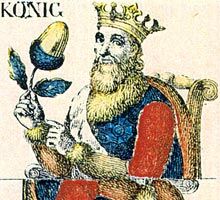
David Hurter, Schaffhausen
David Hurter built up a playing card business in Schaffhausen during the 18th century.

Antique Swiss Playing Cards, c.1530
The Swiss national suit system of shields, acorns, hawkbells and flowers originated sometime during ...
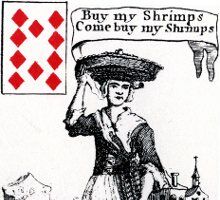
Cries of London
The cards were printed from copper plates, with the red suit symbols being applied later by stencil....
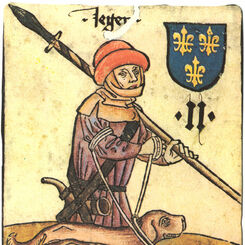
Hofamterspiel, c.1460
Hofamterspiel, c.1460
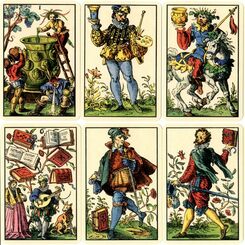
The Book of Trades by Jost Amman, 1588
The Book of Trades by the prolific German Renaissance artist Jost Amman (1539-91). Suits are books, ...
Peter Flötner, c.1545
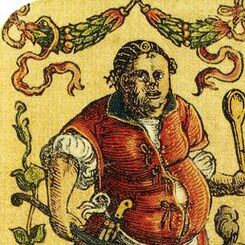
Seven cards from a satirical pack produced by Peter Flötner of Nuremberg, c.1545. The suit symbols a...
Early German Engraved Playing-cards
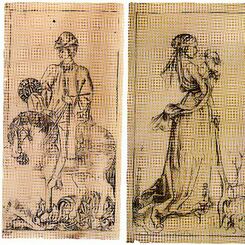
During the second half of the fifteenth century, with printing technology commercially established a...

Playing cards in the Upper Rhine region
Documentary evidence suggests that card playing established itself in Italy in 1376, and then spread...
Unsun Karuta
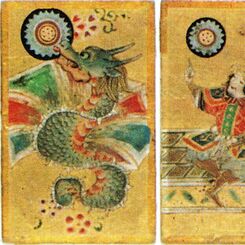
Unsun Karuta うんすんかるた Japan c.1780.
Most Popular
Our top articles from the past 60 days


