


Master of the Banderoles
Playing Cards by the Master of the Banderoles, one of the earliest professional printmakers.
Playing Cards by the “Master of the Banderoles”
Der Meister mit den Bandrollen
The Master of the Banderoles - so-called because of the banderoles (speech banners) present in many of his prints - originated in the North Netherlands during the mid-fifteenth century and lived in the east of the Netherlands between Zwolle and Bocholt ca. 1462-1500. He (or she) was one of the earliest professional printmakers. Most of his output consisted of devotional and decorative images for the emerging market for prints which would have been pasted onto boards or into books. He tended to copy subjects from other sources whilst building up a composition, or reuse his own motifs, rather than create original works.
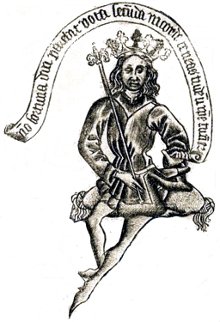
Right: detail from 'Fortune and Death' by the Master of the Banderoles, c.1450-1475
showing a banderole or scroll containing 'speech' emanating from a King →
Working almost within living memory of the first arrival of playing cards into Europe, the Master of the Banderoles’ set of playing cards provide a rare glimpse into their early development. Some of the Master's work was based on Italian models, so it is possible that he was influenced by or had visited Italy. These eight cards appear to be from an Italian (or Spanish)-suited pack of at least 48 cards, although no Aces or court cards are present in the fragment. The cards have been engraved in sequential order and are separated by a single line.
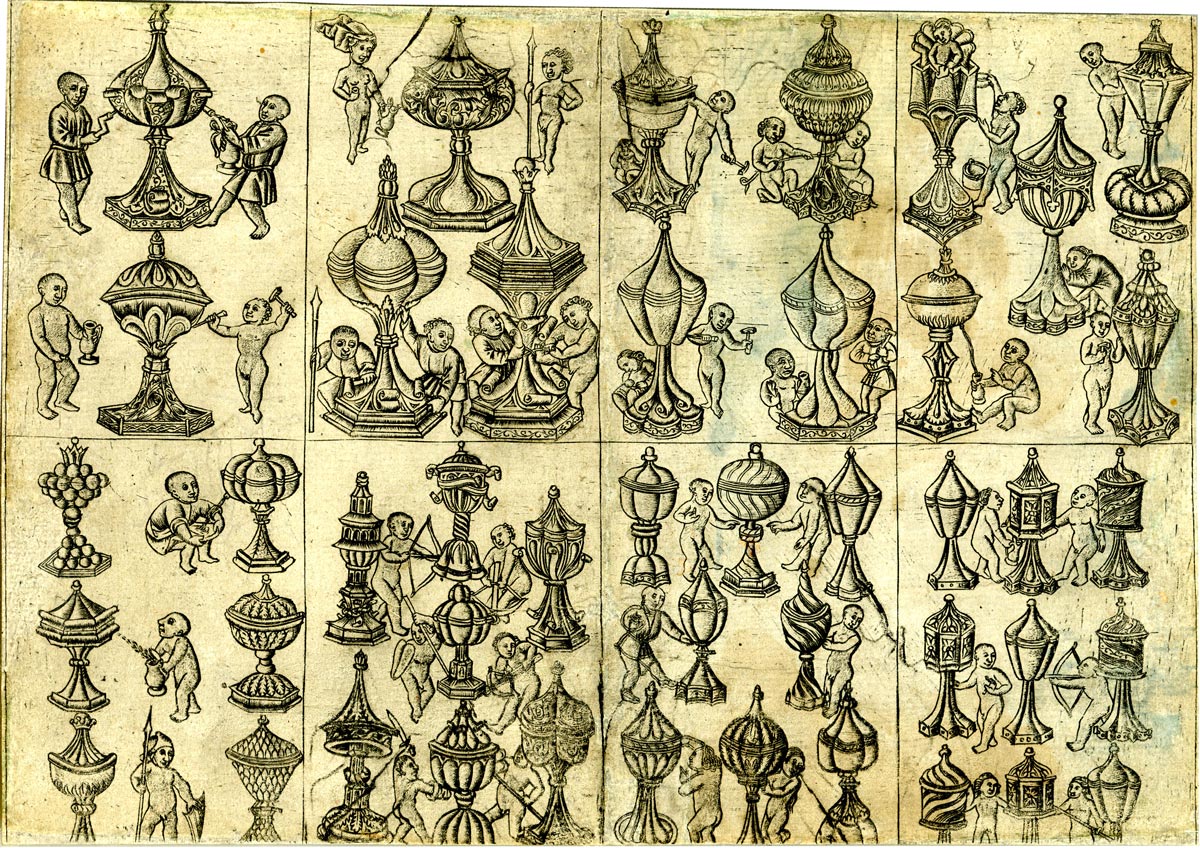
Above: an uncut sheet of eight playing cards probably the work of the Master of the Banderoles, an artist who is supposed to have worked on the Lower Rhine about 1470. The designs suggest Italian inspiration. Height of sheet: 192 millimetres; Width: 270 millimetres. ©The Trustees of the British Museum. All rights reserved.
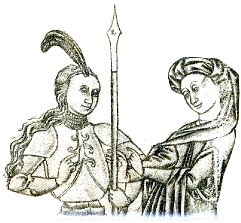
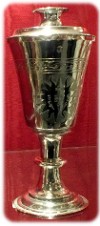
The Master of the Banderoles produced religious and devotional images as well as subjects such as grotesque alphabets and these playing cards. He worked in the new medium of engraving which required draughtsmanship and technical ability for copying the works of existing masters. The cross-over between religious and profane images is evident in the cup suit symbols which are in fact ciboria, cups for holding hosts from the Christian Eucharist and presumably ‘sacred’, similar to the chalices used for wine. The Master of the Banderoles seems to be very familiar with their designs. They were usually made of precious metal, or plated with silver, and possibly decorated with engraving. Ciboria were sometimes kept at homes to be handy for the Last Rites where needed. The impish little figures - ‘putti’ - cavorting amongst the ciboria add a slightly irreverent sense of fun and playfulness to the playing cards, consistent with their use as a recreational game.
Cherubs and ‘Putti’, which started reappearing in medieval art during the 15th century, were distinct. Cherubs were Angels and thus close to God. Putti were associated with Eros/Cupid and profane love and used as decorative art on buildings, frontispieces and illuminated capital letters. The Master of the Banderoles entertainingly merges spiritual and secular themes in his pack of playing cards by placing ‘putti’ amongst the ciboria.
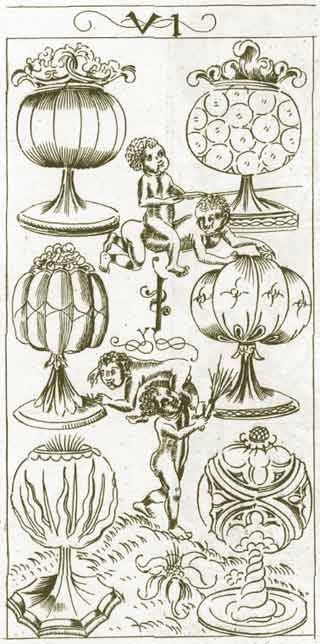
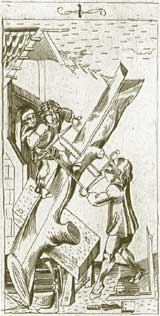
Similar antics can be seen in the miniature figures adorning the numeral cards in another elaborate Italian or Spanish-suited, Gothic pack of playing cards, produced in South Germany, which appears to commemorate the marriage, in 1496, of Felipe I of Spain and Doña Juana, daughter of Ferdinand and Isabella more →
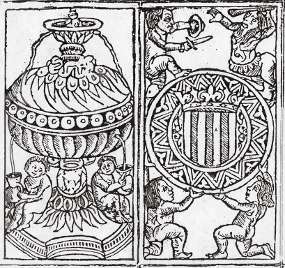
Right: Ace of Batons and Six of Cups from the pack of cards by the South German Engraver showing children cavorting amongst the pip symbols, late 15th century.
Left: Aces of Cups & Coins from a Gothic Spanish-suited pack produced in Spain, late 15th / early 16th century decorated with small children playing around the suit symbols.
← In addition, there is another Gothic Spanish-suited pack with naked children gamboling in the numeral cards, produced by woodcuts rather than engraving, believed to have been made in Spain around the same time.
The practice of decorating playing cards with small naked figures, or ‘putti’, persisted for several centuries in many Spanish and Italian-suited cards. In the Baroque period the putto came to represent the omnipresence of God. see example →
Bibliography and References:
Lockhart, Anne I.: Four Engravings by the Master with the Banderoles, The Bulletin of the Cleveland Museum of Art, Vol. 60, No. 8 (Oct., 1973), pp. 247-254
Acknowledgements: thanks to Samten de Wet for kind assistance with research.
I would suggest an Italian origin for these ideas - which permeated through Venice to Augsburg, Nuremberg, and the so-called Northern German Renaissance - which had as its climatic fruition, the work of Durer. Warburg scholars have paid attention to this field, and even for example, Durer made versions of the so-called Tarot of Mantegna. The classical research for this imaginal world can be traced back to Cyriacus of Ancona. These are a few bones of thought . . . Samten
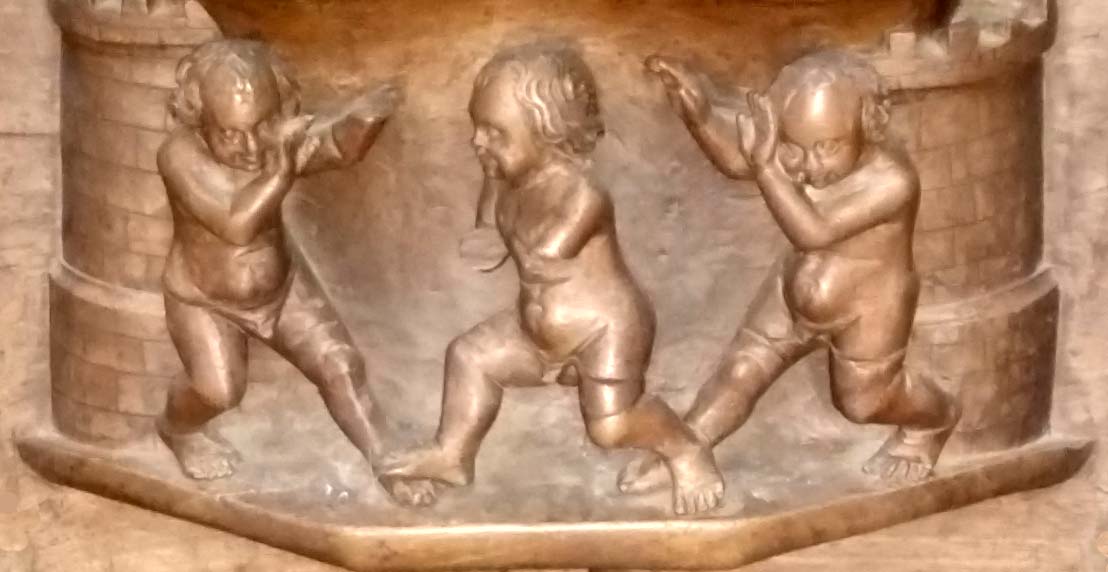
Above: detail of gothic woodcarving in walnut wood on the choir stalls in Plasencia cathedral, Spain. Nudity could represent the purity and innocence associated with childhood. In the playing cards it might allude to the unpredictability of fortune in the game.

By Simon Wintle
Spain • Member since February 01, 1996
I am the founder of The World of Playing Cards (est. 1996), a website dedicated to the history, artistry and cultural significance of playing cards and tarot. Over the years I have researched various areas of the subject, acquired and traded collections and contributed as a committee member of the IPCS and graphics editor of The Playing-Card journal. Having lived in Chile, England, Wales, and now Spain, these experiences have shaped my work and passion for playing cards. Amongst my achievements is producing a limited-edition replica of a 17th-century English pack using woodblocks and stencils—a labour of love. Today, the World of Playing Cards is a global collaborative project, with my son Adam serving as the technical driving force behind its development. His innovative efforts have helped shape the site into the thriving hub it is today. You are warmly invited to become a contributor and share your enthusiasm.

Activity for Master of the Banderoles
Sign in to comment or save this article.

Related Articles
NS Reizigers Promotion
A Dutch Railways pack with an unusually elongated format.
Les Chevaliers de la Toison d’Or
Medieval manuscript art at its finest.
Jeu Gothique
‘Jeu Gothique’ illustrating the Gothic period in France, published by Editions Dusserre.
Dutch costume playing cards from an unknown maker
Another pack of Dutch costume playing cards c.1880.
Royal Cards Reign of Queen Anne
“Royal Cards Reign of Queen Anne” cover historical events, both honourable and treacherous, during t...
72: The Ace of Spades
In standard English packs the Ace of Spades is associated with decorative designs. This is a histori...
Illustrated Playing Cards, c.1740
Illustrated playing cards featuring comical engravings and rhymes about saints, c.1740.
Forrest Cards, c.1750s
Hand-coloured Forrest Cards produced for “Young Gentlemen & Ladys who are Lovers of Ingenuity”, c.17...
Delightful Cards, c.1723
Delightful Cards, containing variety of entertainment for young Ladies and Gentlemen c.1723.
Master of the Playing Cards
Animal suited playing cards engraved by the Master of the Playing Cards, Germany, c.1455
Bubble Cards, 1720
Bubble Cards - known as “All the Bubbles”, c.1720.
Hidden meanings in painting by Jheronimus Bosch
Medieval View of Gambling in the ‘Garden of Earthly Delights’ by Jheronimus Bosch
Joseph Losch
French-suited pack with full-length courts by Joseph Losch, c.1800.
Archaeological find: old playing cards under the floorboards
The municipal archaeological service in Dordrecht (Netherlands) recently found some antique playing ...
Flemish Hunting Deck
Set of medieval playing cards with King, Queen, Knave and numeral cards from one to ten in each of f...
Das Kupferstichspiel des I.M.F. von 1617
Playing cards had been made as precious objects for wealthy clients since the late 14th century. The...
Netherlands
Playing cards have been known in the Low Countries since the 14th century
Mamluk Playing Cards
Nã'ib, the game of lieutenants... these cards are amongst the earliest Arabic playing cards ext...
South German Engraver
A pack of 52 cards with banner 10s, female 'Sotas', horsemen and kings, the pack was engraved in the...
The History of Playing Cards
Playing cards appear in European records in the late 14th century, but their earlier history lies fu...
Most Popular
Our top articles from the past 60 days


Alannyë Daeris
19 November 2025, 09:47SavedSaved this article to Decks Históricos
Paola Benzoni
12 July 2026, 13:25SavedSaved this article to Mazzi