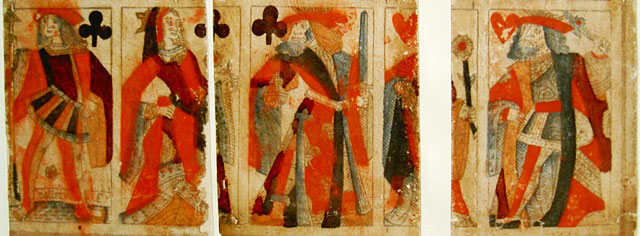
Playing cards in the Upper Rhine region
Documentary evidence suggests that card playing established itself in Italy in 1376, and then spread rapidly northwards across the Alps into the Upper Rhine regions of Germany and Switzerland and westwards into France and Spain.
Playing cards in the Upper Rhine region
 |
||||
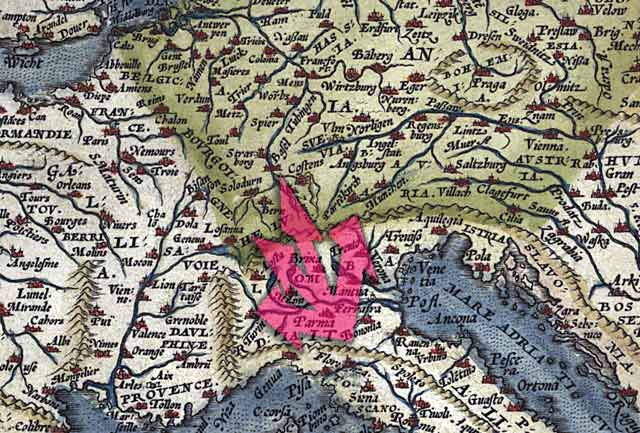
Documentary evidence suggests that card playing established itself in Italy in 1376, and then spread rapidly northwards across the Alps into the Upper Rhine regions of Germany and Switzerland and westwards into France and Spain, as suggested by the pink arrows on the above map. In 1377, the Dominican monk Johannes von Rheinfelden from Basle wrote an allegory on the pack of cards in which he described packs containing queens, or two kings and two queens each with their 'marschalli', or packs with four, five or six kings each (i.e. 4, 5 or 6 suits), and so on… North of the Alps, the Upper Rhine emerged as an important area for early playing card manufacture. A major economic factor was the city of Basle, a significant commercial centre situated on the transit route between Italy and the Rhine valley. Many of the extant early painted and engraved playing cards originated here. |
Factors facilitating the dissemination of card playing include the emergence of an urban mercantile class whose trading activities necessitated fast transport routes; the existence of cheap raw materials for printing in the form of paper; and finally the technique of reproducing the images by means of wood carving. See also: The Stuttgart Playing Cards | The Ambras Court Hunting Deck | The Master of the Playing Cards | Early German Engraved Cards | Hofämterspiel, c.1460 | XV century Spanish cards | XV century Italian cards | Spanish-suited cards made in Germany | Early French cards | XVI century Swiss cards.
|
|||

By Simon Wintle
Spain • Member since February 01, 1996
I am the founder of The World of Playing Cards (est. 1996), a website dedicated to the history, artistry and cultural significance of playing cards and tarot. Over the years I have researched various areas of the subject, acquired and traded collections and contributed as a committee member of the IPCS and graphics editor of The Playing-Card journal. Having lived in Chile, England, Wales, and now Spain, these experiences have shaped my work and passion for playing cards. Amongst my achievements is producing a limited-edition replica of a 17th-century English pack using woodblocks and stencils—a labour of love. Today, the World of Playing Cards is a global collaborative project, with my son Adam serving as the technical driving force behind its development. His innovative efforts have helped shape the site into the thriving hub it is today. You are warmly invited to become a contributor and share your enthusiasm.

Activity for Playing cards in the Upper Rhine region
Sign in to comment or save this article.

Related Articles
Luigi Del Pieve Minchiate
Luigi Del Pieve and the “Alli Sorte” Minchiate of Florence.
Burgdorf Abschreckhärtetechnik
Promotional pack for a German steel hardening business, with designs by Costante Costantini.
Early German playing cards
Some early examples of popular German playing cards from the XV and XVI centuries.
Vues et Caractères Suisses No.228
A Swiss souvenir pack by Dondorf
Wüst Costumes Suisses No.93
Two version of a Swiss souvenir pack by C.L.Wúst
Portuguese-suited cards
Portuguese-suited cards with dragon aces, made in Italy, 1613.
History of Playing Cards explained in 5 Minutes
Video by Art of Impossible. In this video you will get a short overview of the most important histor...
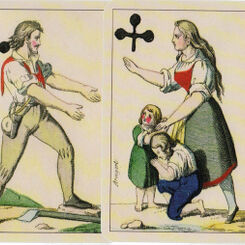
William Tell
Facsimile of Swiss William Tell deck from c.1870 published by Lo Scarabeo.
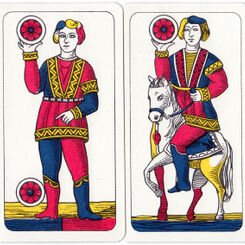
Trentine Pattern
Trentine Pattern
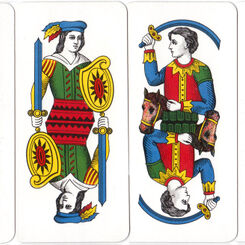
Primiera Bolognese
Primiera Bolognese by Modiano, c.1975
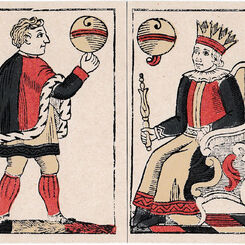
Johannes Müller c.1840
Facsimile edition of Swiss suited deck first published by Johannes Müller in c.1840.
Hermanos Solesio
“Money Bag” pattern by Hermanos Solesi, late 18th c.
Joseph Losch
French-suited pack with full-length courts by Joseph Losch, c.1800.
Das Kupferstichspiel des I.M.F. von 1617
Playing cards had been made as precious objects for wealthy clients since the late 14th century. The...
Giuseppe Cattino
Playing cards manufactured in Italy by Giuseppe Cattino and Paolo Montanar for Spanish markets.
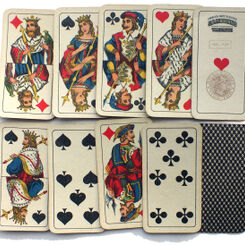
Lombardy (or Milanesi) pattern
The origins of the Lombardy pattern probably lie in the early 19th century when it was a full-length...
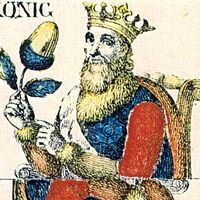
David Hurter, Schaffhausen
David Hurter built up a playing card business in Schaffhausen during the 18th century.
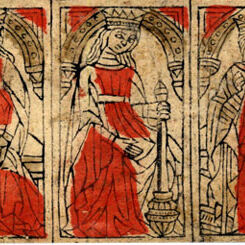
XV Century Italian Playing Cards
Cards from a pack of an early form of north Italian playing cards, with the swords back-to-back and ...
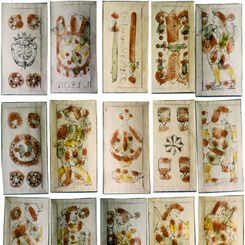
Sicilian playing cards by Antonio Monasta.
"Il Leon" Sicilian playing cards, 40-card pack based on Spanish designs, made in Sicily by Antonio M...
Italian Playing Cards
The first reliable evidence that playing cards were being used in Italy is from 1376, when a game ca...
Most Popular
Our top articles from the past 60 days