


Gambling and Vice in the Middle Ages
Gambling and Vice in the Hours of Charles V: card-playing in the local tavern
The month of September in the Book of Hours of Charles V, produced in Paris around 1500, has a miniature painting showing the sinner gambling accompanied by two women. Playing cards can be seen arranged on the table, along with money and other items. One of the women is distracting him whilst the other cheats. This is a frequent theme in Northern European medieval art. The moral message is that not only is he losing his soul but also all his goods, leading to misery. A libra sign is shown at the top left-hand corner. The right-hand miniature depicts salvation through prayer.
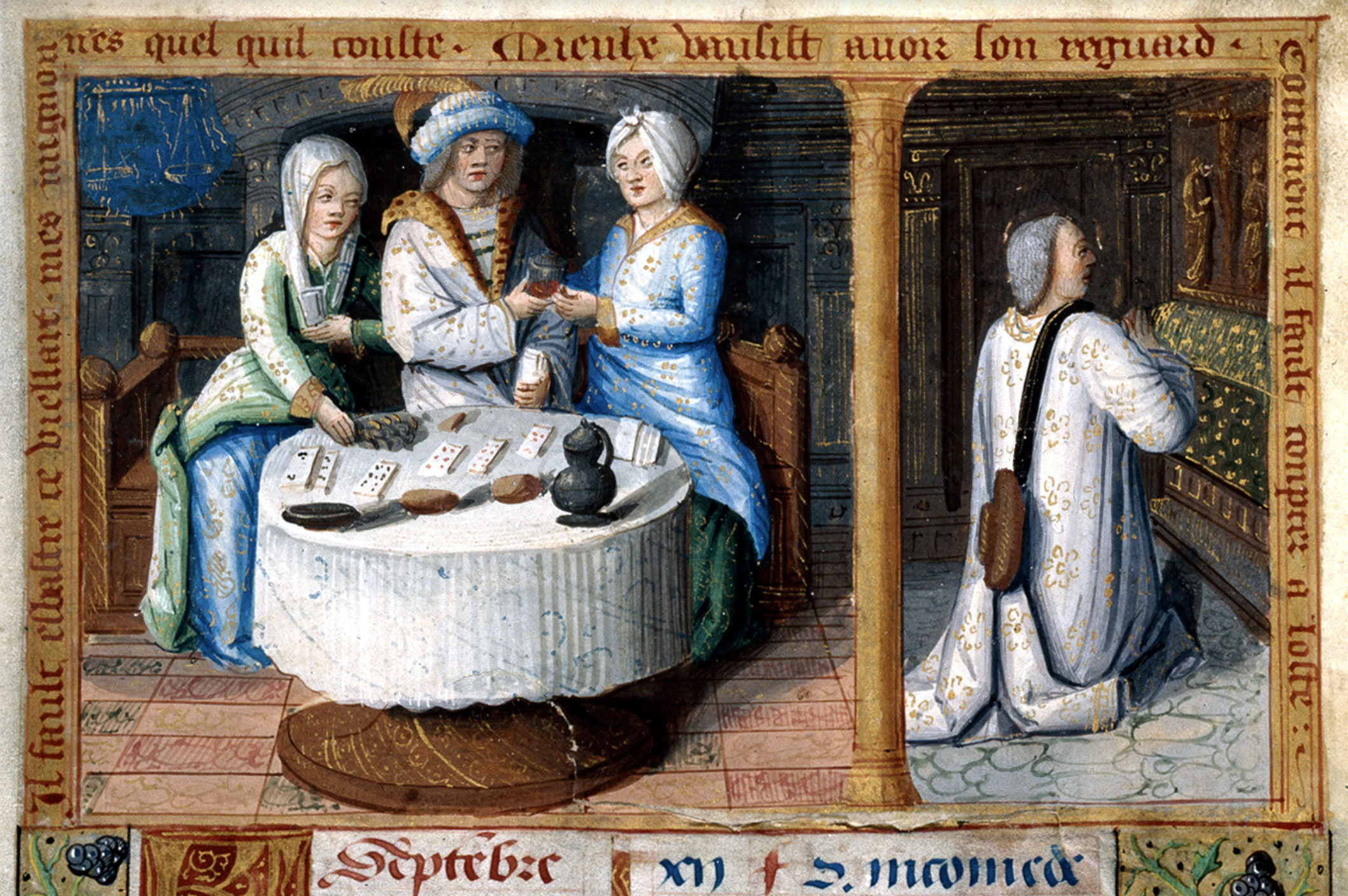
Above: detail from the month of September from Libro de horas de Carlos V, Biblioteca Nacional de España, online here► (click 13th thumbnail).
Apart from the theological meaning, the illustration offers what was most probably a typical scene in taverns or public houses of that time.
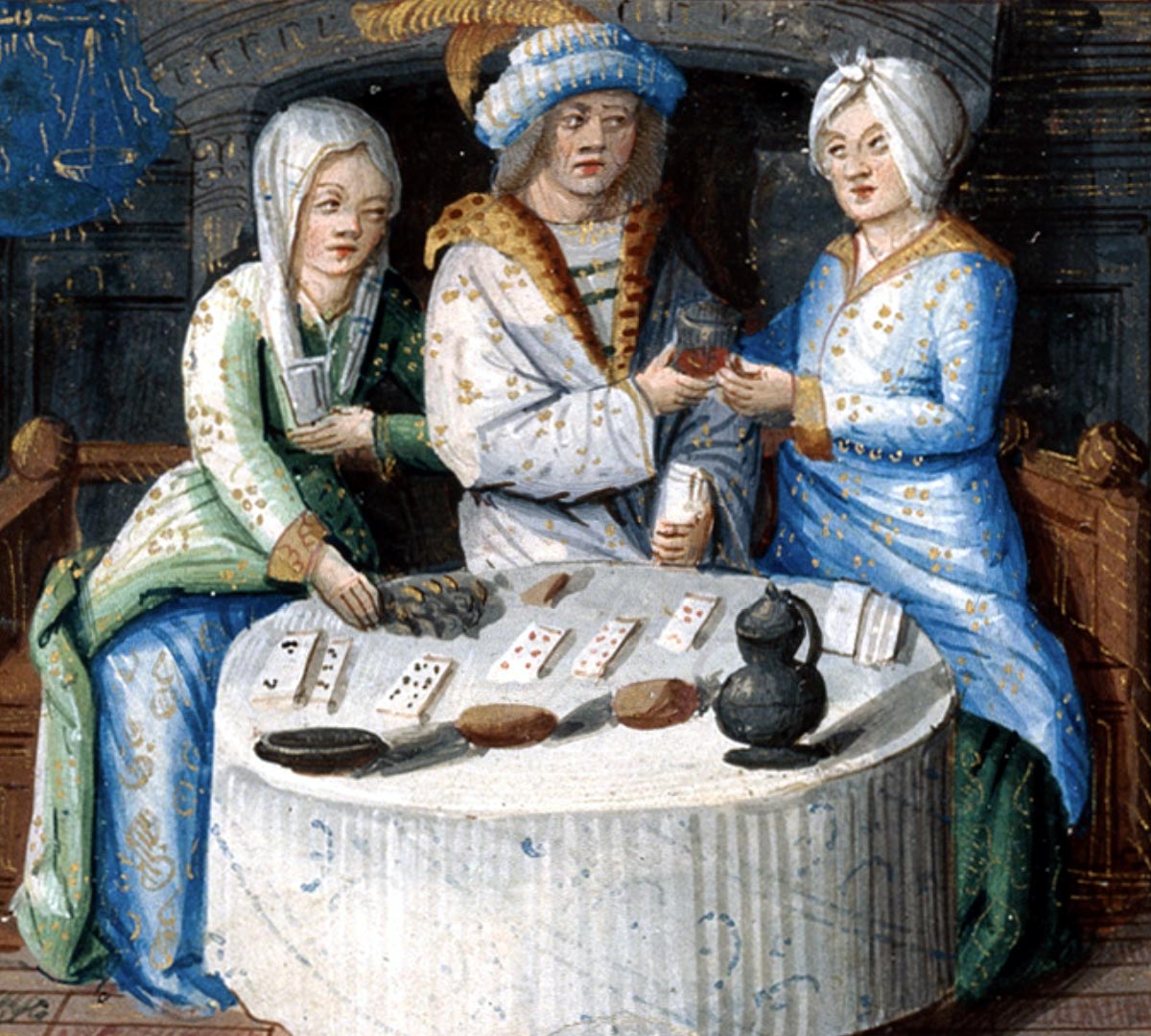
Above: the french artist has not painted much detail on the playing cards, but black and red pips can be seen on fairly elongated cards. The manner of holding the cards is one just above the other, in a single pile, rather than fanned out more →
Further Thoughts
“La primera conclusión es que todo el mundo jugaba a las cartas a pesar de que estaba prohibido jugar apostando”... more →
A late XV century engraving by the German engraver and goldsmith Israhel van Meckenem (c.1445 – 1503) also has a possible allegorical or moral interpretation. It shows a seated woman showing a playing card to a young man who seems slightly startled, raising his hand in surprise. The room is a detailed domestic scene with pitchers and other items. The rest of the pack of cards is on the table between them, but no coins or money.
The woman could be a fortune-teller using playing cards, which were associated with both games and divinatory practices during this period. The young man’s hand gesture suggesting surprise or concern possibly indicates moral confusion. The image might be a cautionary allegory warning about the perils of divination or other temptations, the youth being lured away from virtuous behaviour, led astray by superficial diversion.
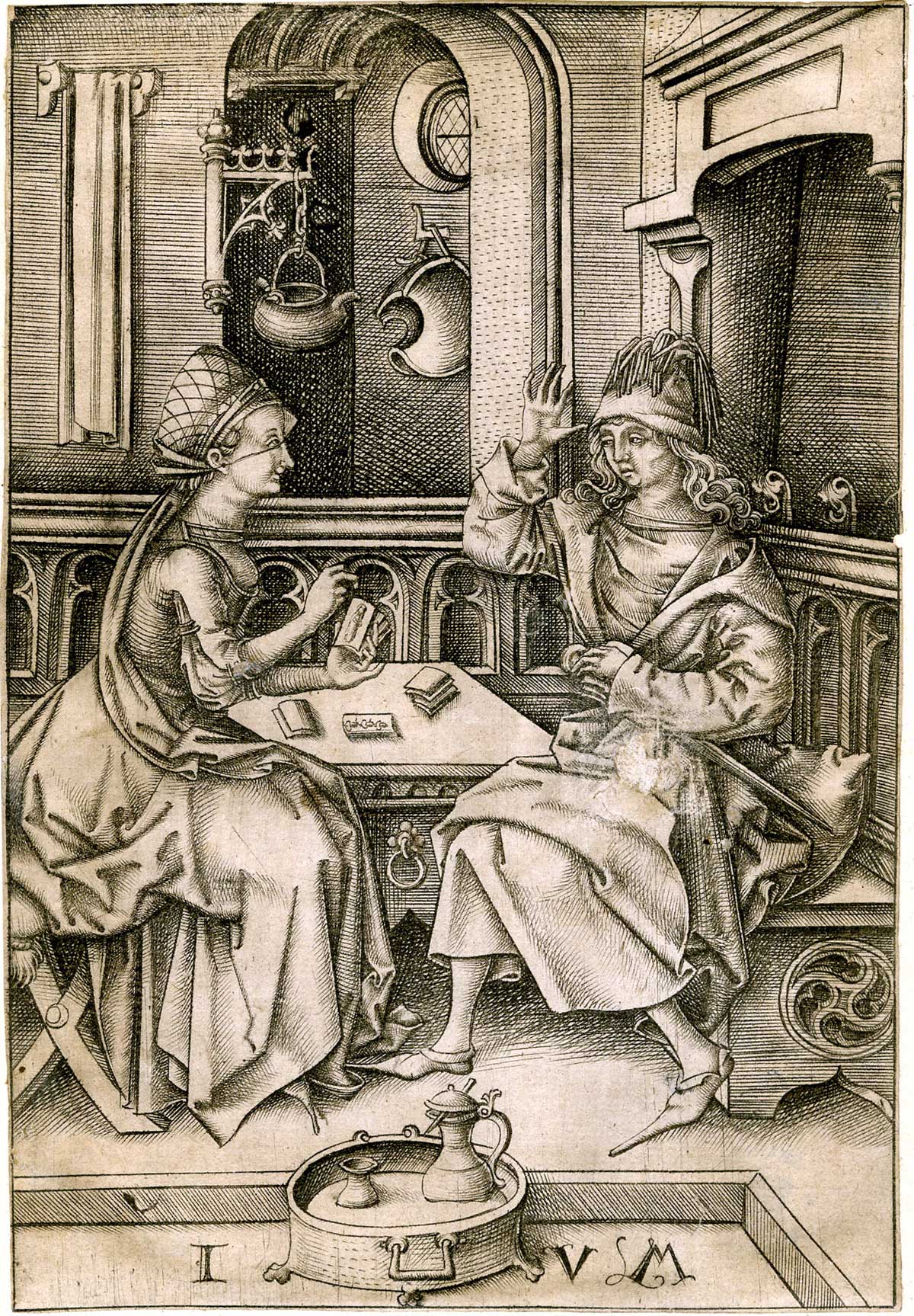
Above: a late XV century engraving by the German engraver and goldsmith Israhel van Meckenem (c.1445 – 1503)

By Simon Wintle
Spain • Member since February 01, 1996
I am the founder of The World of Playing Cards (est. 1996), a website dedicated to the history, artistry and cultural significance of playing cards and tarot. Over the years I have researched various areas of the subject, acquired and traded collections and contributed as a committee member of the IPCS and graphics editor of The Playing-Card journal. Having lived in Chile, England, Wales, and now Spain, these experiences have shaped my work and passion for playing cards. Amongst my achievements is producing a limited-edition replica of a 17th-century English pack using woodblocks and stencils—a labour of love. Today, the World of Playing Cards is a global collaborative project, with my son Adam serving as the technical driving force behind its development. His innovative efforts have helped shape the site into the thriving hub it is today. You are warmly invited to become a contributor and share your enthusiasm.

Activity for Gambling and Vice in the Middle Ages
Sign in to comment or save this article.

Related Articles
Saga aka King Arthur
Capturing the spirit of medieval legend on playing cards.
Les Chevaliers de la Toison d’Or
Medieval manuscript art at its finest.
La baraja de Almagro
De la chimenea al monumento nacional: la baraja de Almagro y el renacer del corral de comedias.
David’s fortune-telling cards
Entertaining and easy-to-use fortune-telling cards published by David, Paris, c.1895.
Le Poker Politique
French politicians and various world leaders caricatured by the German artist Bubec.
Le Jeu des Personnages de l’Antiquité et du Moyen-Age
Edouard Pastor’s designs in black and gold inspired by Antiquity and the Middle Ages.
Sevilla 1647 reproduction
Facsimile of Spanish-suited pack produced in Sevilla, Spain, 1647.
Les Chemins de Saint-Jacques
Paintings, statues, monuments and maps associated with different routes to Compostela.
History of Playing Cards explained in 5 Minutes
Video by Art of Impossible. In this video you will get a short overview of the most important histor...
“Deck with French suits”
A facsimile of an early 19th century French-suited deck from the collection of F.X. Schmid.
64: The descendants of the French regional patterns: 2
A continuation oF the development of the off-spring of the Paris patterns and a few examples of how ...
Pedro Varangot, 1786
Archaic Navarra pattern produced for the Pamplona General Hospital Monopoly by Pedro Varangot in 178...
Hidden meanings in painting by Jheronimus Bosch
Medieval View of Gambling in the ‘Garden of Earthly Delights’ by Jheronimus Bosch
Hans Sebald Beham
Playing cards designed by Hans Sebald Beham (1500–1550).
Playing Cards & Gaming
Soon after their first appearance in Europe we hear of playing cards being banned by the authorities...
Geistliche Karten
Geistliche Karten, Augsburg, 1718. Each card carries a text in Gothic typeface giving advice regardi...
Paris Pattern
The Paris pattern was established as such around the middle of the seventeenth century (based, perha...
Significado de los Naipes Españoles
Cartomantic meanings of Spanish playing cards by Benita the Witch (XVI century), published by Chocol...
The History of Playing Cards
Playing cards appear in European records in the late 14th century, but their earlier history lies fu...
Phelippe Ayet, c.1574
Archaic, late medieval Spanish-suited playing cards printed by Phelippe Ayet, c.1574.
Most Popular
Our top articles from the past 60 days


