


Playing Cards & Gaming
Soon after their first appearance in Europe we hear of playing cards being banned by the authorities...
Attitudes about gambling and card playing run from being seen as a sin, a vice or a moral weakness...
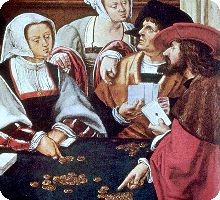
Soon after their first appearance in Europe we hear of playing cards being banned by the authorities. Although they were a very popular addition to the repertoire of leisure pastimes, they brought with them anti-social behaviour on account of the dishonest characters, gamblers and card-cheats who were drawn to it. The wagering process was often very close to drinking and other vices. This led inevitably to bans and prohibitions as preachers demonised the game and the authorities devised ways to regulate it. References to gambling often use loaded expressions such as ‘addicted’, ‘inveterate’, ‘reckless’ and we hear of cases where a man loses everything including his wife. See: Playing Cards & Religion→
At the same time, the nobility and upper classes commissioned artists to produce expensive packs of cards with which they enjoyed courtly games with social etiquette and also spent sums of money at gambling.
Joannes, a brother in the monastery at Brefeld, wrote in 1377 “that it is of advantage to noblemen and to others, especially if they practice it courteously and without money.” Everybody played cards, from kings and dukes, clerics, friars and upper-class ladies to whores, sailors, explorers and prisoners in jail. Henry VII of England enjoyed gambling and his private expenses include several entries for money lost at cards. Likewise, Duke Wenceslas of Luxemburg and Duchess Joanna of Brabant repeatedly spent sums of money at cards.
Bologna appears to have been a hotbed of gambling in the early XV c., and it needed St. Bernardino to persuade players to burn their cards. He preached at the church of San Petronio against the vices of gaming in general and playing cards in particular (See: original story here►). A series of official bans against card games were recorded in Paris (1377); St Gallen (1379); Barcelona (1382); Lille (1382); Valencia (1384); Ulm (1397) and so on, whereby the authorities sought to ban or regulate card playing, see more →
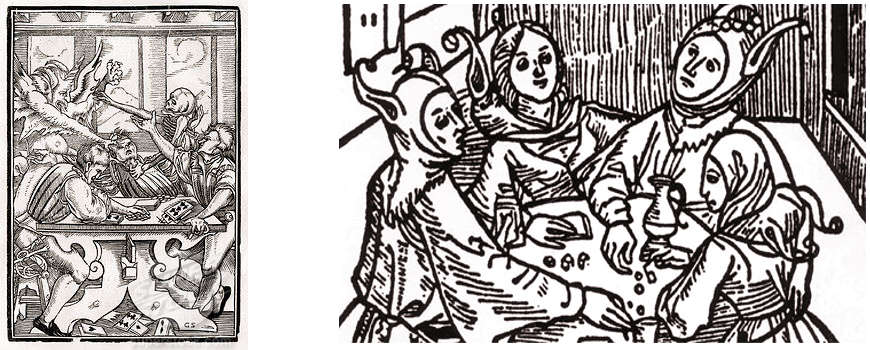
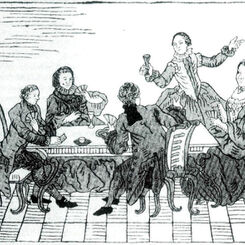
Above: card playing and gambling was a magnet for anti-social behaviour on account of the dishonest characters, card-sharps, cheats and scoundrels who frequented the less-reputable gaming houses. A whole underclass of confidence tricksters and professional swindlers were attracted to the gambling dens.
Most contemporary descriptions of card playing by Spaniards, Mexicans or Americans were generally couched in similar terms... gambling and card playing were dangerous and hence had a certain aura of forbidden pleasure and dreams of quick wealth. Successful gamblers are the stuff of legend.
Seville was a favoured location by gamblers. Taverns, inns, gaming dens and brothels flourished along the banks of the Guadalquivir. The gaming house was the centre of a complex social system of occupations and functions, with its own hierarchy of master gamblers, card-sharps, money lenders and colluders, whose objective was to fleece any unfortunate fool. There were professionals and amateurs, specialised activities and a terminology of jargon to describe them. Gaming attracted a colourful underclass, a sort of inverted reflection of respectable society. The owner of the venue was assisted by a team of astute and shrewd stewards, sidekicks and racketeers who were informed in every aspect of card sharping and gambling tactics.
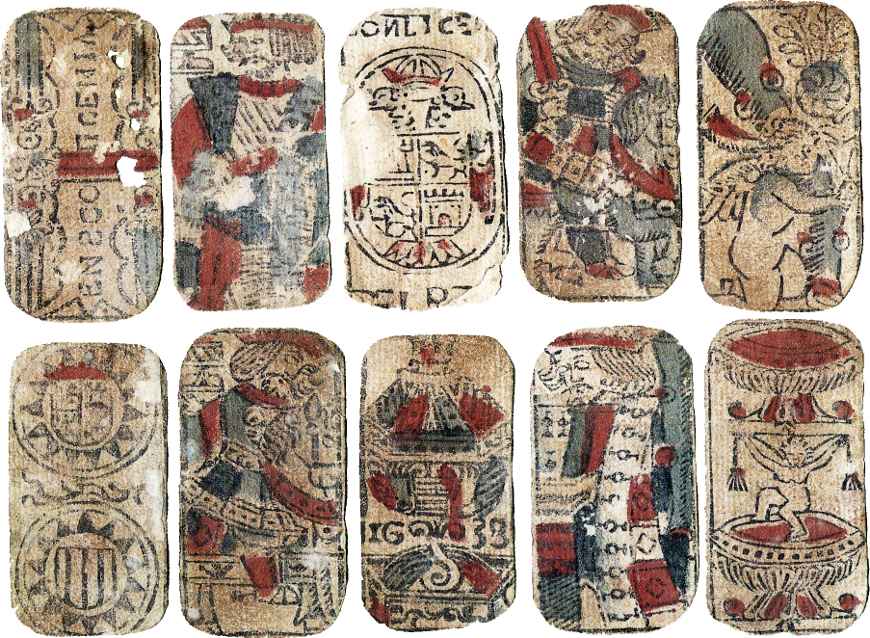
Above: Spanish playing cards, woodcut & stencil, Seville, dated 1638 on the Ace of Cups. The Ace of Batons and the Two of Cups have small naked figures adorning the suit symbols. The Ace of Coins has a two-headed imperial eagle. Inscriptions on the cards read: "En S (en Sevilla) Con Licencia del Rey." These cards were discovered inside a wall during the demolishing of the former Granada prison, and were probably handled by gambling card players running a racket inside jail. Image of cards in the Fournier Museum, Alava, taken from: Agudo Ruiz, Juan de Dios: Los Naipes en España, Diputación Foral de Álava, 2000.
Seville was also a major shipping port and the administrative headquarters for the New Indies. The lucrative Seville playing card monopoly at that time also included Granada and the Canary Isles read more →. The Spaniards took their beloved playing cards and gambling habits to Italy and also to the New World when they explored Mexico and South America in search of gold.
Religious minds often have doctrinaire views. An early writer inveighing against gaming wrote: “The Playe of Cards is an invention of the Devill, which he found out, that he might the easilier bring ydolatrie amongst men. For the Kings and Coate Cards that we use nowe, were in olde time the images of idols and false gods: which since they that would seeme christians, have changed into Charlemagne, Launcelot, Hector, and such like names, because they would not seeme to imitate their idolatrie therein, and yet maintaine the playe itself.” This stern warning refers to the French practice of naming the court cards after heroes of antiquity but the idea that playing cards (and tarot or cartomancy cards) are the invention of the devil still persists amongst some religious sects who warn us against dabbling in the occult see examples →
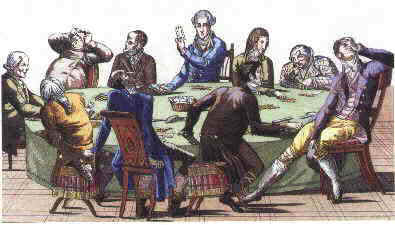
Studies show that though many people participate in gambling as a form of recreation or even as a means to gain an income, gambling, like any behaviour which involves variation in brain chemistry, can become psychologically addictive and harmful in some people. Reinforcement schedules may also make gamblers persist in gambling even after repeated losses.
The Ten of Hearts. In February, 1773, at Brook's Club in London, Lord Lauderdale wagered £5,000 that if he was dealt a hand including the Ten of Hearts he would make a trick with it. Finally it appeared in his hand, he revoked, forfeited the trick and lost his bet.
In 2009 the legal gambling market totalled $335 billion globally. Nearly two-thirds of that came from lotteries and casinos including online blackjack, poker and skill games. The other third was related to sportsbetting and wagering. Gambling in casinos is growing fast in East Asia, particularly Macau, the world’s biggest market. Online gambling is legal, taxed and regulated in Britain. Whereas American punters must rely on arcane payment systems and companies located offshore, British punters are safer. Companies have an incentive to keep minors from betting and to operate transparently. Elsewhere in Europe there are signs of market-opening—even in France, which has long protected its national racing and lottery monopolies.
See also: Early References • History of Playing Cards • Spanish Playing Cards • 16th Century Spanish Playing Cards discovered in Peru
References:
Chamorro Fernández, María Inés: Léxico del naipe del Siglo de Oro, Ediciones Trea, S.L., Gijón, 2005.
Hargrave, Catherine Perry: A History of Playing Cards and a Bibliography of Cards and Gaming, Dover Publications, New York, 1966

By Simon Wintle
Spain • Member since February 01, 1996
I am the founder of The World of Playing Cards (est. 1996), a website dedicated to the history, artistry and cultural significance of playing cards and tarot. Over the years I have researched various areas of the subject, acquired and traded collections and contributed as a committee member of the IPCS and graphics editor of The Playing-Card journal. Having lived in Chile, England, Wales, and now Spain, these experiences have shaped my work and passion for playing cards. Amongst my achievements is producing a limited-edition replica of a 17th-century English pack using woodblocks and stencils—a labour of love. Today, the World of Playing Cards is a global collaborative project, with my son Adam serving as the technical driving force behind its development. His innovative efforts have helped shape the site into the thriving hub it is today. You are warmly invited to become a contributor and share your enthusiasm.

Activity for Playing Cards & Gaming
Sign in to comment or save this article.

Related Articles
La baraja de Almagro
De la chimenea al monumento nacional: la baraja de Almagro y el renacer del corral de comedias.
Mamluk Cards and the Making of the European Deck
Mamluk “naib” cards — four suits with named courts — offer a persuasive clue to how playing c...
Ganjifa - Playing Cards from India
Indian playing cards, known as Ganjifa, feature intricate designs with twelve suits and are traditio...
Multicard
A Spanish-suited pack with multiple uses including roulette and dice.
Russian Playing Card History - From the Beginnings to 1917
An in-depth review of the history of card-playing, gambling, legislation, manufacture and taxation o...
72: The Ace of Spades
In standard English packs the Ace of Spades is associated with decorative designs. This is a histori...
Playing Cards: A Secret History
Playing Cards: A Secret History
History of Playing Cards explained in 5 Minutes
Video by Art of Impossible. In this video you will get a short overview of the most important histor...
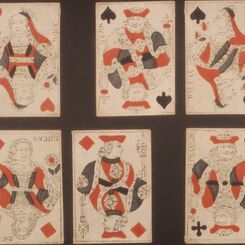
64: The descendants of the French regional patterns: 2
A continuation oF the development of the off-spring of the Paris patterns and a few examples of how ...
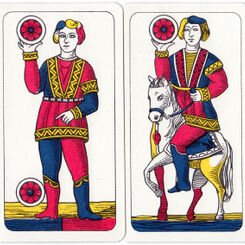
Trentine Pattern
Trentine Pattern
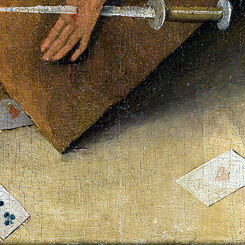
Hidden meanings in painting by Jheronimus Bosch
Medieval View of Gambling in the ‘Garden of Earthly Delights’ by Jheronimus Bosch
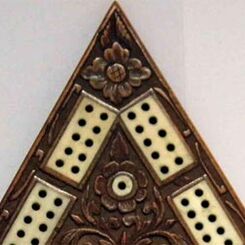
Cribbage Board Collection part 3
A collection of antique and vintage Cribbage Boards by Tony Hall, part 3
Suicide King
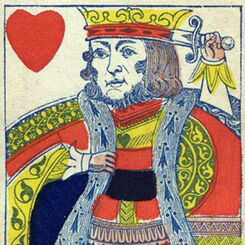
The King of Hearts, holding a sword behind his head, is sometimes nicknamed the “Suicide King”. He c...

A World Without Playing Cards
Card games are one of the oldest forms of entertainment.
1: Playing Cards and their History: An Introduction and some links to other sites
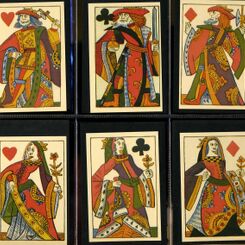
What was considered the first mention of playing cards in England is in 1463 when Edward I banned th...

Casinos On The Internet
While card rooms and private gaming clubs may have been around for hundreds of years, the earliest k...
History of Blackjack
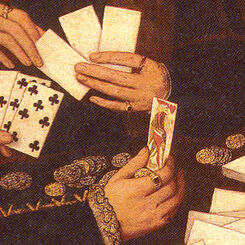
Over the years the origin of Blackjack, like many other games, has eluded researchers for a long tim...

History of Online Casinos
Online casinos appeared shortly after the internet became a more mainstream tool for the public to u...
Mamluk Playing Cards
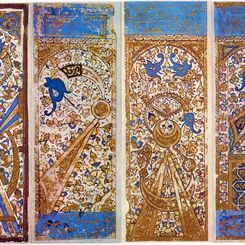
Nã'ib, the game of lieutenants... these cards are amongst the earliest Arabic playing cards ext...
The History of Playing Cards
Playing cards appear in European records in the late 14th century, but their earlier history lies fu...
Most Popular
Our top articles from the past 60 days


