


Pope Joan Trays
Some traditional Pope Joan boards comprise a circular tray, others are square, divided into sections labelled Ace, King, Queen, Jack, Intrigue and Matrimony. In the game, the Nine of Diamonds is “Pope Joan”.
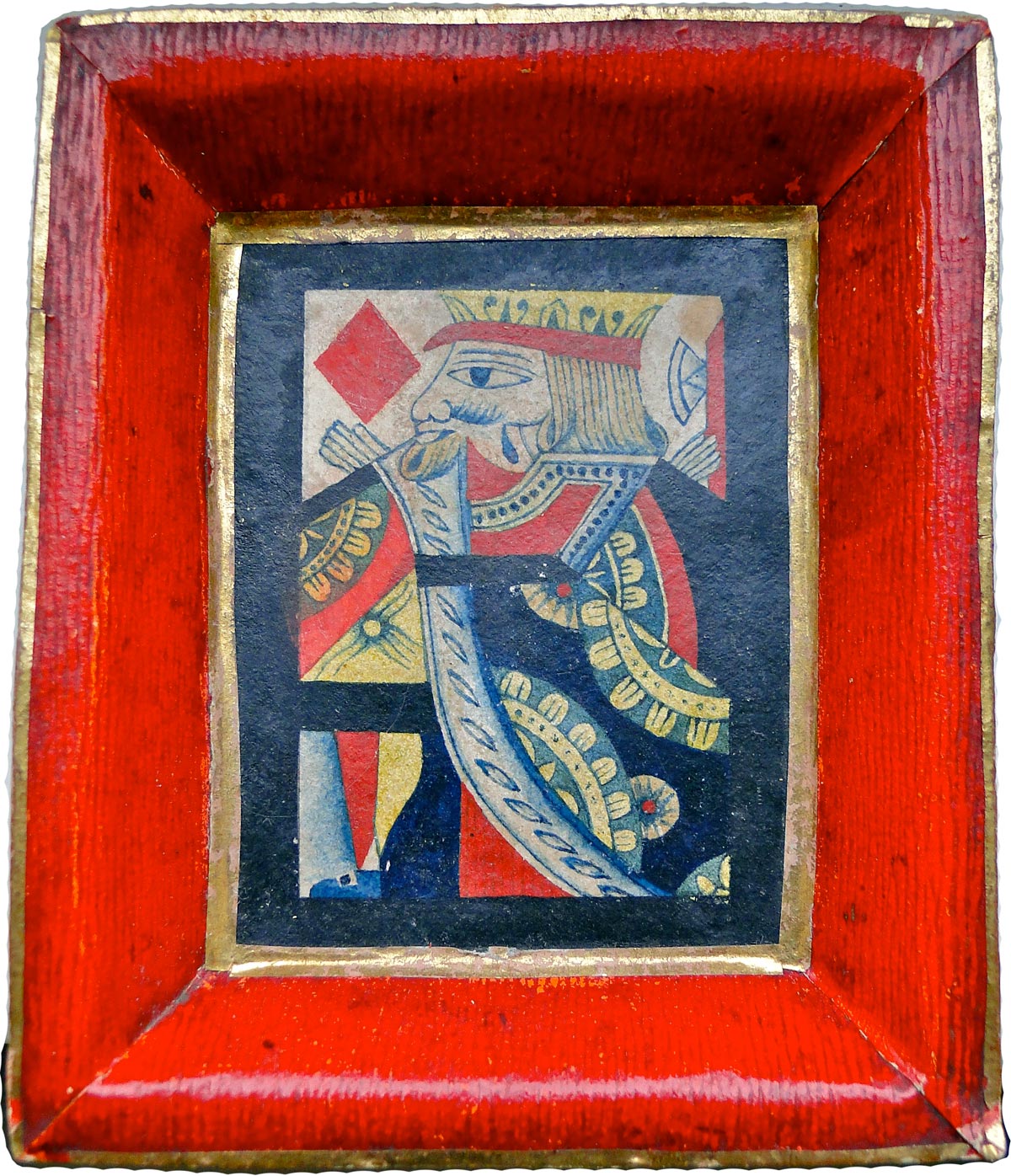
“Pope Joan” Game Trays
with gilt and painted panels
Pope Joan is a card game for three or more players in which the object is to win as many counters as possible by playing certain cards. The game was first recorded in Britain in 1732. It was popular in the 19th century and is mentioned in 'Pickwick Papers'. Some traditional Pope Joan boards comprise a circular tray, others are square, divided into sections labelled Ace, King, Queen, Jack, Intrigue and Matrimony. In the game, the Nine of Diamonds is “Pope Joan”.
Right: click the images to zoom →
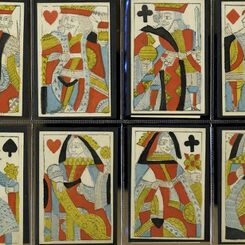
The full-length playing card images in the trays are consistent with woodblock and stencil playing cards produced in England around c.1790-1820. The red and gold in the frames really brightens up the playing card images in this set.
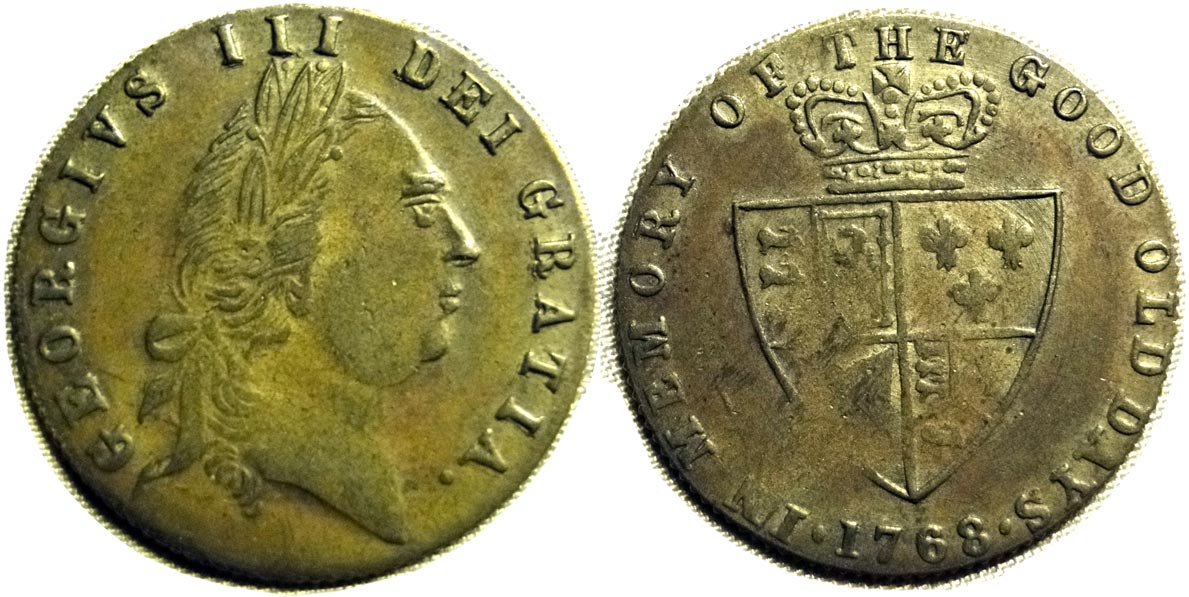
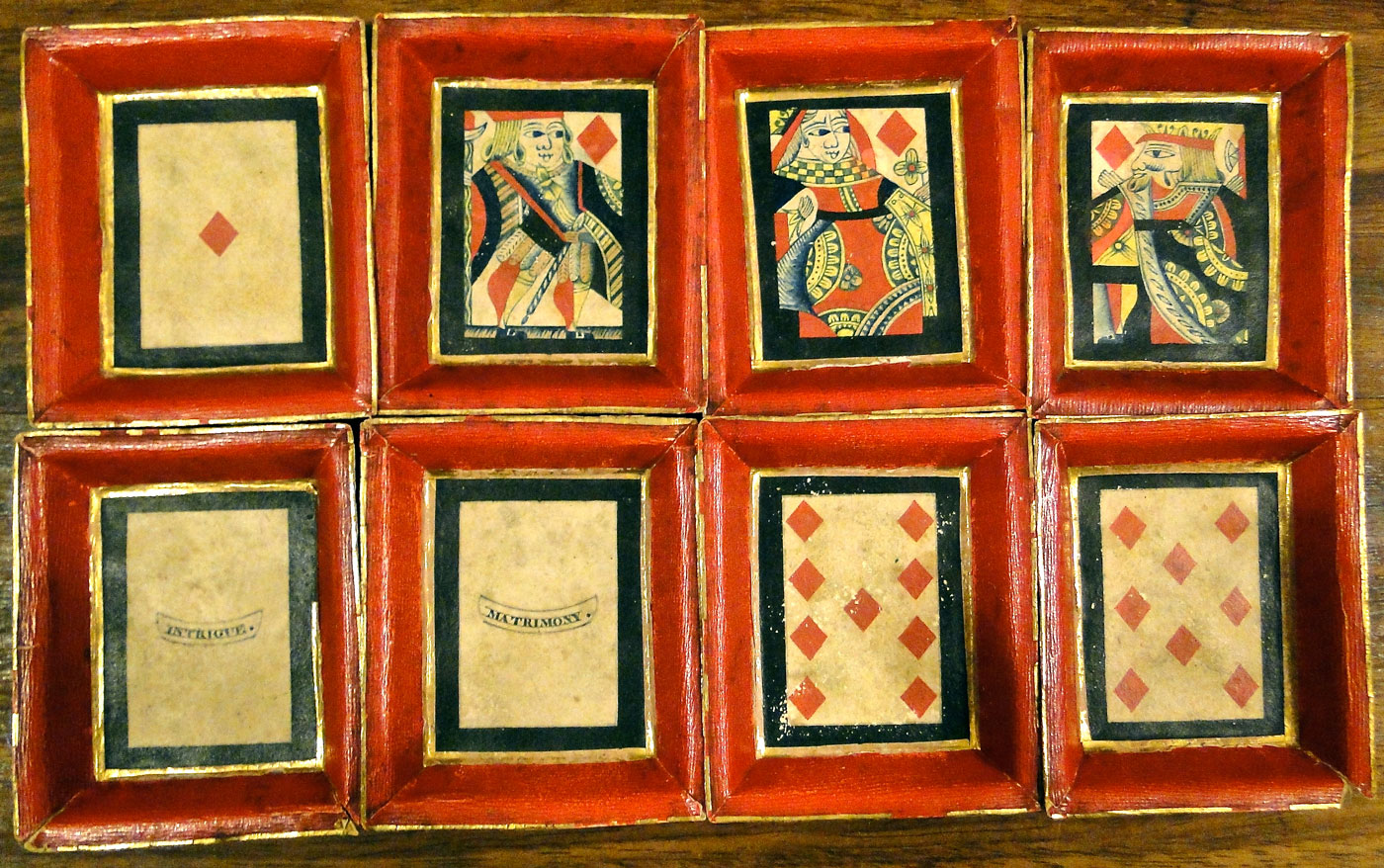
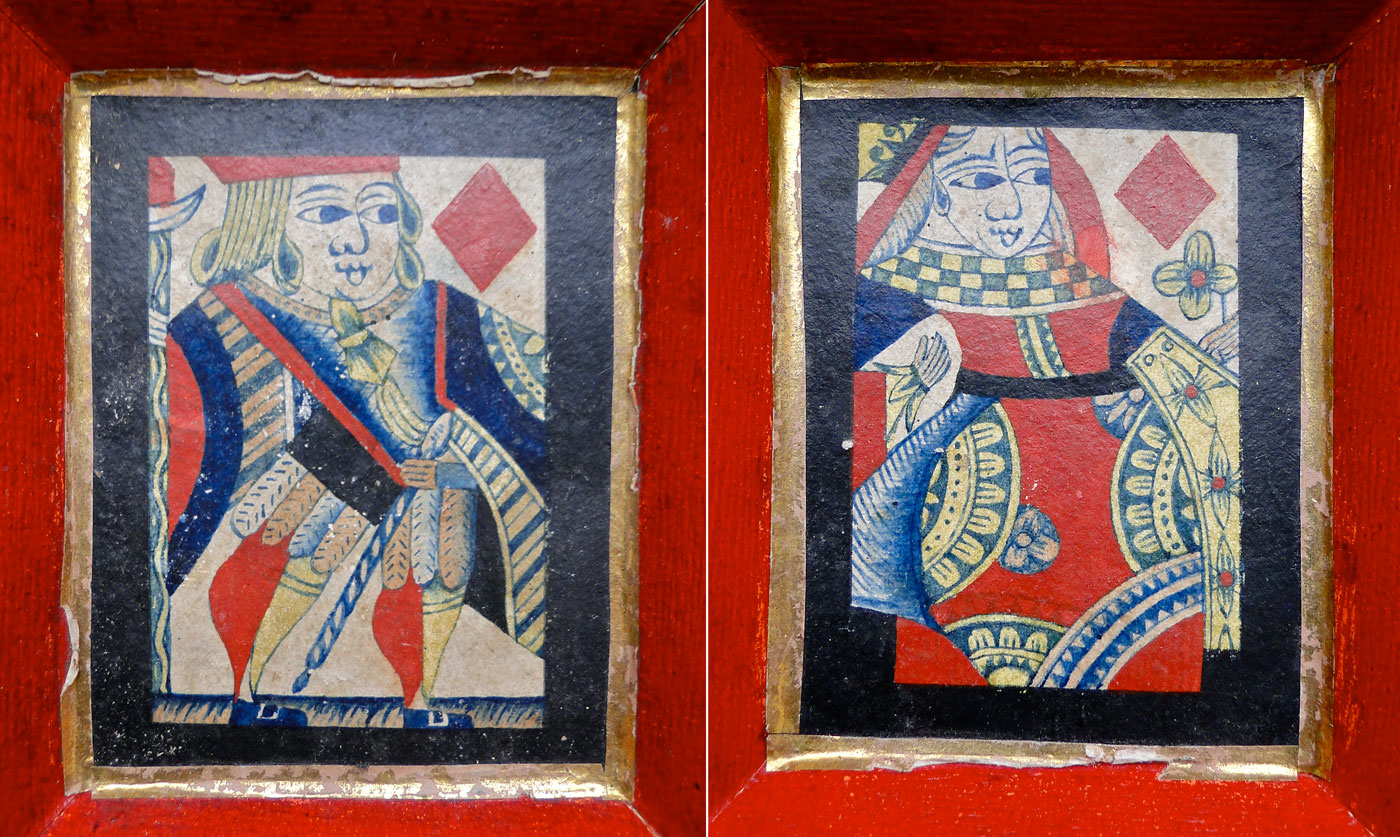
Above: Pope Joan trays with old playing cards forming their base, early 19th century. Images courtesy Tim Paine.

By Simon Wintle
Spain • Member since February 01, 1996
I am the founder of The World of Playing Cards (est. 1996), a website dedicated to the history, artistry and cultural significance of playing cards and tarot. Over the years I have researched various areas of the subject, acquired and traded collections and contributed as a committee member of the IPCS and graphics editor of The Playing-Card journal. Having lived in Chile, England, Wales, and now Spain, these experiences have shaped my work and passion for playing cards. Amongst my achievements is producing a limited-edition replica of a 17th-century English pack using woodblocks and stencils—a labour of love. Today, the World of Playing Cards is a global collaborative project, with my son Adam serving as the technical driving force behind its development. His innovative efforts have helped shape the site into the thriving hub it is today. You are warmly invited to become a contributor and share your enthusiasm.

Activity for Pope Joan Trays
Sign in to comment or save this article.

Related Articles
The Jovial Cards
Publicity items for a group of entertainers, Southend-on-Sea, Essex, UK, 1911.
Playing Cards: A Secret History
Playing Cards: A Secret History
Leather Card Case Patent Application
In 1932, a patent was granted to Colin Hart and George Franklin for a leather case in the form of a ...
71: Woodblock and stencil: the hearts
A presentation of the main characteristics of the wood-block courts of the heart suit.
70: Woodblock and stencil : the spade courts
This is a presentation in a more straight forward fashion of the work done by Paul Bostock and me in...
Illustrated Playing Cards, c.1740
Illustrated playing cards featuring comical engravings and rhymes about saints, c.1740.
Fortune Telling playing cards
English Fortune Telling cards probably published c.1770.
Delightful Cards, c.1723
Delightful Cards, containing variety of entertainment for young Ladies and Gentlemen c.1723.
Arms of English Peers
The Arms of English Peers playing cards were first published in 1686. Heraldry, or a knowledge of th...
47: Welch’s postcards and De La Rue’s redrawing
There are a number of court card designs that have never actually been produced as cards. It's a sha...
Cribbage Board Collection part 2
A collection of antique and vintage Cribbage Boards by Tony Hall, part 2
Music Manuscripts
Artwork featuring playing cards in Music Manuscripts
Suicide King
The King of Hearts, holding a sword behind his head, is sometimes nicknamed the “Suicide King”. He c...
Draughts League Medals
Arthur Charles Prince worked for De la Rue as a playing card cutter and later was promoted to superv...
19: 19th Century Breaks with Tradition - Unusual versions of the Standard English Pattern
The centuries-long tradition of English court cards was subject to misinterpretation and in some cas...
Mathematical Instruments
Mathematical Instruments playing cards forming an instrument maker's trade catalogue, Thomas Tuttell...
Lottery Scratch Playing Card
Move your mouse over the scratch area...
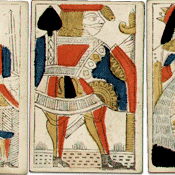
History of Court Cards
The court cards in English packs of playing cards derive from models produced by Pierre Marechal in ...
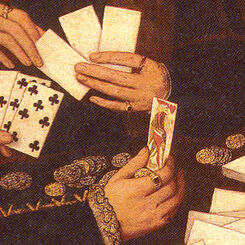
History of English Playing Cards & Games
The History of English Playing Cards dates probably from the mid 15th century
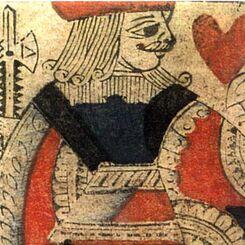
Early English Playing Cards
Early examples of traditional, standard English playing cards of which the best known are those of H...
Most Popular
Our top articles from the past 60 days


