


The Parisian Tarot
The “Parisian Tarot”, early 1600s, with imagery and design synthesizing several influences.
The Parisian Tarot, from the early 1600s, is the first wood-block printed deck that is conplete with 78 cards. Although the titles are in French and numbers on the trump cards correspond with the standard Tarot de Marseille sequence, the imagery and design contain elements of several foreign influences. For example, the four aces depict animals with banners indicating the suit signs, the numeral cards have imaginative arrangements, and the chequered framing of the cards is a trompe-l'oeil reminder of Italian tarots with edges folded over from the backs.
The finer details of the designs unfortunately have been obscured by the stencil colouring process which lacks delicacy. It is unclear what it's purpose may have been... was it intended for divination, or to play the game of tarocchi? Mystery teachings veiled as a pack of cards, or maybe a limited edition curiosity for collectors?
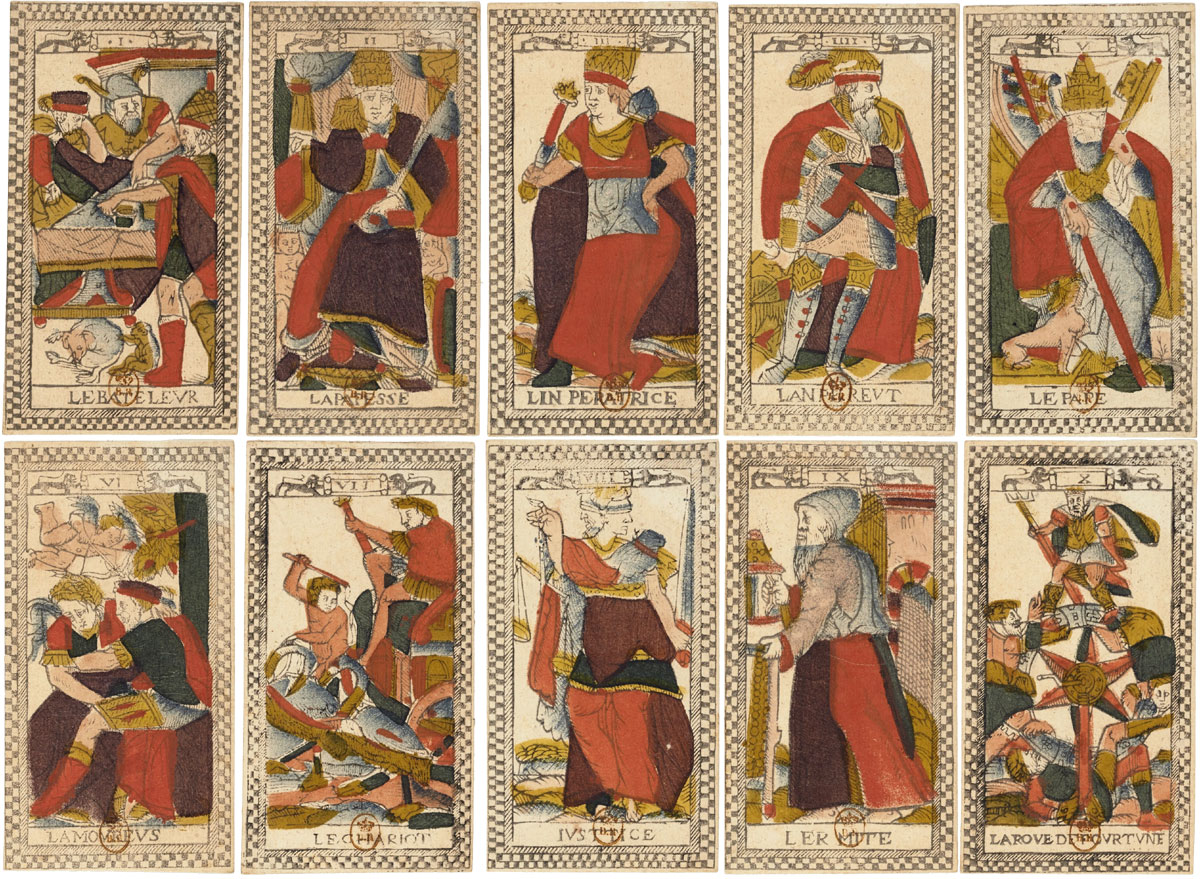
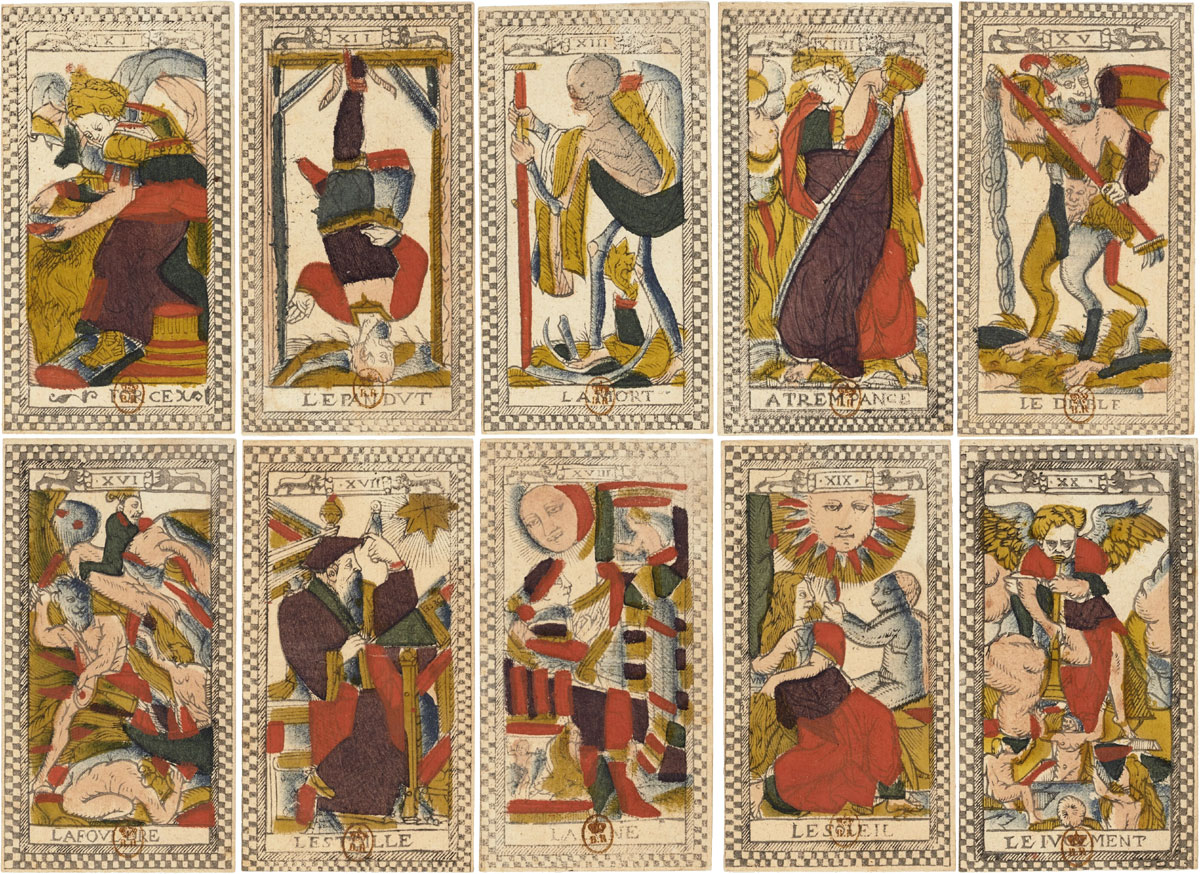
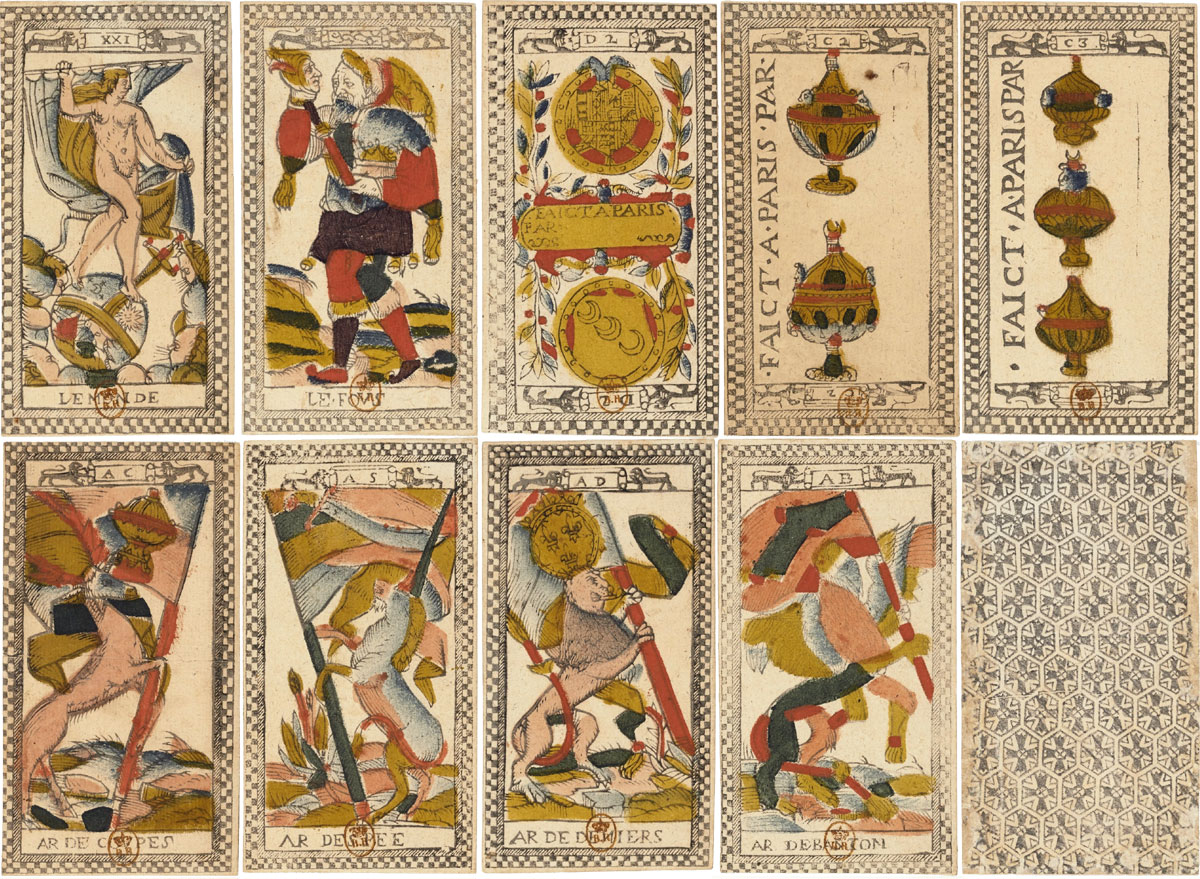
Above: The “Parisian Tarot”, early 1600s. 78 cards: stencil coloured woodcut; 12.8 x 6.8 cm. The name “Parisian” refers to where the pack was produced. The name of the engraver or publisher has been removed from the twos of coins and cups, and is now unknown. The framing of the cards is a Trompe-l'oeil reminder of Italian tarots with folded over edges from the backs. Source gallica.bnf.fr / Bibliothèque nationale de France • Jeu de tarot parisien anonyme à enseignes italiennes►
The Swords and Batons are neither of the usual Italian shape, nor the Spanish one, they do, however, for the most part intersect with one another. The swords (and the aces) remind us of those in the pack by the South German Engraver. The small cartouche with two lions at the top of each card has the initial of the suit in Italian: S for spade, etc. In all later French Latin-suited Tarot packs, including the Marseille tarot, the Italian suit-system is used.
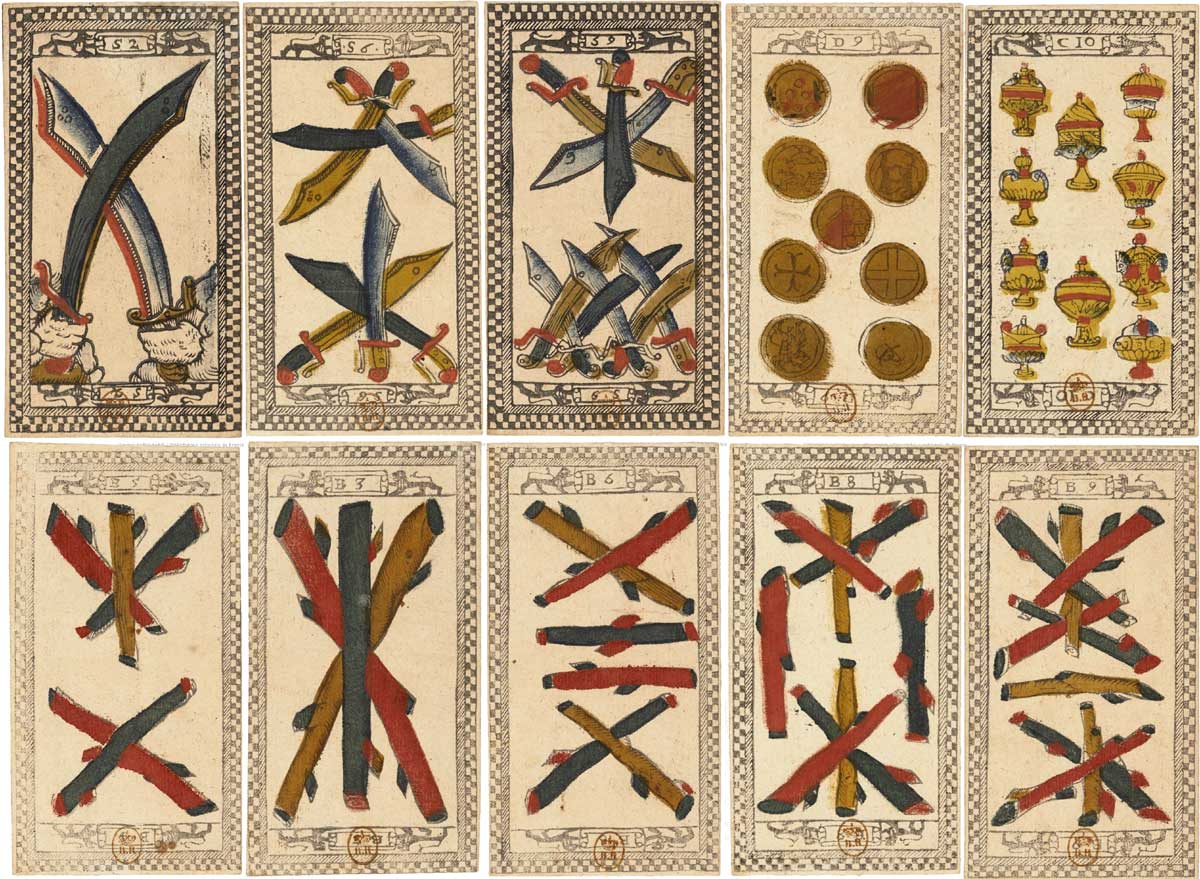
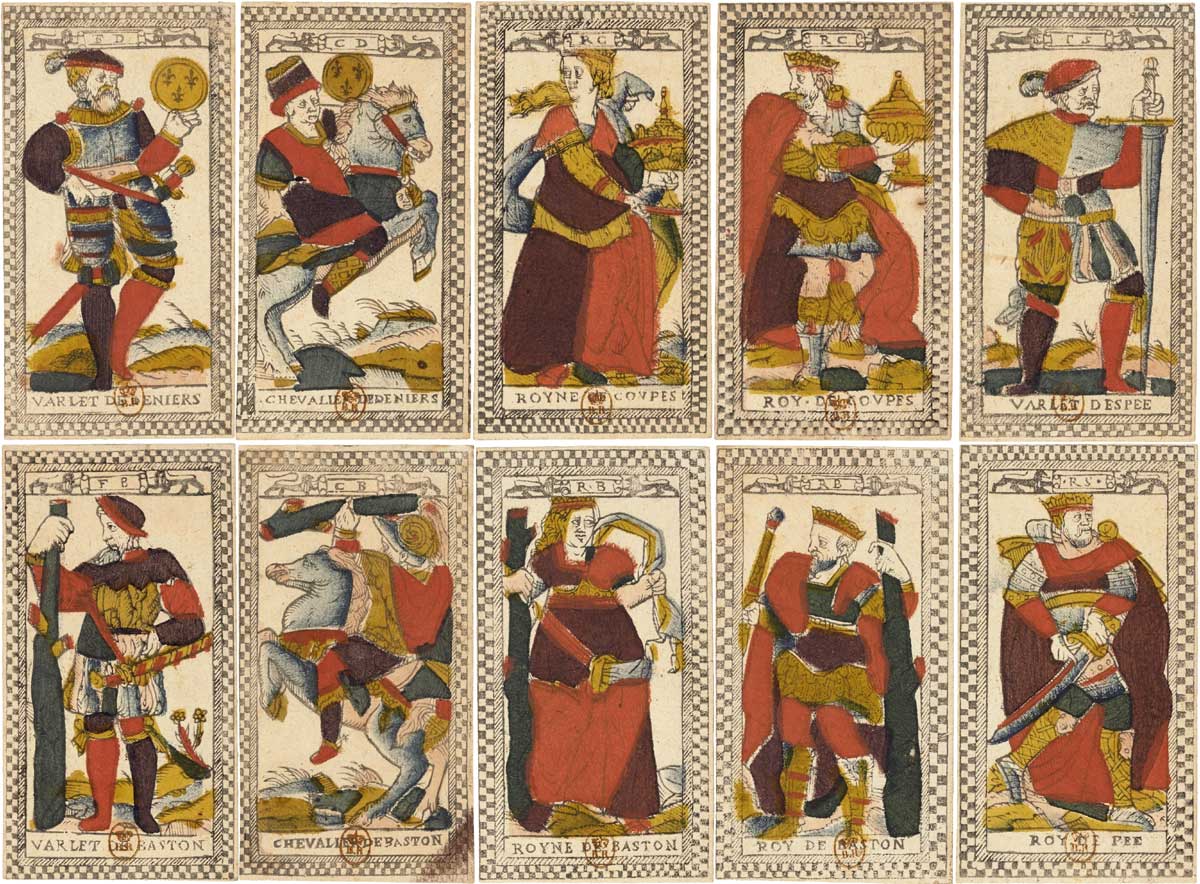
Above: numeral cards and court cards from the Parisian Tarot, unknown maker, Paris, early 1600s. Source gallica.bnf.fr / BnF

By Simon Wintle
Spain • Member since February 01, 1996
I am the founder of The World of Playing Cards (est. 1996), a website dedicated to the history, artistry and cultural significance of playing cards and tarot. Over the years I have researched various areas of the subject, acquired and traded collections and contributed as a committee member of the IPCS and graphics editor of The Playing-Card journal. Having lived in Chile, England, Wales, and now Spain, these experiences have shaped my work and passion for playing cards. Amongst my achievements is producing a limited-edition replica of a 17th-century English pack using woodblocks and stencils—a labour of love. Today, the World of Playing Cards is a global collaborative project, with my son Adam serving as the technical driving force behind its development. His innovative efforts have helped shape the site into the thriving hub it is today. You are warmly invited to become a contributor and share your enthusiasm.

Activity for The Parisian Tarot
Sign in to comment or save this article.

Related Articles
French Revolutionary cards by Pinaut
Seven cards from a French Revolutionary pack by Pinaut featuring characters from classical antiquity...

Morgan-Greer Tarot
Based on the knowledge, wisdom and interpretation of Paul Foster Case and Arthur Edward Waite.
Jeu de Cartomancie pour l’amusement des Dames
Early French Cartomancy deck "for the amusement of Ladies" but also referred to as "Jeu divinatoire ...
Antoine de Logiriera
Archaic Spanish-suited playing cards published in Toulouse by Antoine de Logiriera (1495-1518).
Jean Noblet Tarot de Marseille
Jean Noblet: the oldest known ‘Tarot de Marseille’ deck, Paris, c.1650.
A. Camoin & Cie
This deck was inherited from ancestors, it has has a family history surrounding it. Details of the l...
64: The descendants of the French regional patterns: 2
A continuation oF the development of the off-spring of the Paris patterns and a few examples of how ...
63: The descendants of the French regional patterns: 1
A great many regional patterns were exported from France and subsequently copied elsewhere. Some of ...
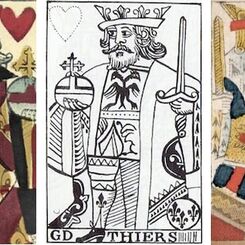
61: French regional patterns: the kings
On page 11 I illustrated several examples of the regional French patterns from Sylvia Mann's collect...
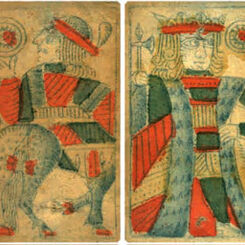
Pedro Varangot, 1786
Archaic Navarra pattern produced for the Pamplona General Hospital Monopoly by Pedro Varangot in 178...
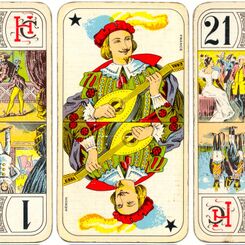
Héron French tarot
French edition of the ‘Bourgeois’ Tarot by Héron.
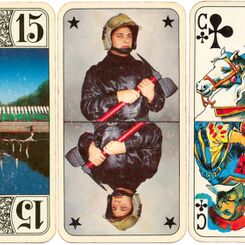
Tarot des Sapeurs-Pompiers de Paris
Tarot des Sapeurs-Pompiers de Paris, a French Fire Brigade tarot deck published by Éditions Dusserre...
Charles Cheminade Tarot
Marseille Tarot cards by Charles Cheminade of Grenoble, France, early 18th century.
Linocut Printed Tarot Cards
Linocut is a printing technique similar to woodblock printing where a design is cut into linoleum (a...

Benoist Laius
Spanish playing cards such as these were used in those parts of France where certain games were enjo...
Lyon Pattern type iii
This pattern was used in various parts of eastern France but was ultimately replaced by the official...
1: Playing Cards and their History: An Introduction and some links to other sites
What was considered the first mention of playing cards in England is in 1463 when Edward I banned th...
Paris Pattern
The Paris pattern was established as such around the middle of the seventeenth century (based, perha...
XV Century Italian Playing Cards
Cards from a pack of an early form of north Italian playing cards, with the swords back-to-back and ...
History of Court Cards
The court cards in English packs of playing cards derive from models produced by Pierre Marechal in ...
Most Popular
Our top articles from the past 60 days


