


Eglantine Table
The Eglantine Table, Hardwick Hall, Derbyshire, elaborately inlaid with marquetry depicting musical instruments, playing-cards, games and heraldic references.
Eglantine Table, Hardwick Hall, Derbyshire, 1567
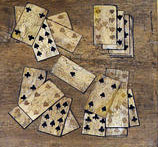
The Eglantine or “Aeglantyne” table is located in the High Great Chamber at Hardwick Hall, Derbyshire. The oak table is elaborately inlaid with walnut marquetry depicting Elizabethan musical instruments, games and heraldic references, including playing cards, allegorical figures and wooden sheet music by the famous Renaissance composer, Thomas Tallis. The songs are, of course, uplifting rather than bawdy. In one corner is this ‘guitar’ surrounded by twelve playing cards: four aces, fives and tens in each suit.
The question is: Why are only the four aces, fives and tens shown in each suit? Perhaps there is an occult meaning. We had thought about musical intervals. 5:10 = 1:2 which is an octave. But 1:5 has no musical meaning that we know. Do you know anybody who might have an idea what they mean?
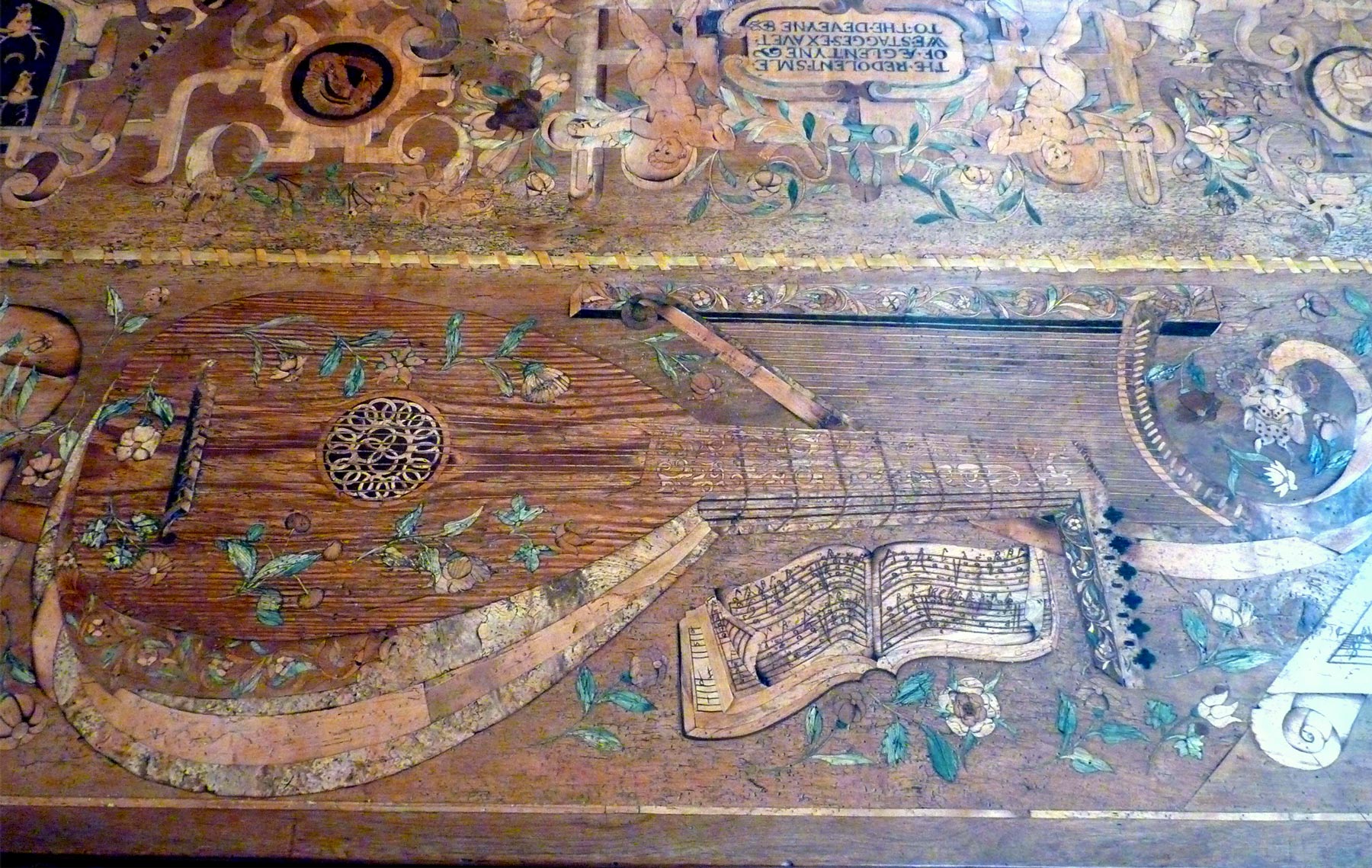
Above: detail from the Eglantine Table (Aeglantyne Table), Hardwick Hall, Doe Lea, Chesterfield - The High Great Chamber. The table was made to celebrate the triple marriage contract between the families of Talbot and Cavendish in 1567. Photo credit: Christopher Page.
• See also: National Trust website.

By Simon Wintle
Spain • Member since February 01, 1996
I am the founder of The World of Playing Cards (est. 1996), a website dedicated to the history, artistry and cultural significance of playing cards and tarot. Over the years I have researched various areas of the subject, acquired and traded collections and contributed as a committee member of the IPCS and graphics editor of The Playing-Card journal. Having lived in Chile, England, Wales, and now Spain, these experiences have shaped my work and passion for playing cards. Amongst my achievements is producing a limited-edition replica of a 17th-century English pack using woodblocks and stencils—a labour of love. Today, the World of Playing Cards is a global collaborative project, with my son Adam serving as the technical driving force behind its development. His innovative efforts have helped shape the site into the thriving hub it is today. You are warmly invited to become a contributor and share your enthusiasm.

Activity for Eglantine Table
Sign in to comment or save this article.

Related Articles
Songs with Flute accompaniment
Eighteenth century English engraved cards with music for voice and flute.
The Chamber of 52 Cards
Playing cards published by Peter Wood as a tribute to the rock band Genesis.

Gilbert & Sullivan Cards
“Gilbert & Sullivan” hand-made Savoy Operas pack designed and created by Rex Pitts.
Music Manuscripts
Artwork featuring playing cards in Music Manuscripts
Thomas Wheeler
Thomas Wheeler appears in directories at 2 Richbell St (1799), 8 Middle Row, Holborn (1801), 118 Hol...

Denbro (Denny Brothers)
Denbro (Denny Brothers) c.1975-79

Woodpecker Press Ltd
Woodpecker Press is believed to have started up in 1987 as a spin-off from the closure of Astra Game...

Hunt, 1790-1801
Packs manufactured by Hunt, c.1800.
Reynolds non-standard
Sometime around c.1850 Reynolds & Sons produced this non-standard or variant pack with courts inspir...

National Trust Properties
National Trust Properties Pack, c.1997.
Waddington’s “Envoy“ Series
Waddington’s “Envoy“ Series.
Waddington’s Varsity Series
Waddington’s Varsity Series.
Waddington’s Old Master Series, 1933
Waddington’s Old Master Series, 1933
The Beggars’ Opera
The Beggars’ Opera Playing Cards were first published in 1728. The cards carry the words and music o...

Playing cards in Wales - Welsh playing cards
Whereas the distinctiveness of Wales is an important resource contributing to the rich texture of va...

James English & Co.
Victorian Playing Cards manufactured by James English & Co., London, c.1875

J & W Mitchell, Birmingham
This rare Victorian manufacturer made standard English playing cards for a short period during the l...

Games & Print Services
Games & Print Services Limited, of Canvey Island, now part of Cartamundi.
History of English Playing Cards & Games
The History of English Playing Cards dates probably from the mid 15th century
Hunt, c.1800
Standard English pattern playing cards manufactured by Hunt, c.1800.
Most Popular
Our top articles from the past 60 days


