


Early Cadiz pattern by Marchan
Typical early Cadiz pattern by Marchan of Cadiz, 1817.
Bearing striking similarities to the Cadiz pattern pack by Marchand in the collection of the WCMPC in London¹ which is dated 1812, this pack includes many features typically found on early Cadiz pattern packs: the kings’ feet are not yet visible, while most of the cavaliers and sotas wear quilted knee-breeches². The date 1817, the arms of Castile and León with three fleur-de-lys, and the maker’s name can all be seen on the Ace of Coins, with ‘Cadiz’ on a ribbon across the centre of the 2 of Coins. The 4 of Coins has a crossed anchor and caduceus at its centre. The coin in the centre of the 5 of Coins includes a male Roman head. The sun rises over clouds on the 4 of Cups. There is no tax stamp present but the signatures of the tax controllers³ can be seen on the 4 of Cups. The pattern on the reverse is made up of alternate dots and dotted hexagons in blue.


Above: Cadiz pattern by Marchan, Cadiz, Spain, 1817. 46 cards of 48 (missing: Cavalier, 3 of Cups). Size: 56 x 89.5 mm.
Luis Marchand was a French card maker and several packs are known, the earliest being a Cadiz pattern dated 1812. In the very similar pack shown here his name appears without the 'd'.
References
- Berry, John. Playing-cards of the World. Bromley, UK: John Berry; 1995. V 12 [720]. WCMPC Collection : L Marchand, Cadiz, 1812 ►
- Denning, Trevor. The Playing-cards of Spain. London, UK: Cygnus Arts; 1996. pp 54-55.
- On 26 September 1811, the Treasury Committe of the Cortes (the Spanish parliament) approved a law stipulating that playing cards intended for the domestic market would be subject to a tax of 18 maravedís, while those destined for export or manufactured in the Americas would be taxed at 24 maravedís: “That at the time of payment of this duty at customs, ...two signatures shall be affixed to the four of cups by the respective administrators and accountants, or other officials designated for that purpose.” The law was in force until 1833. Information courtesy Alberto Pérez González.

By Roddy Somerville
France • Member since May 31, 2022
Roddy started collecting stamps on his 8th birthday. In 1977 he joined the newly formed playing-card department at Stanley Gibbons in London before setting up his own business in Edinburgh four years later. His collecting interests include playing cards, postcards, stamps (especially playing cards on stamps) and sugar wrappers. He is a Past President of the Scottish Philatelic Society, a former Chairman of the IPCS, a Past Master of the Worshipful Company of Makers of Playing Cards and Curator of the WCMPC’s collection of playing cards. He lives near Toulouse in France.

Activity for Early Cadiz pattern by Marchan
Sign in to comment or save this article.

Related Articles
Los Maffei y la marca “El León”
Mariano Maffei (Mafei) Cano, 1818-1840.
Moguls, Highlanders and Merry Andrews
Discover the historic origins and evolution of card naming and quality designations like ‘Moguls’ an...
The Henry Hart Puzzle
Explore the intricate history and unique design variations of Henry Hart's playing cards, tracing th...
73: Fakes, forgeries and Tax Evasion
When there are official taxes to pay, people will find a way to avoid paying them - often illegally....
Russian Playing Card History - From the Beginnings to 1917
An in-depth review of the history of card-playing, gambling, legislation, manufacture and taxation o...
Russian Playing Card Monopoly
The Russian Playing Card Monopoly was established in March 1798 with all revenue going to support th...
72: The Ace of Spades
In standard English packs the Ace of Spades is associated with decorative designs. This is a histori...
66: Adverts and related material 1862-1900
Some further material relating to cards from nineteenth and twentieth century periodicals.
Australian Excise Duty
Excise Duty was introduced on Australian playing cards in 1932
Greek Heroes
Playing Cards manufactured by Aspioti Elka A.E., 1960, with ancient greek-style courts.

Tunisia
Playing Cards in Tunisia. Chkobba is one of the most popular card games in Tunisia, mainly played by...
Tax on Spanish Playing Cards
Taxation on Spanish playing cards, the monopolies and smuggling.
Fours of Cups
Over the years the company evolved, and changes in the company's name and address can be seen reflec...
Argentina Tax Stamps on playing cards 1895-1968
Argentina Tax Stamps on playing cards 1895-1968
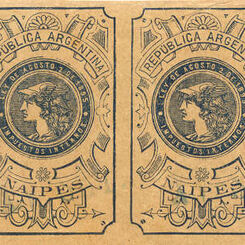
Impuestos Internos Sobre Naipes
Duty was first introduced on playing cards in Argentina in 1892, as part of the Internal Duties law,...

Estanco de Naipes del Perú
In October 1888 the Republic of Peru Congress passed Law no.26 establishing taxes on playing cards, ...
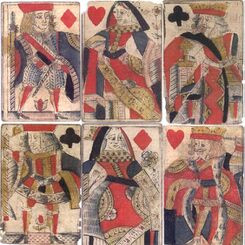
United Kingdom
Playing cards first arrived in England during the 15th century, but none have survived from such an ...
Impuesto de Timbre para Naipes
EL CONGRESO DE COLOMBIA. LEY 69 DE 1946, por la cual se elevan las tarifas de algunos impuestos indi...

Uruguay playing card tax
In 1806 the Council of Concepción del Uruguay imposed an 8 Peso tax on card and billiard tables on a...
Most Popular
Our top articles from the past 60 days


