

Thomas Wheeler
Thomas Wheeler appears in directories at 2 Richbell St (1799), 8 Middle Row, Holborn (1801), 118 Holborn Hill (1802-07) and 127 Holborn Hill (1807-21).
Thomas Wheeler, London, 1799-1821
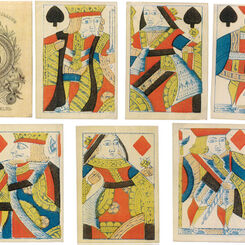
Thomas Wheeler appears in Post Office directories (and other similar sources) at 2 Richbell St (1799), 8 Middle Row, Holborn (1801), 118 Holborn Hill (1802-07) and 127 Holborn Hill (1807-21). His early cards are particularly crude, as illustrated below. They are a poor copy of the courts produced by Hall at the time.

Above: standard English pattern woodblock & stencil playing cards manufactured by Thomas Wheeler, with a ‘Garter’ duty Ace of Spades►
However, Thomas Wheeler soon changed to a more usual style of court like those of Brotherton.


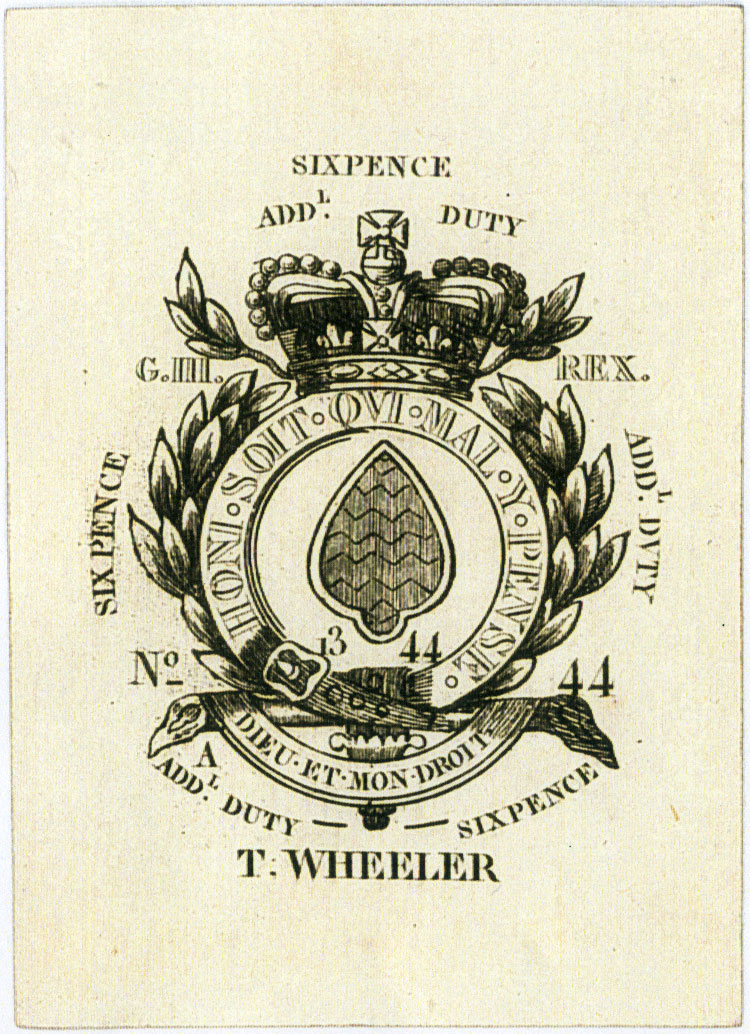
Above: cards from a pack by Thomas Wheeler, c.1803. This ace of spades, known as the Ludlow Ace, is die number 44, 1st re-cut, and bears a date of 1344 (needs to be read under a glass where the 3 can be clearly read). Wheeler ascribed this date to the forming of the Order of the Garter (the Garter Ace of Spades being used on duty aces from 1765-1828), the Order was in fact formed four years earlier! The central spade pip of the ace is shaded, which does not occur on other duty aces by other manufacturers. Images courtesy John Sings.
Thomas Wheeler also produced Ludlow’s Knights Cards around 1800. These were an attempt to introduce some innovations such as double-ended pip cards and in a second version double-ended courts. The design of the courts is even cruder than usual and the double-ended ones are not even mirror images.
Many Wheeler Aces turn up in what are most likely to be second-hand packs, because the courts don’t match the Ace.
References:
Lodge, Ken: The Standard English Pattern (second revised and enlarged edition), Bungay, Suffolk, 2010
• See also: Henry Wheeler►

By Simon Wintle
Spain • Member since February 01, 1996
I am the founder of The World of Playing Cards (est. 1996), a website dedicated to the history, artistry and cultural significance of playing cards and tarot. Over the years I have researched various areas of the subject, acquired and traded collections and contributed as a committee member of the IPCS and graphics editor of The Playing-Card journal. Having lived in Chile, England, Wales, and now Spain, these experiences have shaped my work and passion for playing cards. Amongst my achievements is producing a limited-edition replica of a 17th-century English pack using woodblocks and stencils—a labour of love. Today, the World of Playing Cards is a global collaborative project, with my son Adam serving as the technical driving force behind its development. His innovative efforts have helped shape the site into the thriving hub it is today. You are warmly invited to become a contributor and share your enthusiasm.

Activity for Thomas Wheeler
Sign in to comment or save this article.

Related Articles
65: Adverts and related documents 1684-1877
Here are a few early advertisements relating to cards from newspapers 1684-1759 and a number of late...
36: Minor Makers of the 19th Century
In 19th century England there were a number of makers who produced cards in relatively small quantit...
20: English Card-Makers 1761-1905
An initial survey of 19th century playing-card production. More detailed information appears on othe...
Henry Wheeler, manufacturer, c.1828
In 1836 Henry Wheeler was found guilty of using forged duty Aces of Spades.
Most Popular
Our top articles from the past 60 days