


Early Anglo-French Cards
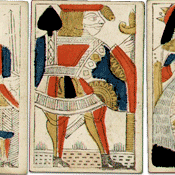
Cards produced in Rouen during the sixteenth century. It was cards like these which were imported to England and are the ancestors of the modern 'Anglo-American' pattern.
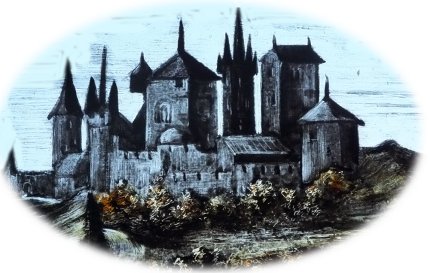
What we now know as ‘French’ suit signs - spades, diamonds, clubs and hearts - is the result of rationalisation of the manufacturing technique during the fifteenth century. Many early or archaic suit systems involved intricate motifs which were more time-consuming to reproduce in woodcuts, hence the French producers invented new ones which could be reproduced with the stroke of a brush over a stencil. The four shapes are easy to recognise - 2 red and 2 black. Some card makers were experimenting with a crescent moon as an alternative symbol, but this didn't catch on. This ‘French’ suit system is now found throughout the world.
Cards shown below were produced in Rouen during the sixteenth century. The cards made in Rouen at that time were an eclectic mixture of features from cards made for various foreign markets, hence the origins of what became the "English" pattern are not one precise source, but a mixture of several earlier regional patterns. It was cards like these which were imported to England and are the ancestors of the modern ‘Anglo-American’ pattern learn more →
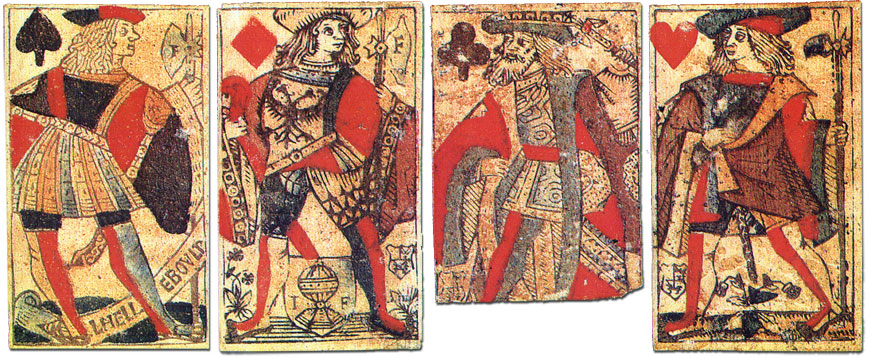
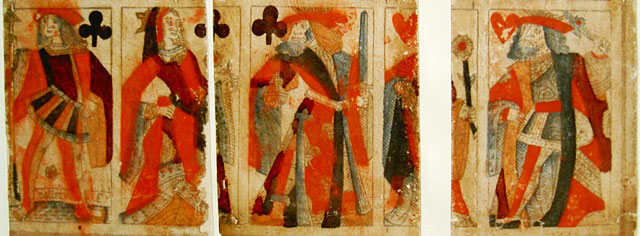
In the hands of English manufacturers the cards gradually became wider, losing their original slimness and liveliness, and the figures became chunky and geometrical. They remained full-length until the nineteenth century when double-ended courts were introduced as another innovation by Victorian manufacturers.
See also: Blanchard • Hunt • Early English Cards • Rick Davidson's Origins Playing Cards►.

By Simon Wintle
Spain • Member since February 01, 1996
I am the founder of The World of Playing Cards (est. 1996), a website dedicated to the history, artistry and cultural significance of playing cards and tarot. Over the years I have researched various areas of the subject, acquired and traded collections and contributed as a committee member of the IPCS and graphics editor of The Playing-Card journal. Having lived in Chile, England, Wales, and now Spain, these experiences have shaped my work and passion for playing cards. Amongst my achievements is producing a limited-edition replica of a 17th-century English pack using woodblocks and stencils—a labour of love. Today, the World of Playing Cards is a global collaborative project, with my son Adam serving as the technical driving force behind its development. His innovative efforts have helped shape the site into the thriving hub it is today. You are warmly invited to become a contributor and share your enthusiasm.

Activity for Early Anglo-French Cards
Sign in to comment or save this article.

Related Articles
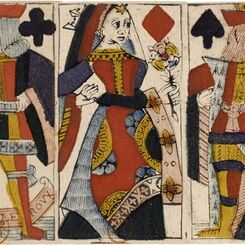
Rouen Pattern - Portrait Rouennais
An attractive XV century French-suited design from Rouen became the standard English & Anglo-America...
Playing Cards: A Secret History
Playing Cards: A Secret History
“Deck with French suits”
A facsimile of an early 19th century French-suited deck from the collection of F.X. Schmid.
71: Woodblock and stencil: the hearts
A presentation of the main characteristics of the wood-block courts of the heart suit.
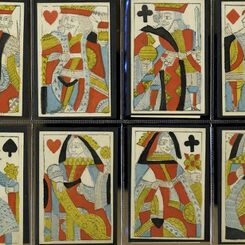
70: Woodblock and stencil : the spade courts
This is a presentation in a more straight forward fashion of the work done by Paul Bostock and me in...
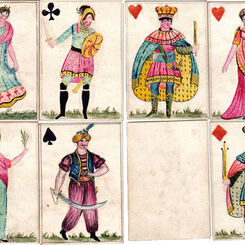
Prisoners of War
Hand-made playing cards by French prisoners of war in Porchester Castle, Hampshire, c.1796.
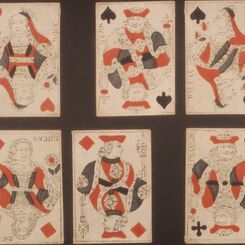
64: The descendants of the French regional patterns: 2
A continuation oF the development of the off-spring of the Paris patterns and a few examples of how ...
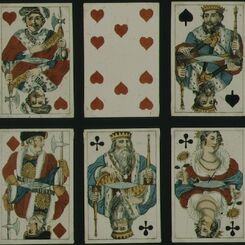
63: The descendants of the French regional patterns: 1
A great many regional patterns were exported from France and subsequently copied elsewhere. Some of ...
Delightful Cards, c.1723
Delightful Cards, containing variety of entertainment for young Ladies and Gentlemen c.1723.
Cribbage Board Collection part 2
A collection of antique and vintage Cribbage Boards by Tony Hall, part 2
Suicide King
The King of Hearts, holding a sword behind his head, is sometimes nicknamed the “Suicide King”. He c...
Pierre Marechal
Rouen became an important centre for card-making whose influence extended far afield. Cards from Rou...
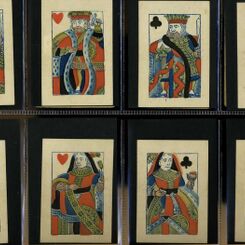
19: 19th Century Breaks with Tradition - Unusual versions of the Standard English Pattern
The centuries-long tradition of English court cards was subject to misinterpretation and in some cas...
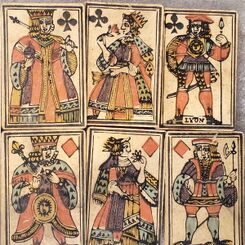
Lyon Pattern type iii
This pattern was used in various parts of eastern France but was ultimately replaced by the official...

De La Rue Continental
During the latter part of the nineteenth century De La Rue produced two special packs of cards for t...
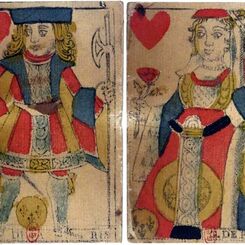
Paris Pattern
The Paris pattern was established as such around the middle of the seventeenth century (based, perha...
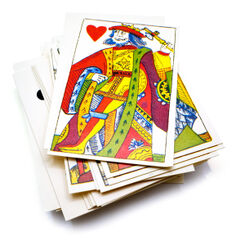
16th Century French Playing Cards based on Illustrations by Gurney Benham
This pack of cards by Rose & Pentagram is said to be based off Pierre Marechal, Rouen pack from the ...
History of Court Cards
The court cards in English packs of playing cards derive from models produced by Pierre Marechal in ...
History of English Playing Cards & Games
The History of English Playing Cards dates probably from the mid 15th century
Early English Playing Cards
Early examples of traditional, standard English playing cards of which the best known are those of H...
Most Popular
Our top articles from the past 60 days


Alannyë Daeris
19 November 2025, 09:47SavedSaved this article to Decks Históricos