


Paris Pattern
The Paris pattern was established as such around the middle of the seventeenth century (based, perhaps, on the cards of Hector of Troyes).
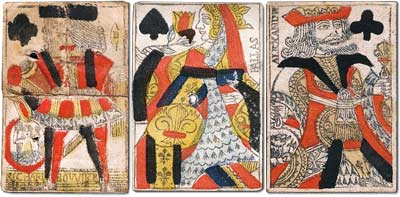
Above: Alexander, the most famous conqueror of Western history, as the king of clubs. Alexander the Great’s relentless energy and ambition drove him to explore remote parts of the world.
Although many of the figures were already known on earlier cards, the “Paris pattern” consolidated around the middle of the seventeenth century (based, perhaps, on the cards of Hector of Troyes). Single-figure courts prevailed until around 1830 when the double-ended version came into use. The court cards are usually named, and the reason for, or origins of, these names seems to derive from legendary heroes of antiquity. The Paris court card designs also appear in other parts of Europe as provincial variants (e.g. Belgian 'Genoese' pattern, Italian 'Piedmont' pattern). See Ken Lodge's Blog►
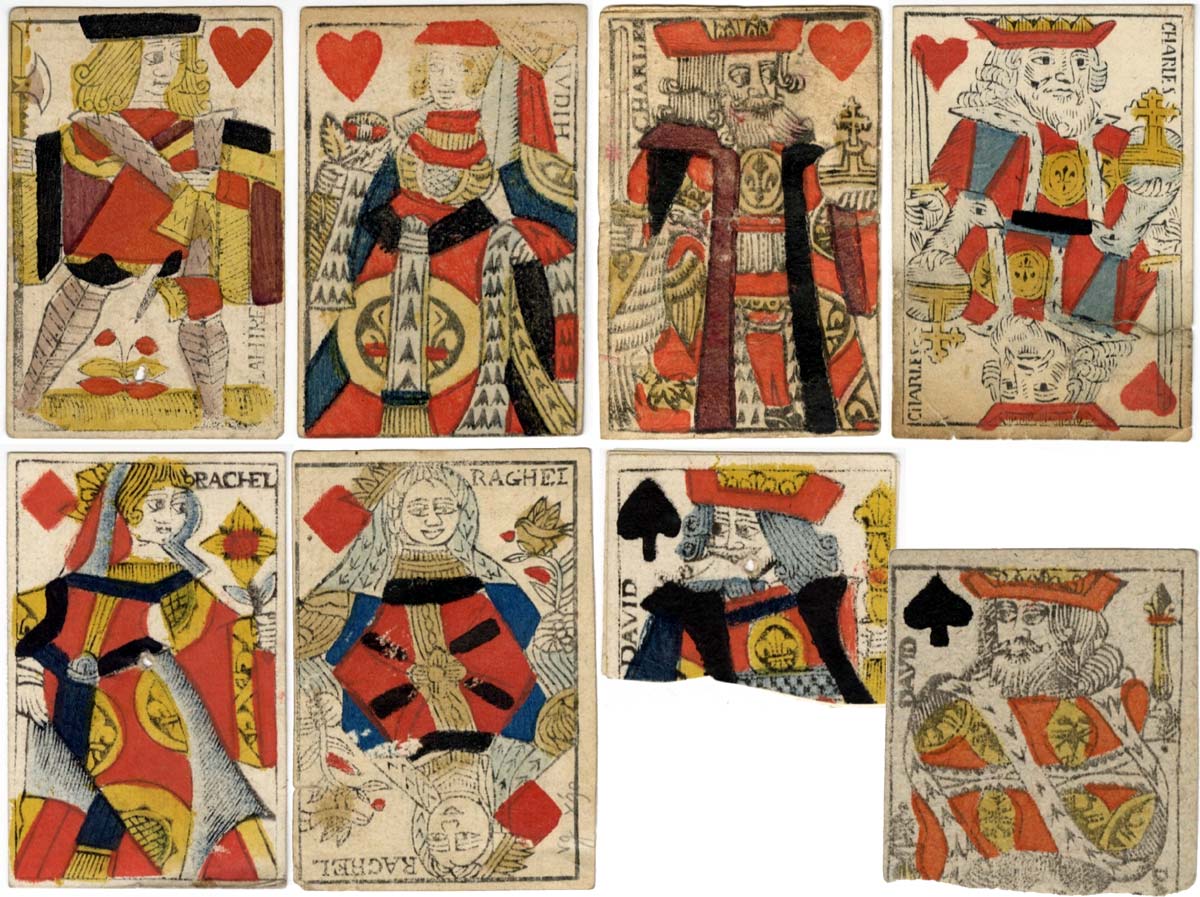
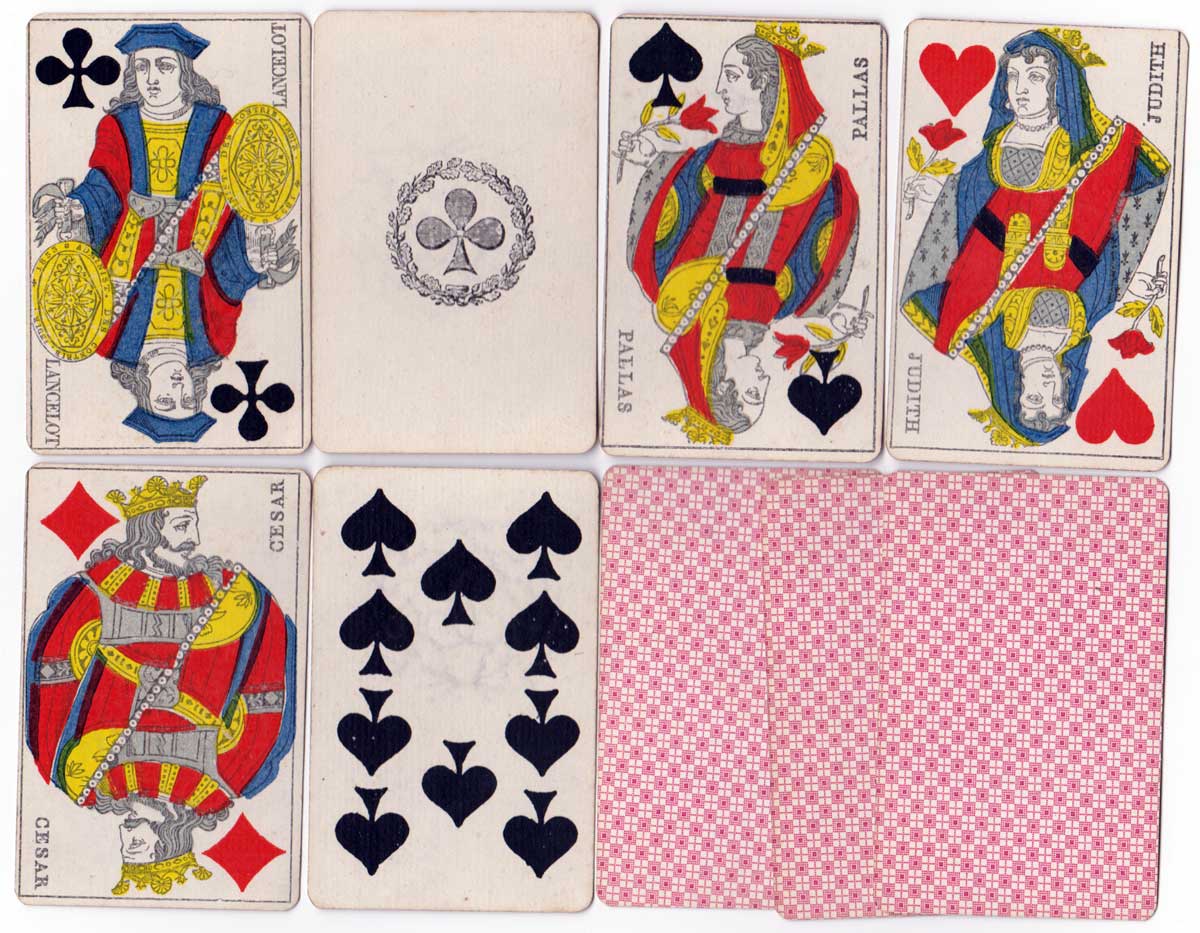
Above: a number of single cards, from different packs of different ages, demonstrating the Paris pattern, both single and double-ended. Each one is named after a legendary or historical person.
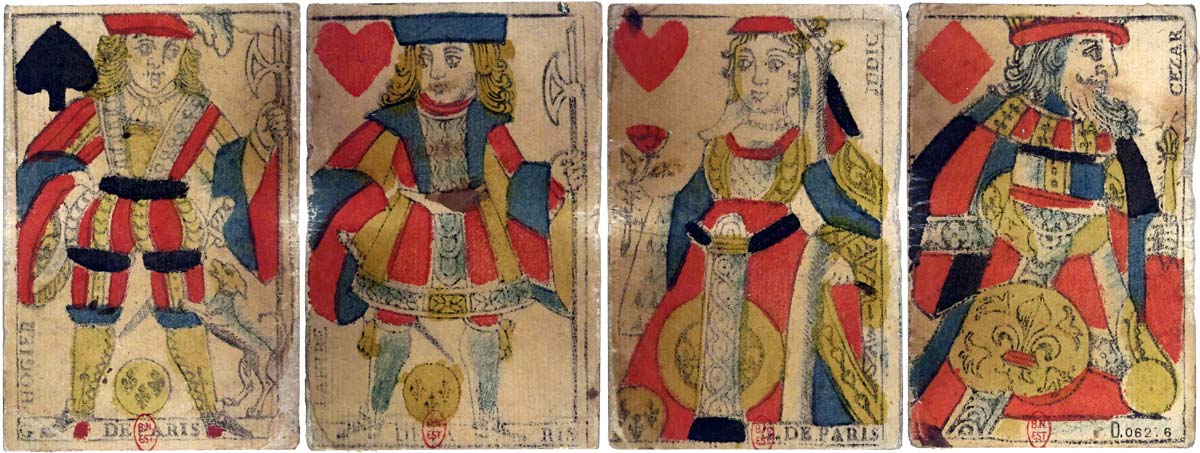
Above: Paris pattern, 1708. Several cards have the inscription ‘G[énéralité] de Paris’. Source Bibliothèque nationale de France • Cartes de tête issues d'un jeu au portrait de Paris►
In the middle of the eighteenth century legislation was introduced making the Paris pattern the official portrait or pattern for the whole of northern France.
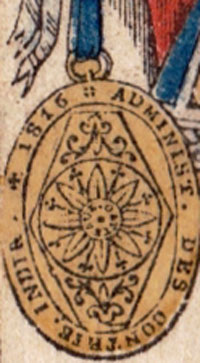
The outsized medallion held by the Jack of Clubs in his right hand was redesigned by Nicholas Marie Gatteaux, a member of a group of engravers who redesigned and standardised the Paris Pattern in 1813. Within this medallion are The Gatteaux Numbers. This was a time of massive French endeavour to standardise everything French under the “Code Napoleon” and set the pattern in a certain manner to last forever with no rogue variations. Well they certainly succeeded for a long time with the Paris pattern; introduced in 1813, the date on the medallion changed from time to time as follows:
all dated 1813
all dated 1816
all dated 1827
all dated 1853 from now on.
These rules were dropped in the 1940s (not forever after all!)
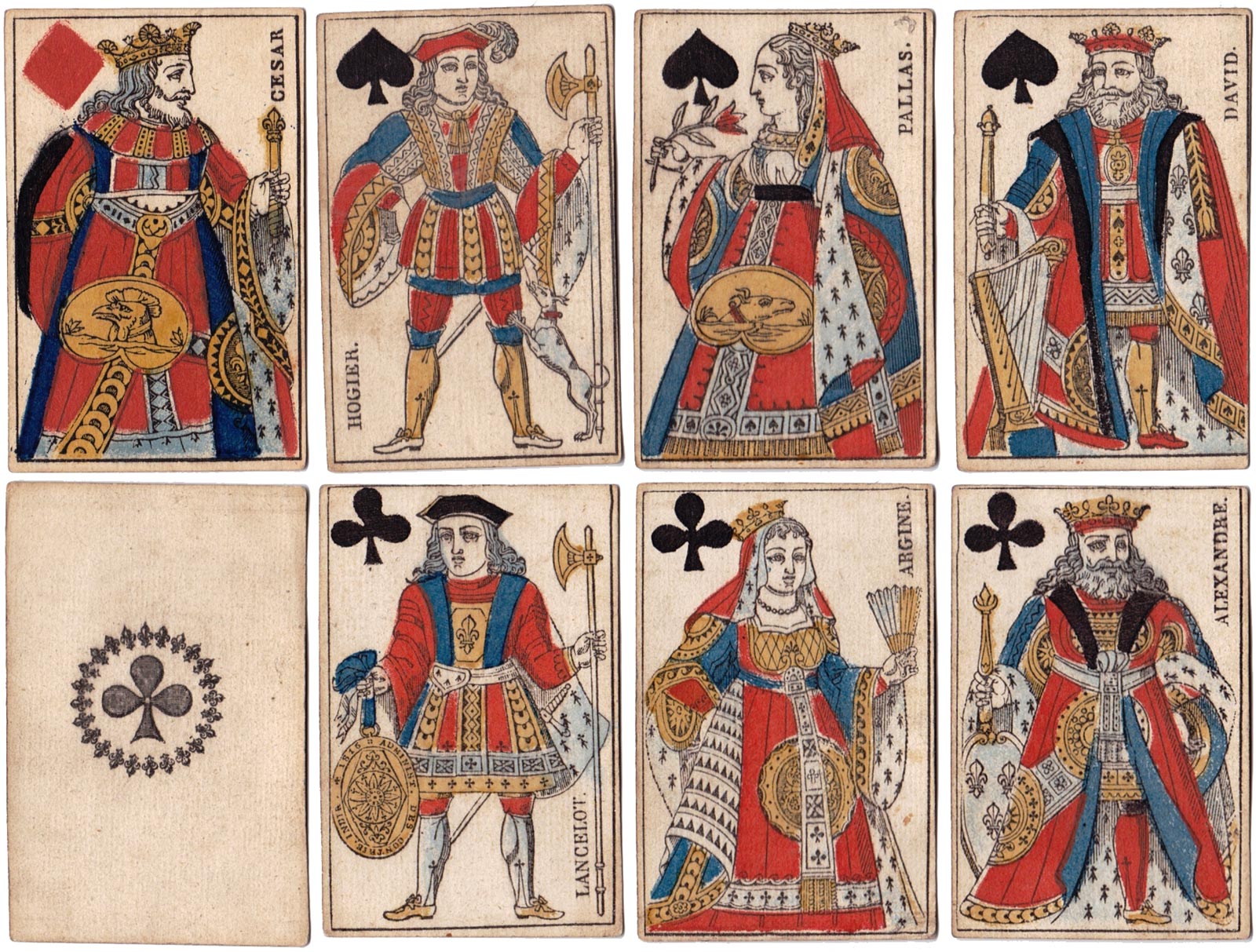
Above: cards from full-length version of the Paris pattern, c.1816-1827. Image and notes courtesy Rex Pitts.
In the double-ended versions, although more convenient, many charming features of the designs are lost.
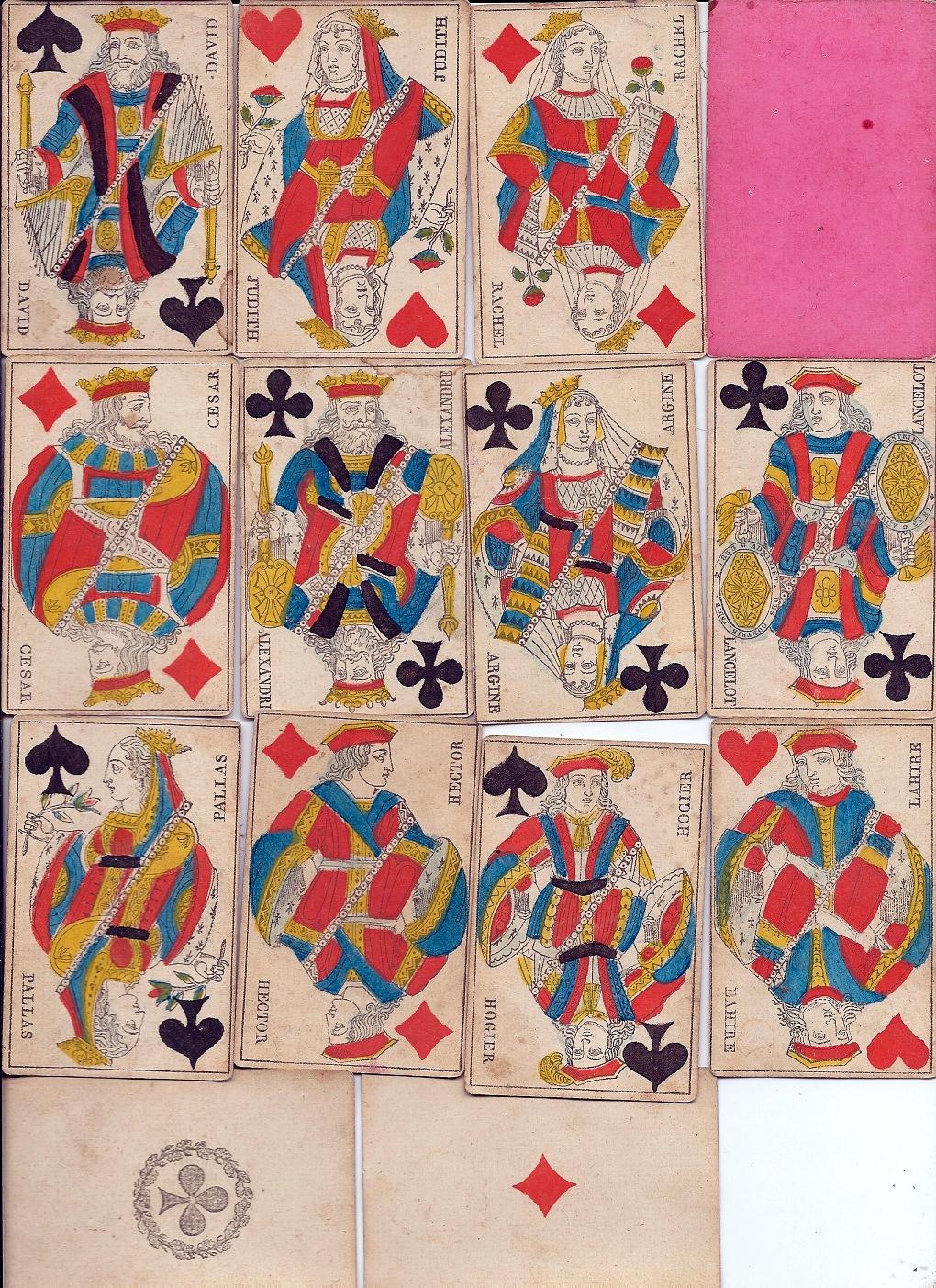
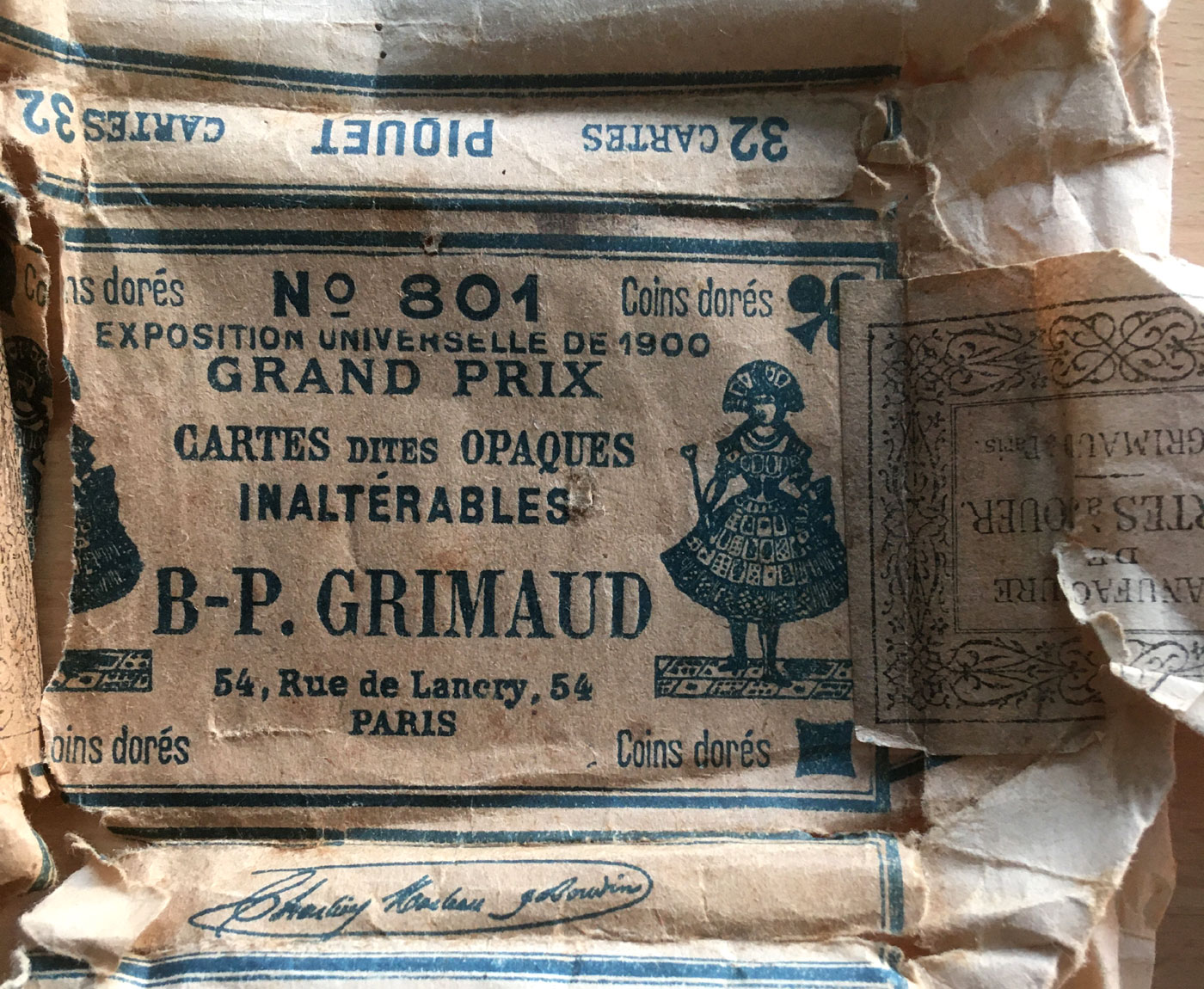
Above: two examples of standard double-ended Paris pattern playing cards, made by B. P. Grimaud, c.1855-75. Both sets are stencil-coloured. The left-hand set is from a 32-card deck and has square corners. The right-hand cards are from a 52-card deck, with rounded corners. There is an imperial eagle watermark on the right-hand cards. See a typical wrapper►
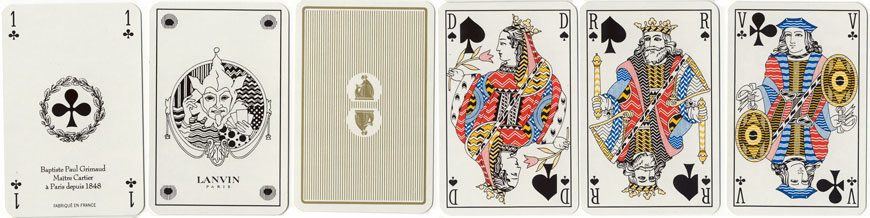
Below: embellished 'Paris pattern' cards specially designed for Lanvin, c.1980
For derivatives of French standard patterns, see
See also: decks manufactured in Germany by Johann Forster, Johann Backofen, Joseph Losch►

By Simon Wintle
Spain • Member since February 01, 1996
I am the founder of The World of Playing Cards (est. 1996), a website dedicated to the history, artistry and cultural significance of playing cards and tarot. Over the years I have researched various areas of the subject, acquired and traded collections and contributed as a committee member of the IPCS and graphics editor of The Playing-Card journal. Having lived in Chile, England, Wales, and now Spain, these experiences have shaped my work and passion for playing cards. Amongst my achievements is producing a limited-edition replica of a 17th-century English pack using woodblocks and stencils—a labour of love. Today, the World of Playing Cards is a global collaborative project, with my son Adam serving as the technical driving force behind its development. His innovative efforts have helped shape the site into the thriving hub it is today. You are warmly invited to become a contributor and share your enthusiasm.

Activity for Paris Pattern
Sign in to comment or save this article.

Related Articles
La baraja de Almagro
De la chimenea al monumento nacional: la baraja de Almagro y el renacer del corral de comedias.
French Revolutionary cards by Pinaut
Seven cards from a French Revolutionary pack by Pinaut featuring characters from classical antiquity...
The Parisian Tarot
The “Parisian Tarot”, early 1600s, with imagery and design synthesizing several influences.
Languedoc pattern - Portrait de Languedoc
The old Languedoc pattern was known at the beginning of the seventeenth century, if not before.
Pierre Roiné Aluette
Archaic form of Aluette published by Pierre Roiné, Nantes, c.1785.
Antoine de Logiriera
Archaic Spanish-suited playing cards published in Toulouse by Antoine de Logiriera (1495-1518).
A. Camoin & Cie
This deck was inherited from ancestors, it has has a family history surrounding it. Details of the l...
“Deck with French suits”
A facsimile of an early 19th century French-suited deck from the collection of F.X. Schmid.
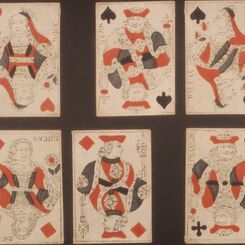
64: The descendants of the French regional patterns: 2
A continuation oF the development of the off-spring of the Paris patterns and a few examples of how ...
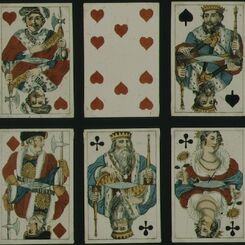
63: The descendants of the French regional patterns: 1
A great many regional patterns were exported from France and subsequently copied elsewhere. Some of ...
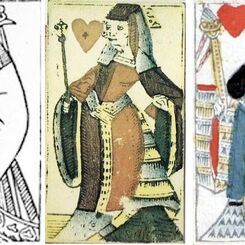
62: French regional patterns: the queens and jacks
Continuing our look at the figures from the regional patterns of France.
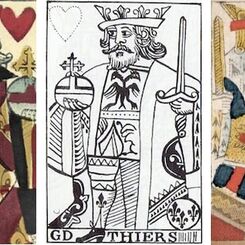
61: French regional patterns: the kings
On page 11 I illustrated several examples of the regional French patterns from Sylvia Mann's collect...
Trentine Pattern
Trentine Pattern
Pedro Varangot, 1786
Archaic Navarra pattern produced for the Pamplona General Hospital Monopoly by Pedro Varangot in 178...
Pierre Marechal
Rouen became an important centre for card-making whose influence extended far afield. Cards from Rou...
Benoist Laius
Spanish playing cards such as these were used in those parts of France where certain games were enjo...
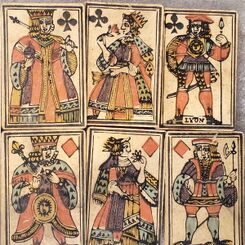
Lyon Pattern type iii
This pattern was used in various parts of eastern France but was ultimately replaced by the official...
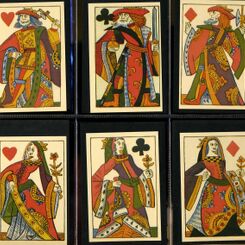
1: Playing Cards and their History: An Introduction and some links to other sites
What was considered the first mention of playing cards in England is in 1463 when Edward I banned th...
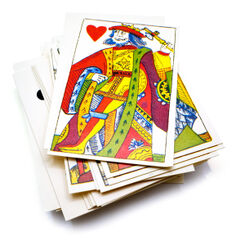
16th Century French Playing Cards based on Illustrations by Gurney Benham
This pack of cards by Rose & Pentagram is said to be based off Pierre Marechal, Rouen pack from the ...
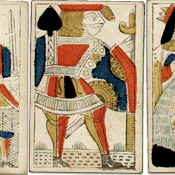
History of Court Cards
The court cards in English packs of playing cards derive from models produced by Pierre Marechal in ...
Most Popular
Our top articles from the past 60 days


Jason Somers
14 June 2026, 17:07SavedSaved this article to Jason Somers's Collection