Rouen Pattern - Portrait Rouennais
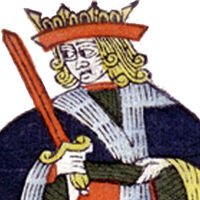
An attractive XV century French-suited design from Rouen became the standard English & Anglo-American pattern.
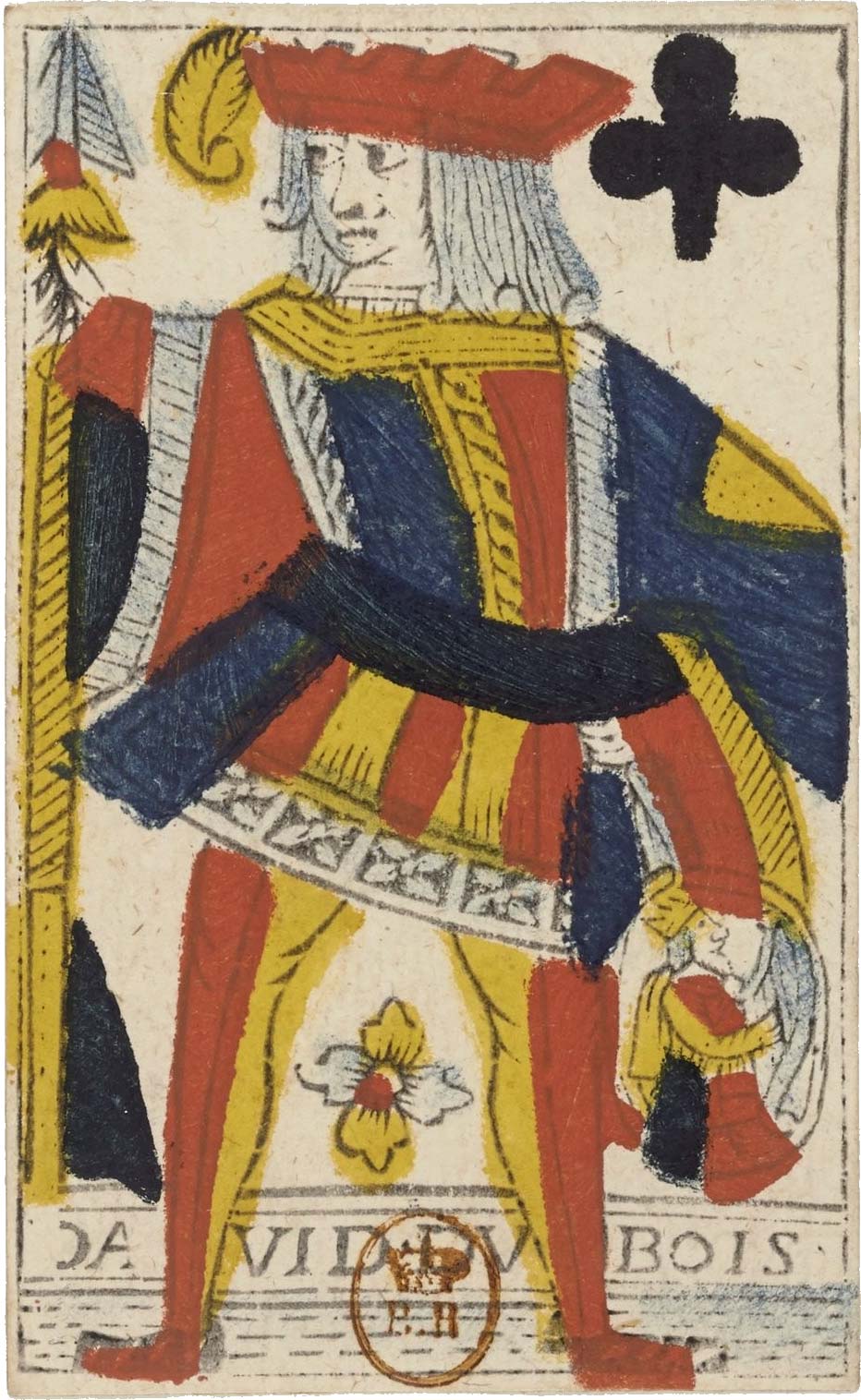
Rouen cardmakers, like their Lyonnais counterparts, exported playing cards widely. However, they did not export an “English pattern” to England: they simply used a local French-suited pattern and exported those so successfully that it became the English pattern, and was adopted by English cardmakers. In its modern, double-ended format it is now the standard Anglo-American or International pattern.
The cards made in Rouen at that time were more elongated than today's cards, and include features from cards made for various foreign markets, hence the origins of what became the "English" pattern is a mixture of several late medieval designs. Although their importation was prohibited early in Edward IV's reign, it is believed that cards like these which were imported to England in the XV and XVI centuries are the ancestors of the modern ‘Anglo-American’ pattern.
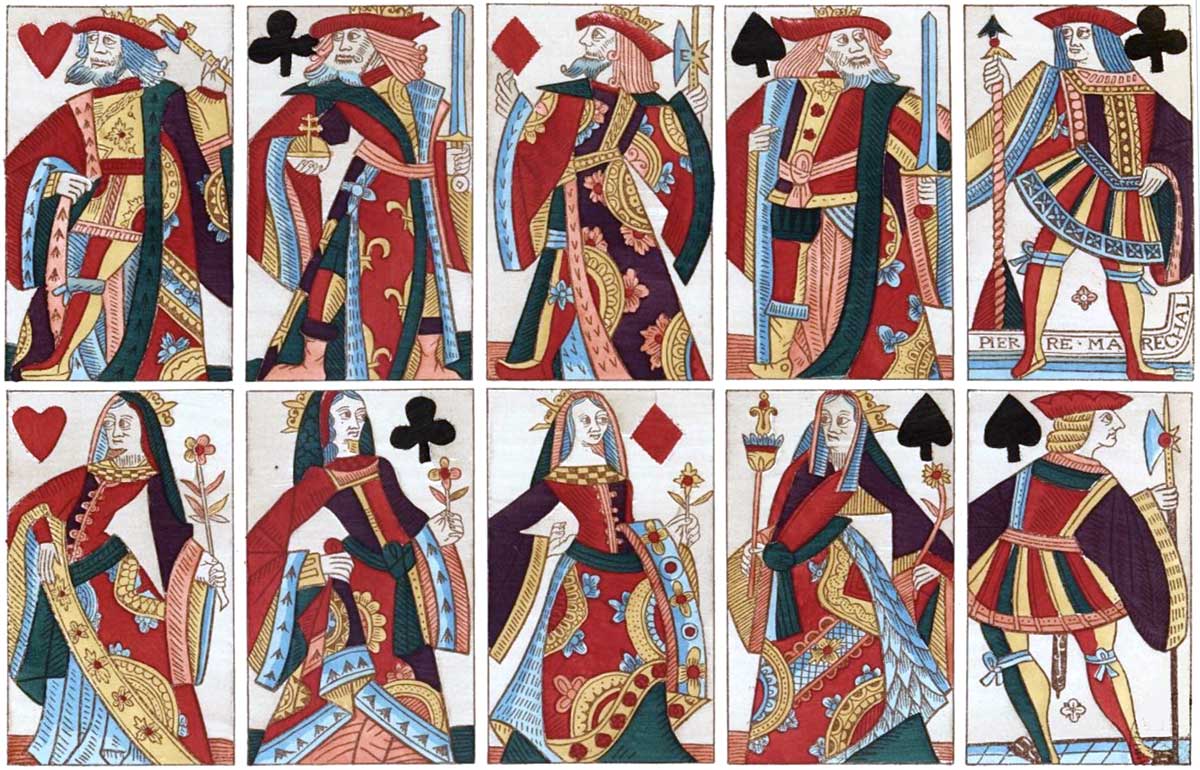
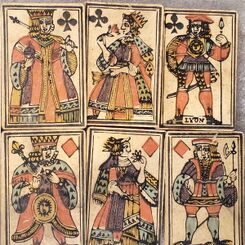
Pierre Marechal, 1567
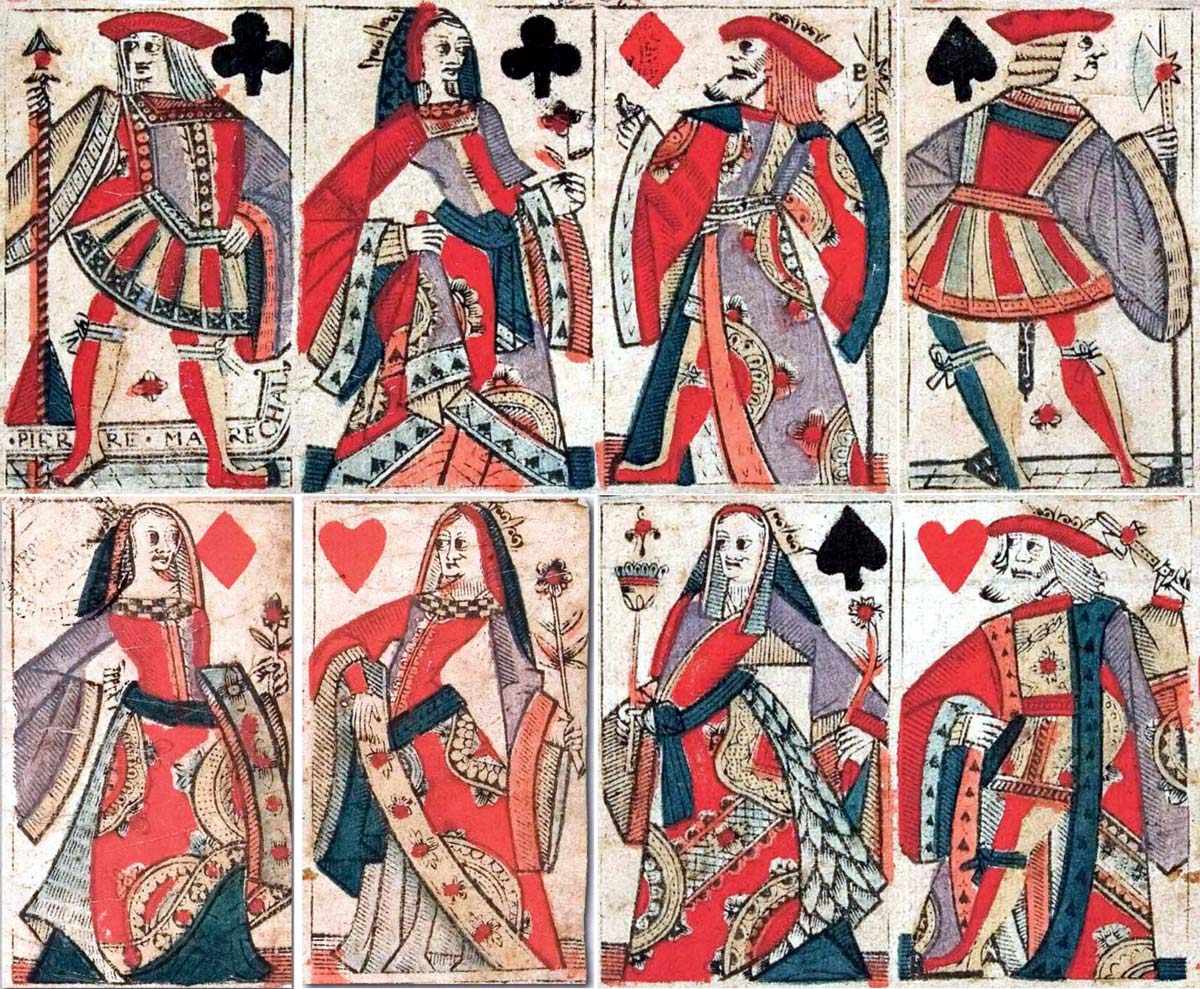
Above: Rouen pattern by Pierre Marechal, 1567. Archives Department, Seine-Maritime, Rouen, France. Facsimile images of these cards can also be found in d'Allemagne (1906, p.86-7 ) and in Gurney Benham.
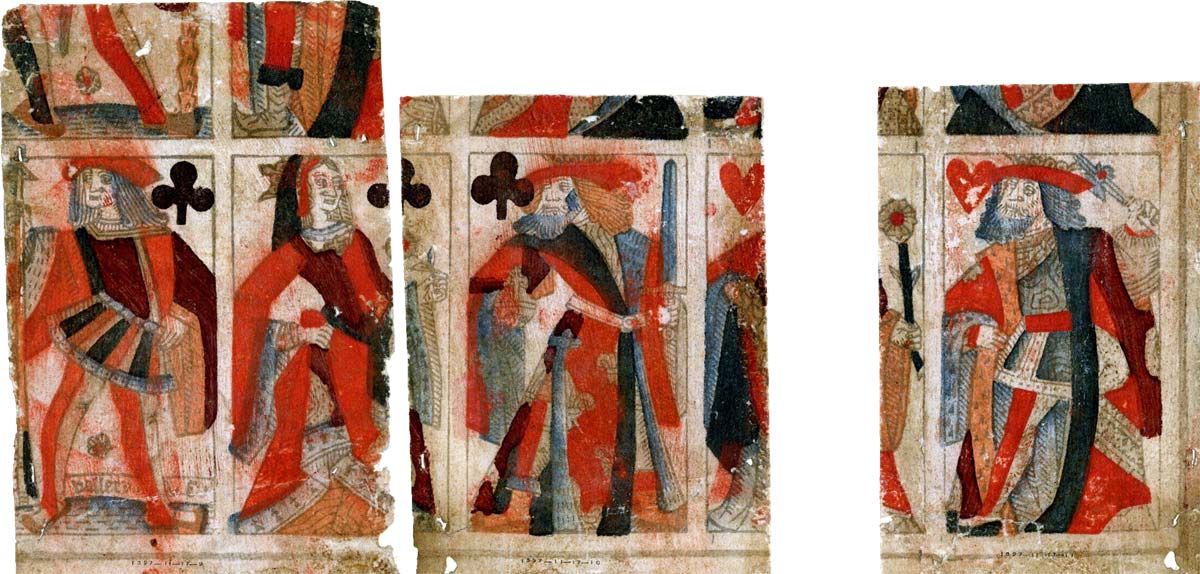
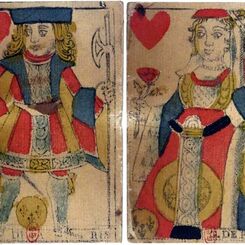
Pierre Leroux, 1660
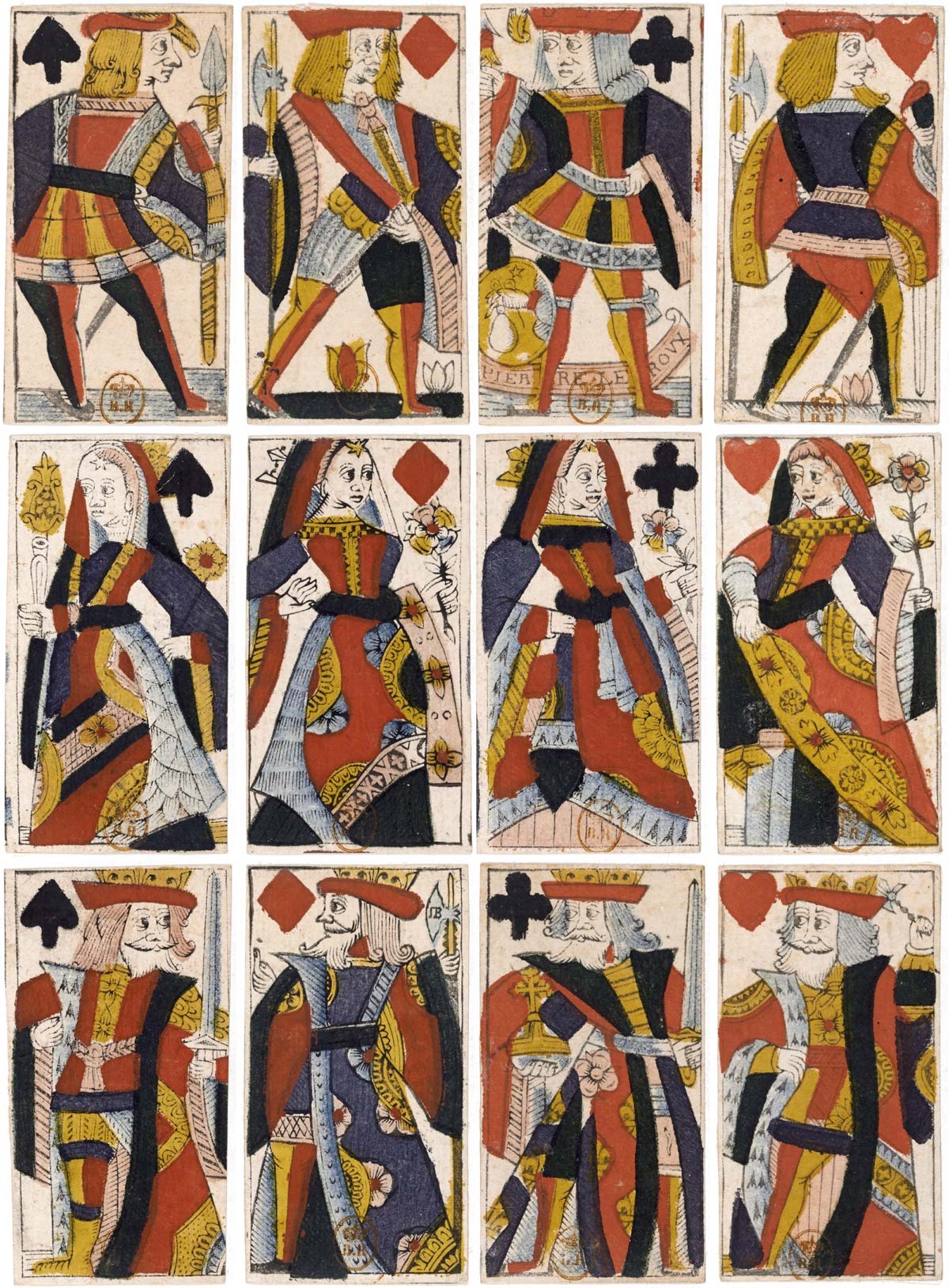
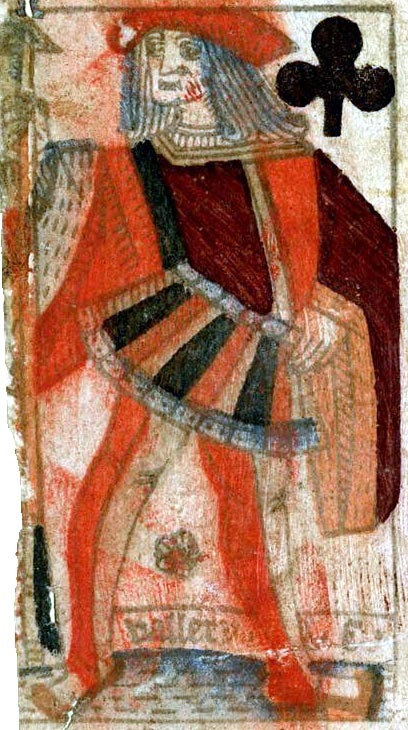
Above: 12 cards of the Rouen pattern published by Pierre Leroux (Rouen), c.1656-1664. Plain backs. Stencil-coloured woodcuts, 8,5 x 4,6 cm. Engraver's initials I. B. can be seen on the halberd of the King of Diamonds while the cardmaker's name is on the Jack of Clubs. Source of images: Bibliothèque nationale de France: Cartes de tête issues d'un jeu au portrait de Rouen►
Other early makers include Valery Faucil , Nicolas Bénières, David Dubois, Anthoine Le Cornu and others . Early English pattern cards were also produced in Antwerp by Jehan Henault in 1543. At some point English manufacturers began to make them for themselves. One of the earliest we know about is C. Hewson.

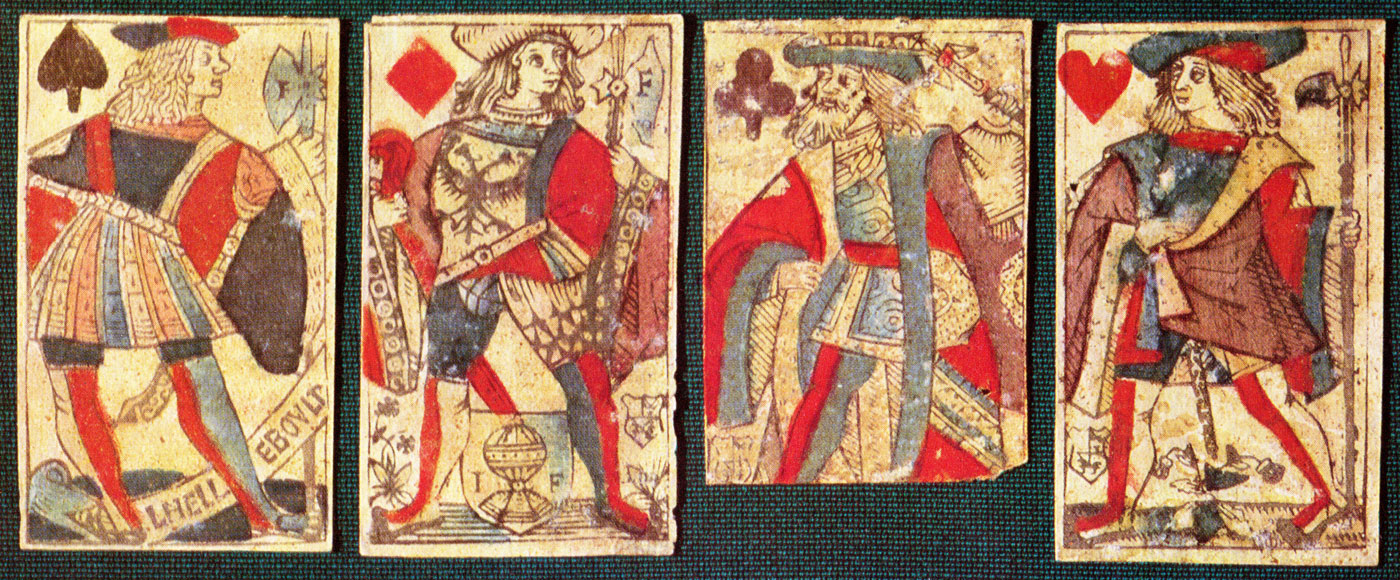
C. Hewson
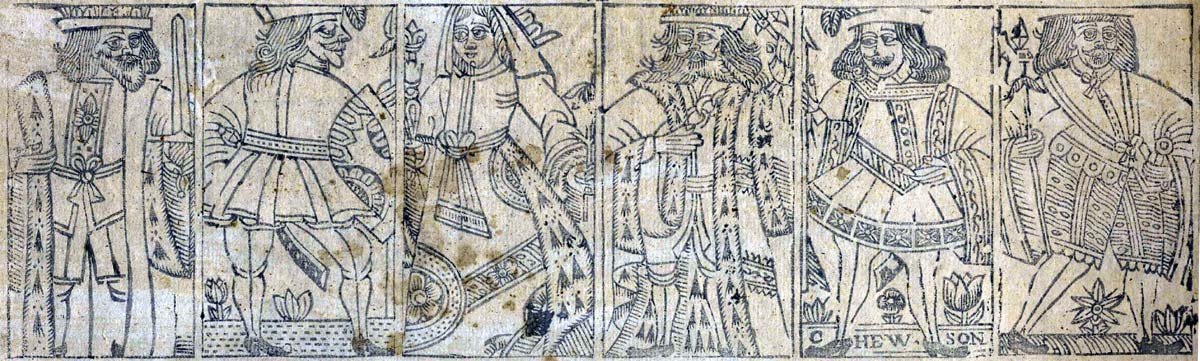
Above: cards by a maker named C. Hewson, mid-17th century, in what was becoming the standard English pattern • see more►
However, as the French cards were more elongated, the designs needed to be adjusted to fit the different format used by English manufacturers. But when the figures are fitted inside a shorter rectangle, certain body proportions are constrained. Over time the English pattern courts lost their slender figures and life-like qualities and became compressed and more abstract.
• See anonymous English cards found under the floorboards, 1700s
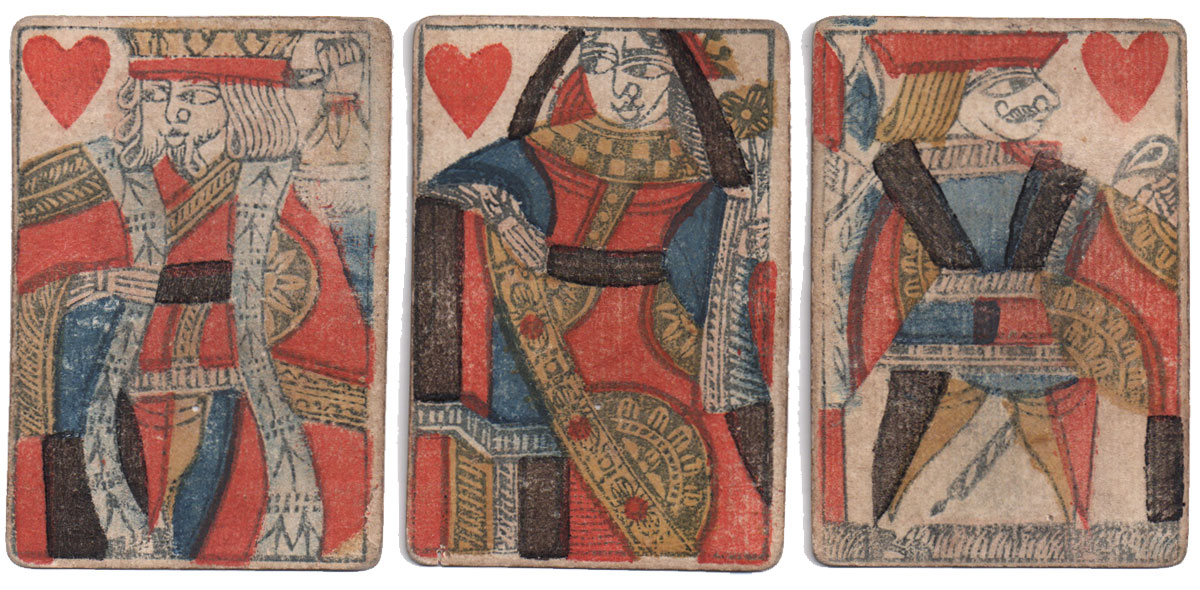
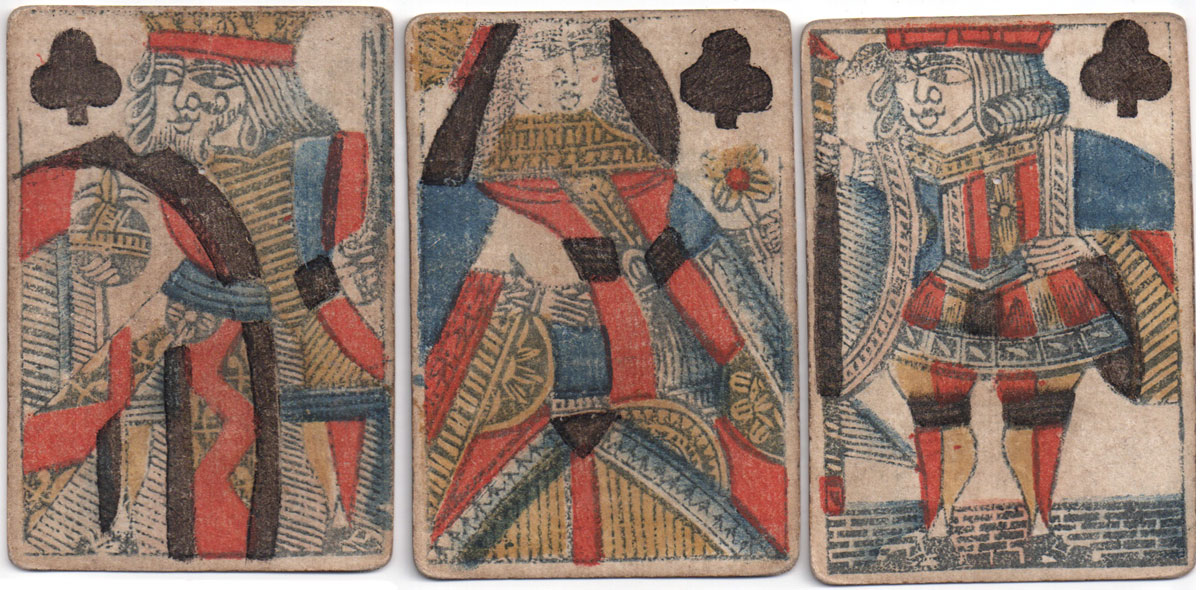
Above: cards by John Llewellyn, playing card manufacturer, London, 1778-1785
References
d'Allemagne, Henry-René : Les cartes à jouer du XIVe au XXe siècle, Hachette et Cie, Paris, 1906. 2 vols.
Bibliothèque nationale de France: Cartes issues de jeux au portrait de Lyon et de Rouen ►
Bibliothèque nationale de France: Copies de cartes au portrait de Rouen éditées par Pierre Maréchal en 1567 ►
Davidson, Rick: ‘Origins’ playing cards booklet The Art & the History►

By Simon Wintle
Spain • Member since February 01, 1996
I am the founder of The World of Playing Cards (est. 1996), a website dedicated to the history, artistry and cultural significance of playing cards and tarot. Over the years I have researched various areas of the subject, acquired and traded collections and contributed as a committee member of the IPCS and graphics editor of The Playing-Card journal. Having lived in Chile, England, Wales, and now Spain, these experiences have shaped my work and passion for playing cards. Amongst my achievements is producing a limited-edition replica of a 17th-century English pack using woodblocks and stencils—a labour of love. Today, the World of Playing Cards is a global collaborative project, with my son Adam serving as the technical driving force behind its development. His innovative efforts have helped shape the site into the thriving hub it is today. You are warmly invited to become a contributor and share your enthusiasm.

Activity for Rouen Pattern - Portrait Rouennais
Sign in to comment or save this article.

Related Articles
Le Jeu Des Fortifications
An innovation from the time of Louis XIV by Gilles de la Boissière.
French Revolutionary cards by Pinaut
Seven cards from a French Revolutionary pack by Pinaut featuring characters from classical antiquity...
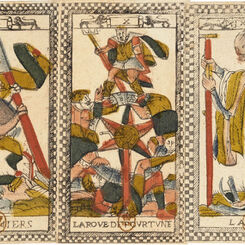
The Parisian Tarot
The “Parisian Tarot”, early 1600s, with imagery and design synthesizing several influences.
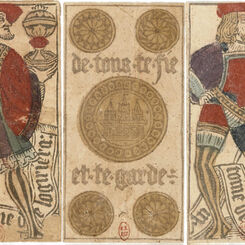
Antoine de Logiriera
Archaic Spanish-suited playing cards published in Toulouse by Antoine de Logiriera (1495-1518).
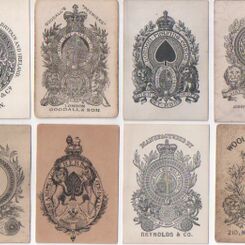
72: The Ace of Spades
In standard English packs the Ace of Spades is associated with decorative designs. This is a histori...
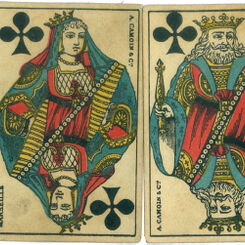
A. Camoin & Cie
This deck was inherited from ancestors, it has has a family history surrounding it. Details of the l...
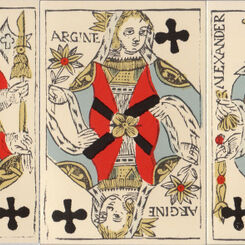
“Deck with French suits”
A facsimile of an early 19th century French-suited deck from the collection of F.X. Schmid.
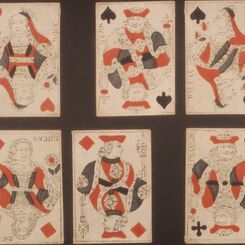
64: The descendants of the French regional patterns: 2
A continuation oF the development of the off-spring of the Paris patterns and a few examples of how ...
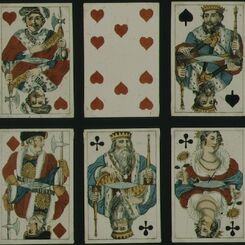
63: The descendants of the French regional patterns: 1
A great many regional patterns were exported from France and subsequently copied elsewhere. Some of ...
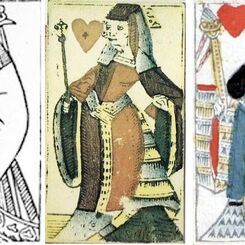
62: French regional patterns: the queens and jacks
Continuing our look at the figures from the regional patterns of France.
61: French regional patterns: the kings
On page 11 I illustrated several examples of the regional French patterns from Sylvia Mann's collect...
Pedro Varangot, 1786
Archaic Navarra pattern produced for the Pamplona General Hospital Monopoly by Pedro Varangot in 178...
Jeu de la Géographie
“Jeu de Géographie” educational playing cards etched by Stefano Della Bella and published in c.1644....
Pierre Marechal
Rouen became an important centre for card-making whose influence extended far afield. Cards from Rou...
Benoist Laius
Spanish playing cards such as these were used in those parts of France where certain games were enjo...
Lyon Pattern type iii
This pattern was used in various parts of eastern France but was ultimately replaced by the official...
Paris Pattern
The Paris pattern was established as such around the middle of the seventeenth century (based, perha...
Early Anglo-French Cards
Cards produced in Rouen during the sixteenth century. It was cards like these which were imported to...
Mamluk Playing Cards
Nã'ib, the game of lieutenants... these cards are amongst the earliest Arabic playing cards ext...
16th Century French Playing Cards based on Illustrations by Gurney Benham
This pack of cards by Rose & Pentagram is said to be based off Pierre Marechal, Rouen pack from the ...
Most Popular
Our top articles from the past 60 days